Wall Street's new darling
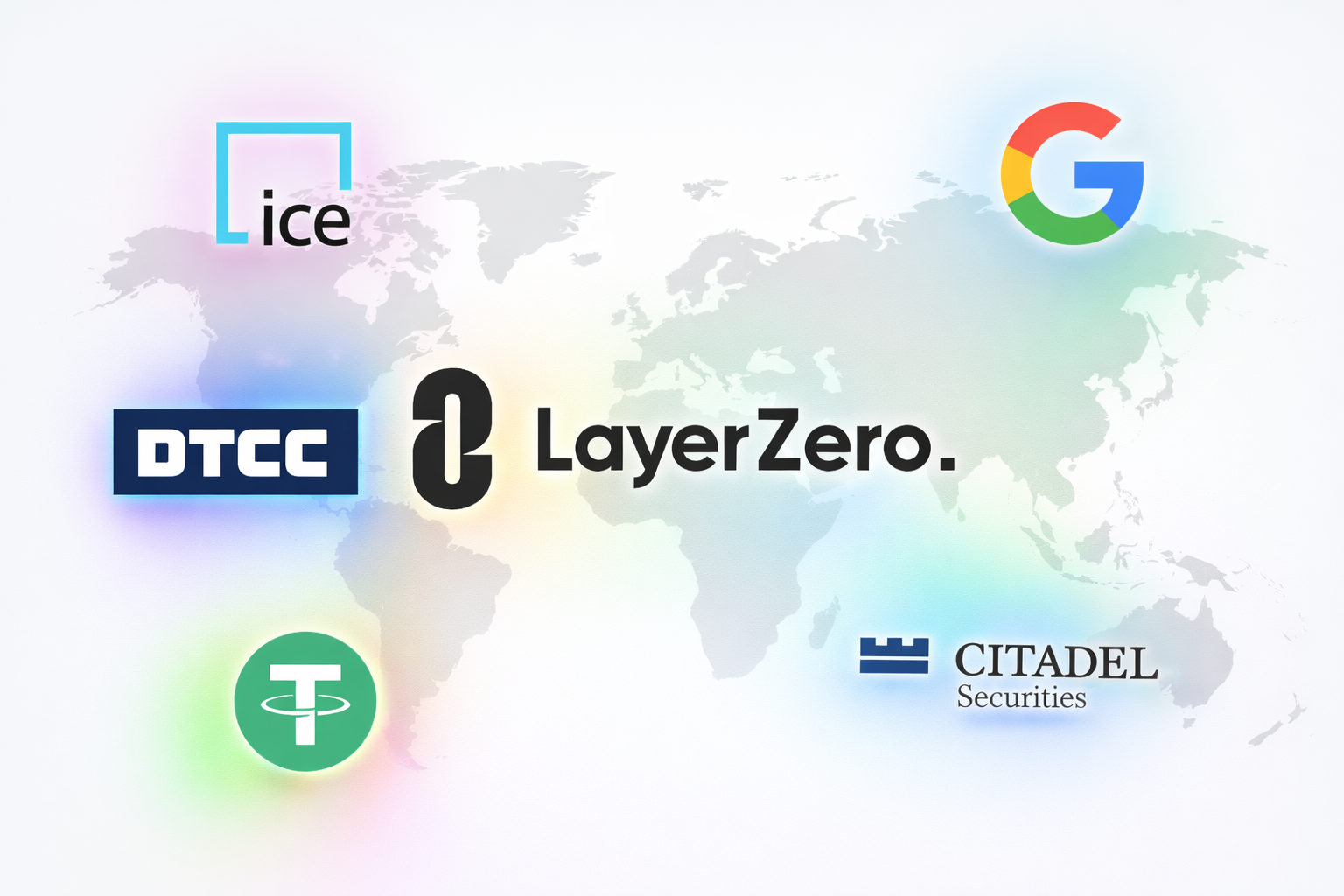
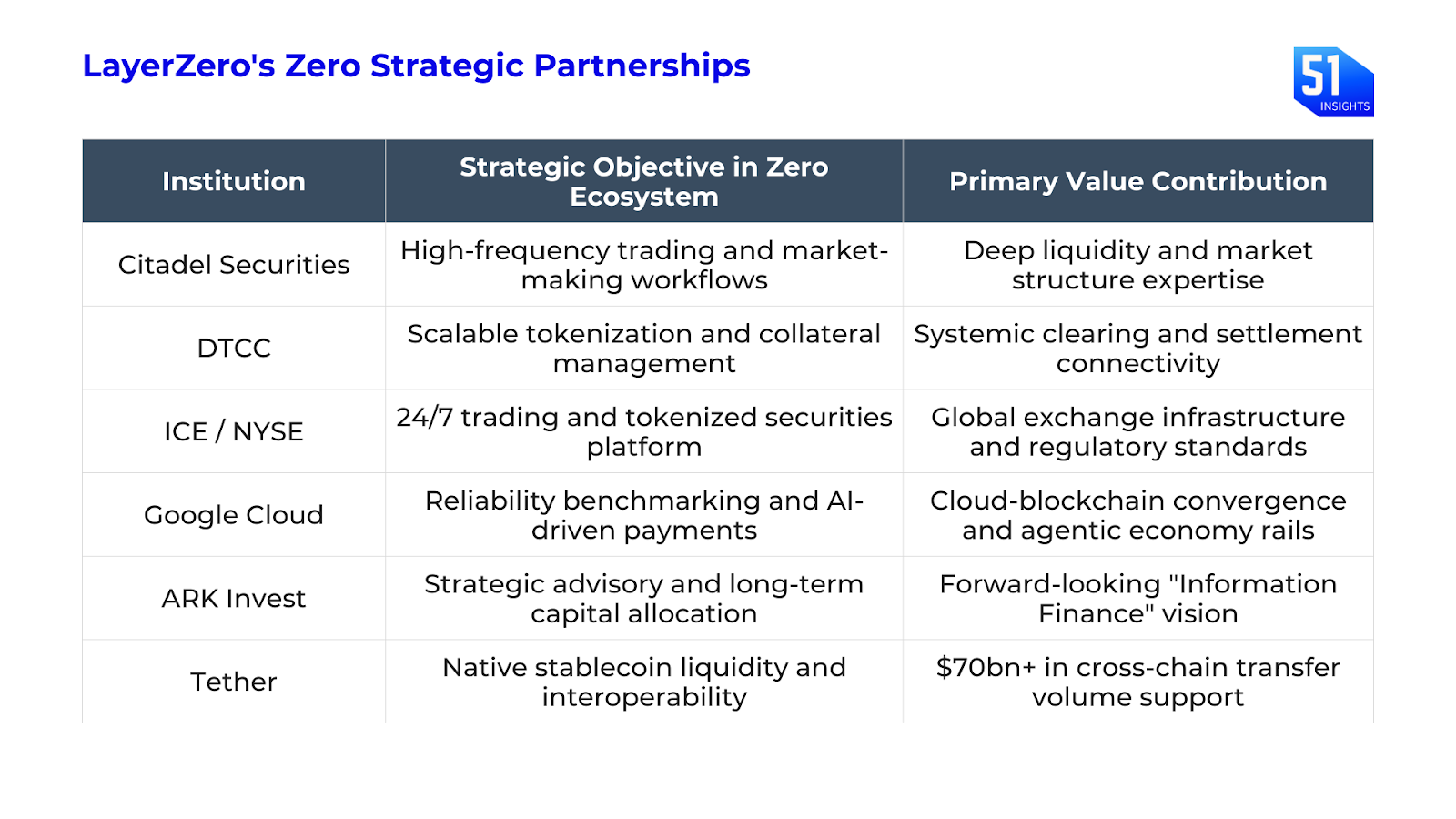
On Monday, Citadel Securities, the DTCC, the New York Stock Exchange, Google Cloud, ARK Invest, and Tether backed a single Layer 1 called Zero.
These aren’t institutions “exploring” blockchain. They’re the operating system of global capital and they just placed a bet on replacing their own plumbing. This is the most consequential infrastructure announcement in digital assets this year. Here’s why. [RELEASE]
👉PRO: PDF at the bottom
 Marc Baumann
 Marc Baumann
What happened
LayerZero launched Zero, a Layer 1 blockchain with backing from institutions that control the core plumbing of global finance. It will launch in Fall 2026. [Whitepaper] [Technical Positioning Paper]
Citadel Securities (processes one-third of U.S. retail equity orders) and ARK Invest (with Cathie Wood joining the advisory board) bought ZRO tokens directly. The DTCC ($3.7 quadrillion annual transaction volume) committed to evaluating Zero for its DTC Tokenization Service and Collateral App Chain.
Just three weeks ago, Intercontinental Exchange, parent of the NYSE, announced plans for a tokenized securities platform with 24/7 trading, marrying its Pillar matching engine to on-chain settlement. Google Cloud joined for infrastructure reliability and AI-driven payment systems. Tether brings $70B+ in cross-chain transfer volume.
Composition of the Zero Advisory Board: Cathie Wood (Founder and CEO of ARK Invest), Michael Blaugrund (VP of Strategic Initiatives at ICE), and Caroline Butler (former head of digital assets at BNY Mellon).
Zooming in: Unlike Ethereum or Solana, Zero utilizes a “heterogeneous architecture” (splitting Block Producers1 and Block Validators2) to target 2 million TPS3 per “Atomicity Zone” with transaction costs at ~$0.000001. Four compounding breakthroughs drive it: QMDB (state storage optimized for rapid I/O), FAFO (parallel compute scheduler), SVID (low-jitter networking), and Jolt Pro (100x faster ZK proving).

By the numbers: It’s 100,000x faster (more transactions per second) than Ethereum 500x faster than Solana with verification light enough for consumer hardware (according to Zero’s own estimates, which haven’t been verified).
Be smart: Every institution on this list has made their move in the last 120 days:
- ICE invested $2B in Polymarket in October. [ANALYSIS]
- The SEC issued a “No-Action Letter” to the Depository Trust & Clearing Corporation (DTCC) for tokenization in December. [ANALYSIS]
- Also in December, DTCC began tokenizing the U.S. Treasuries on the Canton Network; Citadel is a part of it. [ANALYSIS]
- The NYSE announced its tokenized securities platform in January [ANALYSIS]
- Tether launched its US regulated stablecoin, USAT in January 2026. [ANALYSIS]
- Also in January 2026, BNY went live with tokenized deposits with Citadel as a client. [ANALYSIS]
Why it matters
- DTCC unlocks collateral mobility. Frank La Salla, DTCC’s CEO, explicitly committed to leveraging Zero for tokenization and collateral management. The bottleneck has always been “collateral mobility”: T+1 settlement traps high-quality liquid assets for days, increasing systemic risk during volatility spikes (see: UK’s 2022 LDI crisis). Zero enables atomic settlement: asset transfer and payment occur as one cryptographic event. No central counterparty holding collateral against settlement failure. The clearinghouse becomes a protocol governor, not a risk absorber. For the $3.7 quadrillion flowing through DTCC annually, even 1% migration creates massive $ZRO (ZeroLayer token) demand.
- NYSE’s 24/7 vision becomes viable. ICE’s tokenized securities platform combines the Pillar matching engine (front-end) with blockchain settlement (back-end). The value: continuous access to U.S. equities and ETFs, capturing APAC and European liquidity outside New York hours. Instant settlement eliminates principal risk from T+1 cycles, freeing billions in trapped margin. Tokenized deposits (partnering with BNY and Citi) let clearing members manage money outside banking hours. This is a first step towards making 24/7 trading a reality.
- The architecture is the breakthrough.Ethereum does ~15-45 TPS. Solana does ~65,000 theoretically. Zero targets 2 million. The trick: a heterogeneous design that splits transaction processing from verification — like moving from a single-core to a multi-core processor. The result: much higher throughput, without relying on centralized cloud infrastructure to do the heavy lifting. Decrypt notes these claims are unverified and LayerZero has not provided independent benchmarks. That’s the risk.
- The agentic economy requires micro-rails. Google Cloud’s involvement is not just about servers but also about the infinite agentic AI economy. AI agents need to make millions of micro-payments for compute and APIs. Zero’s $0.000001 fee structure makes it the native currency rail for machine-to-machine commerce.
Citadel buying the token is the signal. Citadel Securities handles about one-third of all U.S. retail stock trades. Citadel has backed crypto infrastructure through equity before (Kraken, Ripple). Purchasing ZRO suggests they see the token as essential plumbing — not a speculative bet.Their bet is simple: if Zero’s networking technology can reduce delays and eliminate unpredictable lag, it could deliver the consistent, split-second timing that high-frequency trading firms depend on.
Devil’s advocate: The success of Zero depends on three “unproven” variables: performance, SEC approval for the NYSE’s tokenized venue and system concentration risk with a few large Wall Street firms. The ASX (Australian Securities Exchange) wrote off $255M trying to build a private chain. Execution matters more than architecture.
Investor Alpha
Ethereum’s roadmap relies on a fragmented web of Rollups. Zero is betting that Wall Street wants a single, massively scalable, “multi-core” concurrent environment. Undoubtedly, interoperability is the moat of mainstream finance.
LayerZero didn’t ask permission from crypto. It asked permission from Wall Street. And Wall Street said yes. The protocol that connects 165 blockchains now wants to replace them. If Zero delivers, value capture shifts decisively from applications to infrastructure and data owners.
- ZRO tokens (as a utility asset): As DTCC and ICE migrate services, demand for ZRO to pay gas and proof verification scales with quadrillions in flow. LayerZero’s connectivity to 165+ blockchains makes ZRO the connective tissue, not just an L1 token. Monitor for exchange listings and accumulation patterns through Fall 2026.
- Long ICE: Intercontinental Exchange is effectively cannibalizing the traditional banking hours model. By owning the Exchange (NYSE), the Data (Polymarket), and the Settlement Ramp (Zero integration), they are building a 24/7 monopoly on liquidity.
- Long infrastructure (COIN, GOOGL, BK): Favor picks-and-shovels (Coinbase for custody/derivatives infrastructure, BNY Mellon for tokenized deposit rails). Whereas, Google Cloud is positioning itself as the compute layer for Web3.
Watchlist:
- Feb 10–12: Consensus Hong Kong (CoinDesk)
- Feb 11: US CPI (Jan) release
- Feb 12: US PPI release
- Feb 12: FCA consultation on applying handbook rules to cryptoasset firms
- Feb 17–21: ETHDenver 2026
- Feb 18: FOMC minutes for Jan 27–28 meeting
- Feb: CLARITY‑style market‑structure bills and stablecoin implementation
- Q1’26: Kraken IPO window
- Q1’26: Hong Kong stablecoin licensing regime
- Q1’26: Singapore stablecoin framework launch
- Q1’26: Bitmine MAVAN (Made-in-America Validator Network) rollout
Market signals
- EU seeks to ban all Russian crypto transactions. Link
- Robinhood launches its own blockchain testnet. Link
- BlackRock offers DeFi trading for the first time. Link
That’s it for now.
Marc & Team
Download the PDF
Block producers (BPs) are entities in blockchain networks—frequently Delegated Proof of Stake (DPoS) systems like EOS, Telos, and FIO—responsible for validating transactions and creating new blocks. They are elected by token holders to maintain network security, ensure efficient block production, and participate in decentralized governance. ↩
Blockchain validators are specialized nodes in Proof-of-Stake (PoS) networks that verify transactions, propose new blocks, and maintain network consensus to ensure security and accuracy. By staking cryptocurrency as collateral, they are selected to validate data, earning rewards for honest behavior while facing slashing penalties for malicious actions. ↩
Blockchain throughput is the rate at which a network processes and finalizes transactions, commonly measured in Transactions Per Second (TPS). It serves as a key metric for scalability and efficiency, determining how quickly a blockchain can handle demand without congestion. Factors influencing it include block size, block time, and consensus mechanisms. ↩