DTCC, Goldman, Citadel pick Canton: Why Wall Street chose a private blockchain
Hey, it’s Marc.
For over a decade, Ethereum was supposed to be the future settlement layer for global finance. The public, decentralised backbone that would disrupt centralised clearing houses.
On December 17, 2025, after the SEC’s No Action Letter to DTCC, DTCC selected Canton, a private, permission-based network to tokenise the first tranche of America’s $100T custodial empire. [RELEASE]
Goldman Sachs, Citadel, and BNP Paribas aren’t disrupting the financial system. They’re capturing it. How? Let’s unpack..
Download the PDF
Get your brand in front of 100k+ decision makers in digital assets.
What happened
On December 17, 2025, the DTCC—the post-trade utility processing $3.7 quadrillion annually—announced it will tokenize U.S. Treasury securities on the Canton Network. This move follows a crucial SEC “No Action” letter permitting the Depository Trust Company (DTC) to tokenize assets within its custody. Unlike public chains like Ethereum or Solana, Canton is a permissioned, privacy-first “network of networks.” The initiative is not a sandbox experiment; it targets a production MVP by the first half of 2026. The syndicate backing this (it raised $135M in June 2025) shift reads like a roll call of the financial elite: Goldman Sachs, Citadel, BNP Paribas, and Tradeweb.
Zooming in: DTCC’s move to the Canton Network didn’t come out of nowhere. It followed years of internal work under “Project Ion,” where DTCC tested whether distributed ledgers could handle real U.S. market volumes. The pilot processed more than 100,000 equity transactions a day, proving that this technology could work at a market scale.
Be smart: The Canton Network initiative goes well beyond Project Ion. Instead of maintaining a parallel ledger, it creates on-chain versions of real securities that carry the same legal rights as the originals. This shifts the focus from tracking transactions to actually moving assets, allowing securities to be used, transferred, and settled more directly across systems.
In July 2025, major banks and market makers used the Canton Network to finance DTCC-custodied U.S. Treasuries against USDC and settle the trade instantly on a Saturday, showing that banks can move and reuse high-quality collateral 24/7, even when traditional settlement systems are closed.
Major moves in 2025:
- Mar ’25: Goldman Sachs, HKFMI, and Moody’s joined the Canton Foundation governance body
- Jun ’25: Digital Asset raised $135M led by DRW and Tradeweb
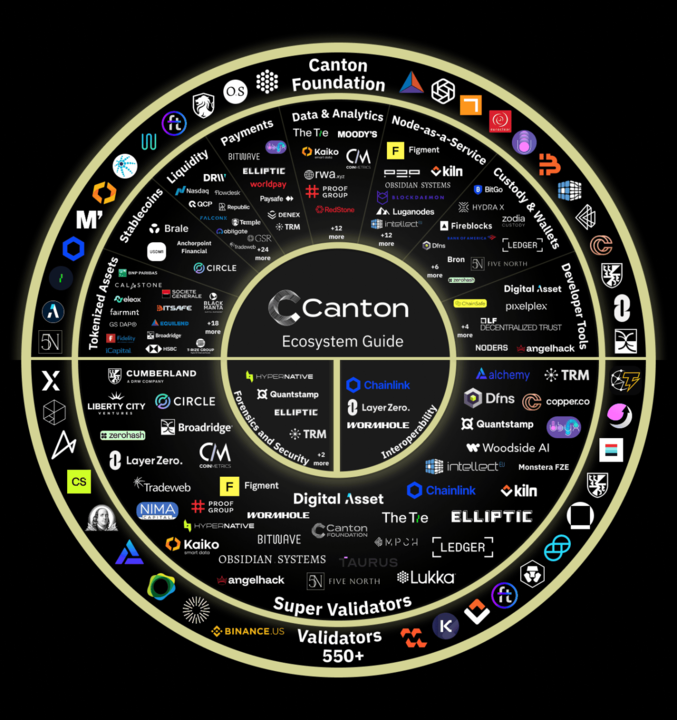
- Jul ’25: Coin Metrics joined Canton as a Super Validator and launched its Network Intelligence app
- Jul ’25: Banks and market makers completed the first 24/7 on-chain U.S. Treasury repo on Canton
- Aug ’25: Kiln joined Canton as a Super Validator
- Sep ’25: Chainlink became a Canton Super Validator and integrated oracle and cross-chain services
- Sep ’25: BNP Paribas and HSBC joined the Canton Foundation
- Oct ’25: DRW and Liberty City Ventures began structuring a $500M Canton Coin treasury vehicle
- Oct ’25: Canton Network surpassed $6T in tokenized real-world assets on-chain
- Dec ’25: Digital Asset raised an additional $50M from BNY Mellon, Nasdaq, S&P Global, and iCapital
- Dec’ 25: Circle integrated USDCx onto Canton Network
- Dec ’25: World Liberty Financial announced plans to deploy its USD1 stablecoin on Canton
- Dec ’25: Second phase of on-chain U.S. Treasury financing completed, enabling real-time collateral reuse
- Dec ’25: EDX Markets joined Canton as a validator and strategic partner
- Dec ’25: Further Asset Management signed an MoU to expand Canton infrastructure in the Middle East
- Dec ’25: Canton completed a major network upgrade to support higher institutional throughput
Our view
- The governance moat: DTCC is the core utility of U.S. capital markets. Its subsidiaries process securities transactions valued at approximately $3.7 quadrillion annually and maintain custody of assets valued at $99T. With DTCC and Euroclear co-chairing the foundation, the “End State” is clear: Global liquidity connectivity that is regulator-compliant by design.
- Buying the Table. Why did every major Wall Street player back Canton? Because they own the upside. Unlike Ethereum, where value accrues to a decentralized set of validators, Canton’s backers (Goldman, DRW, Tradeweb) received significant exposure (likely tokens or equity warrants). Canton didn’t just build a better mousetrap; they bought the biggest cats in the room.
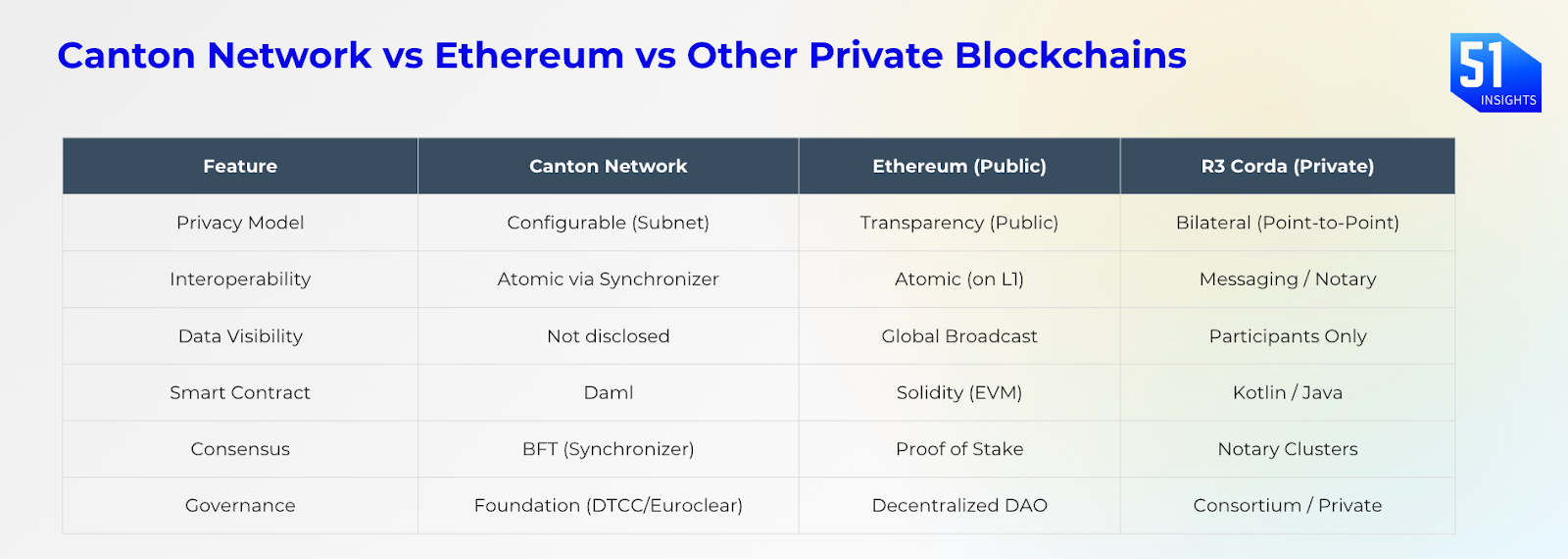
- Solving for privacy: Regulated markets need three things at the same time: privacy between firms, the ability for different systems to work together, and the capacity to operate at national-market scale. Public blockchains fail on privacy. Earlier private blockchains solved privacy by isolating participants, but at the cost of fragmentation. Canton was built specifically to avoid that trade-off. It lets firms transact privately while still remaining part of a shared network, so markets don’t splinter into disconnected silos.
- The New Moat: Wall Street isn’t being disrupted; it is vertically integrating the disruption. By owning the chain (Digital Asset), the validators (Tradeweb, DRW), and the custody (DTCC), incumbents are capturing the efficiency gains of blockchain without ceding control to decentralised governance.
Alpha
The “Fat Protocol” thesis is under scrutiny. We are witnessing a bifurcation: retail innovation stays on public chains (Solana, Base), but the pristine collateral of the global financial system (Treasuries, Repo) is moving to private, interoperable networks where the incumbents hold the keys. Canton might stay an exception, but it’s a signal.
For investors, the DTCC/Canton partnership offers multiple vectors for exposure, ranging from direct token ownership to equity plays.
- Canton Coin (CC): It is currently trading on several exchanges, including Kraken and MEXC. It has intrinsic utility demand. 👉 Trade it on Gate or Coinbase.
- Tradeweb (TW) & Broadridge (BR): Both firms are deeply integrated. Broadridge processes $1.5T in monthly repo volume on its DLR platform (built on Canton technology). Tradeweb is a Super Validator and pilot partner. These stocks provide indirect exposure to the network’s success. 👉 Trade on Robinhood
Alpha
- Stablecoin velocity: The integration of USDC in these pilots suggests that regulated stablecoins are the likely “winners” of the institutional settlement war. This is bullish for the ecosystems supporting USDC (e.g., Circle CRCL, Coinbase COIN). 👉 Trade on Robinhood
- New asset classes: Investors should watch for the launch of “native” digital assets on Canton, such as tokenised money market funds or digital bonds. These instruments will likely offer higher yields (due to lower admin costs) and better liquidity than their off-chain counterparts.
Watchlist:
- Dec: USAT launch by Tether (expected)
- Dec: Clarity Act (H.R.3633) Senate vote (expected)
- Dec 31: Europe’s MiCA full enforcement (Austria, Germany, and Spain) ends
- Jan 1: Basel Committee crypto capital standards implementation in Hong Kong
- Jan’26: SEC Crypto Innovation Exemption
- Jan’26: Spot crypto ETF approvals for altcoin
- Q1’26: Kraken IPO
- Q1’26: Hong Kong Stablecoin licensing
- Q1’26: Singapore Stablecoin framework
Market signals
- Coinbase launches stock trading & prediction markets. Link
- Federal Reserve withdraws restrictive 2023 crypto policy. Link
- Tether launches P2P password manager PearPass. Link
That’s it for now.
Marc & Team
Download the PDF