
SEC & DTCC: the $100 trillion green light
For 4 decades, DTCC operated the only “golden record” of who owns what in America. Every share. Every bond. Every Treasury. Guarding $100T in assets.
On December 11, the SEC handed it the keys to the future. With a historic No-Action Letter, the regulator didn’t just allow the DTCC to experiment with blockchain. It allowed it to tokenise the entire U.S. capital market. [Release]
Let’s unpack.
Download the PDF
Today’s Market Signals
OCC approves Ripple, Circle, BitGo bank charters. Link
Interactive Brokers allows stablecoin funding. Link
Tether considers tokenising stock at $500b value. Link
Bitcoin hoarding company Strategy remains in the Nasdaq 100. Link
What happened
On December 11, 2025, the SEC issued a “No-Action Letter” to the Depository Trust & Clearing Corporation (DTCC), authorising its subsidiary to launch a production-grade service for tokenising real-world assets (RWAs). The rollout is slated for H2 2026. [Letter] [Platform]
The Scope: This isn’t for niche assets. The approval covers highly liquid instruments, including the Russell 1000 index, major ETFs, and U.S. Treasuries.
The Tech: The service will utilize ComposerX1, the DTCC’s new orchestration platform that embeds regulatory logic directly into tokens, and the Collateral AppChain2, a settlement layer built on Hyperledger Besu (which is EVM-compatible).
The Cover: The No-Action Letter effectively creates a regulatory “sandbox” for the DTCC to operate these rails without fear of enforcement, provided they adhere to specific guardrails.
Be smart: DTCC is doing two things at once. First, it’s protecting its job as the main place that keeps track of who owns what, so that role doesn’t get broken up across different blockchains. Second, it’s making a play to run the show when money and assets start moving on-chain, so it stays at the center of how markets work.
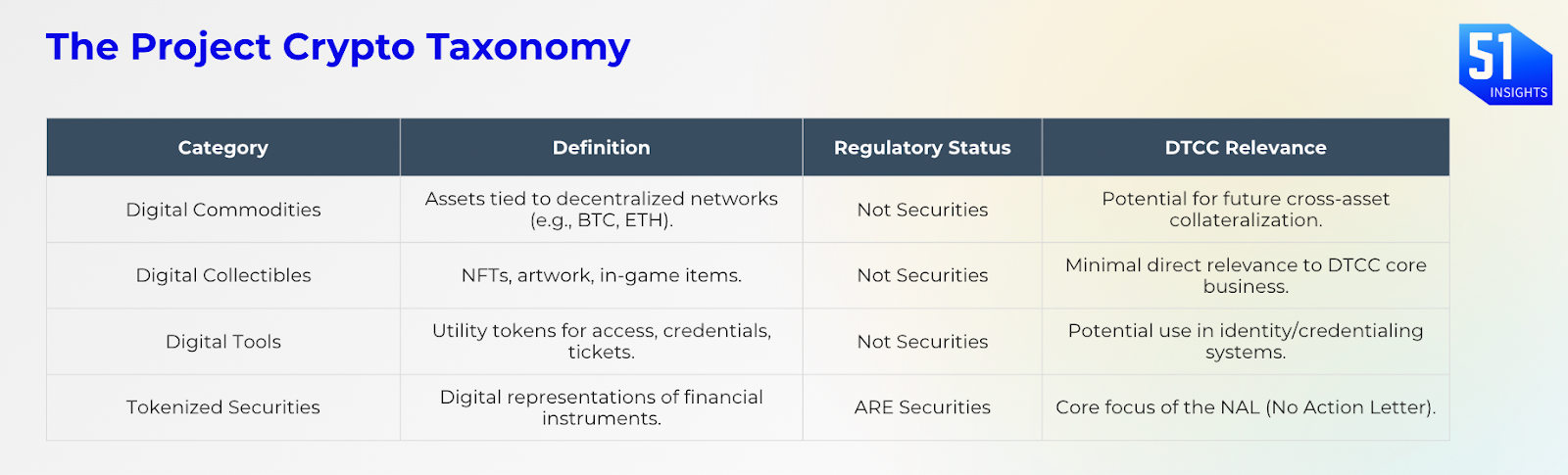
Zooming in: For years, U.S. regulators kept crypto in a gray zone. Chair Atkins is now scrapping that approach and replacing it with clear rules under a new effort called “Project Crypto.” His core view: what matters is the economics of a product, not whether it lives on paper, a database, or a blockchain.
“U.S. financial markets are poised to move on-chain. Under my leadership, SEC is prioritizing innovation and embracing new technologies to enable this on-chain future, while continuing to protect investors.”
– Paul Atkins, SEC Chair
 Marc Baumann
Also read: The SEC’s Approach to Digital Assets: Inside “Project Crypto”
The Super-App vision: Atkins is pushing for “super-app” financial platforms where crypto, Treasuries, and stablecoins sit under one roof. For DTCC, that means its ledger must plug into systems that also hold Bitcoin or stablecoins. The no-action letter is the first step, letting DTCC anchor the securities side of this future.
What other jurisdictions are doing:
- European Union: DLT Pilot Regime
- Singapore: Project Guardian
- United Kingdom: Digital Securities Sandbox
Why it matters
- The DTCC isn’t just another player; it is the operating system of American capital, custodying over $100 trillion in assets and processing quadrillions in annual transactions. DTCC confirmed to Bloomberg that its “ultimate aspiration” is to add the entire depository.
- Velocity over fractionalization: For years, the crypto pitch for RWAs was about “fractionalizing a Picasso.” That was a solution looking for a problem. DTCC is starting with the assets that actually move, Treasuries and money-market instruments, because that’s where faster settlement creates real value. Institutions don’t need fractional real estate; they need collateral that can move instantly. The bet is simple: speed, not slicing, is where blockchain delivers the biggest payoff.
- EVM as the global standard: DTCC choosing Hyperledger Besu and JPMorgan choosing Kinexys, both Ethereum-compatible systems, signals that the EVM has quietly become the standard for institutional blockchain. It means the same smart-contract languages and tools used in crypto now power Wall Street’s infrastructure, creating one shared talent pool and tech stack. And the model taking shape isn’t “public vs. private,” but a Layer-2 style setup: institutions will transact on fast, private EVM chains (like the Collateral AppChain) that can eventually anchor to or interoperate with the public Ethereum mainnet for finality and liquidity.
Investor Alpha
This is one of the most important signals of the year. While the DTCC will utilise a private AppChain built on Hyperledger Besu (an Ethereum-compatible client) for privacy and compliance, their explicit goal is interoperability across the TradFi and DeFi ecosystems. This reinforces the thesis that the future financial rail is EVM-compatible, cementing Ethereum’s standard as the settlement layer for the global economy.
Tokenised RWAs winners:
- Ondo: Its work with DTCC and Chainlink shows where things are heading: DTCC delivers the compliance layer, and Ondo becomes the distribution layer that brings those regulated assets into Web3.
- Protocols that are “compliance-first” and integrated with custodians (like Ondo, Securitize) are potential acquisition targets or long-term winners.
Infrastructure winners:
- Chainlink: It is deeply embedded in the DTCC/Swift stack and stands to capture value from every cross-chain message.
- Ethereum: It benefits from the EVM standardisation and eventual settlement demand.
The SEC’s No-Action Letter is the blueprint for the next fifty years of finance. The result will be a hybrid system: Netted T+03 settlement, running on permissioned EVM chains, connected by decentralised oracles, and anchored by the legal certainty of the central depository.
Watchlist
- Dec 15: SEC roundtable (crypto task force)
- Dec 15: Cboe Global Markets will launch the first U.S.-regulated perpetual-style futures contracts (PBT and PET)
- Dec: Tether is rumored to be preparing the launch of USAT (a new U.S.-compliant stablecoin) later this month to rival Circle.
- Dec: Clarity Act (H.R.3633) Senate vote (expected)
- Dec 31: Europe’s MiCA full enforcement (Austria, Germany, and Spain) ends
- Jan 1: Basel Committee crypto capital standards implementation in Hong Kong
- Jan’26: SEC Crypto Innovation Exemption
- Jan’26: Spot crypto ETF approvals for altcoin
- Q1’26: Kraken IPO
- Q1’26: Hong Kong Stablecoin licensing
- Q1’26: Singapore Stablecoin framework
Take care,
Marc & team
Download the PDF
🙌 Work with us: We arm financial institutions and digital asset leaders with bespoke research, thought leadership to shape the most important conversations, scale trust, and win business.
DTCC ComposerX
In February 2025, DTCC introduced ComposerX, an end-to-end solution for managing the full lifecycle of tokenized assets, bridging traditional finance (TradFi) with decentralized finance (DeFi) infrastructure. It incorporates DTCC’s patented Compliance Aware Token Framework (CATF) to automate regulatory compliance in real-time.
The suite consists of three primary components that work in concert:
ComposerX Capital Markets Platform: It handles the issuance, trading, and asset servicing of tokenized assets. Crucially, it creates an “aggregated view” of cap tables across multiple blockchains, addressing the fragmentation issue.
ComposerX Factory: Factory embeds regulatory logic directly into the token standard. For example, a “Reg D” token could be programmed to automatically reject a transfer to a wallet that hasn’t passed KYC/AML checks, or to enforce a 12-month lock-up period.
ComposerX LedgerScan: A data analytics tool that aggregates transactions across traditional and digital ledgers. ↩
Collateral AppChain
In April 2025, DTCC introduced Collateral AppChain, for moving tokenized assets. It runs on Hyperledger Besu, an Ethereum-based system, which means the code used here can work with the broader Ethereum ecosystem.
The AppChain also acts as a universal “wrapper” layer. Assets issued on any blockchain, Ethereum, Polygon, private chains, can be locked on their home network and re-issued on the DTCC chain for collateral. The result: different blockchain assets can finally sit in one shared collateral pool instead of being trapped in separate silos.
DTCC’s confidence in the AppChain comes from a pilot with Japan’s clearinghouse showing margin calls can be automated with tokenized assets like USDC. The test proved CCPs can settle collateral in minutes instead of hours, cutting risk and reducing how much collateral firms need to post.
The repo market crisis: The $12.6T repo market, where banks and hedge funds swap Treasuries for cash, is essential but fragile, with hidden leverage, settlement failures, and sudden spikes in risk. DTCC’s Collateral AppChain aims to fix that by letting Treasuries move instantly as tokens, giving firms the ability to meet margin calls at any time and use collateral more efficiently. It also creates a real-time dashboard of who is pledging what, giving regulators visibility into leveraged trades like the basis trade before they blow up.
It is fixing the cash-side bottleneck by using Fnality’s central-bank-backed digital cash, letting securities and money settle at the same time, 24/7, with no settlement risk.
In September 2025, Chainlink announced a system that turns unstructured corporate action announcements into instant, verified, shared records, cutting billions in errors and processing costs with 24 major financial institutions, including DTCC, Swift, and Euroclear. ↩
The big debate in market plumbing: Should markets settle every trade instantly (atomic) or batch them and settle only the difference (netting)? Today’s system relies on netting because it dramatically reduces how much cash banks need to move, cutting daily payment obligations by about 98%.
DTCC’s answer: Instead of going all-in on instant settlement, which would force banks to pre-fund every trade and require trillions in extra liquidity, DTCC is pushing a “netted T+0” model. Trades flow in all day, the system calculates who owes what in real time, and everything settles the same day. You keep the speed of same-day settlement without blowing up liquidity needs. ↩