

The end of the closing bell
Yesterday, the New York Stock Exchange (NYSE) dismantled Wall Street’s most long-boundary: market hours.
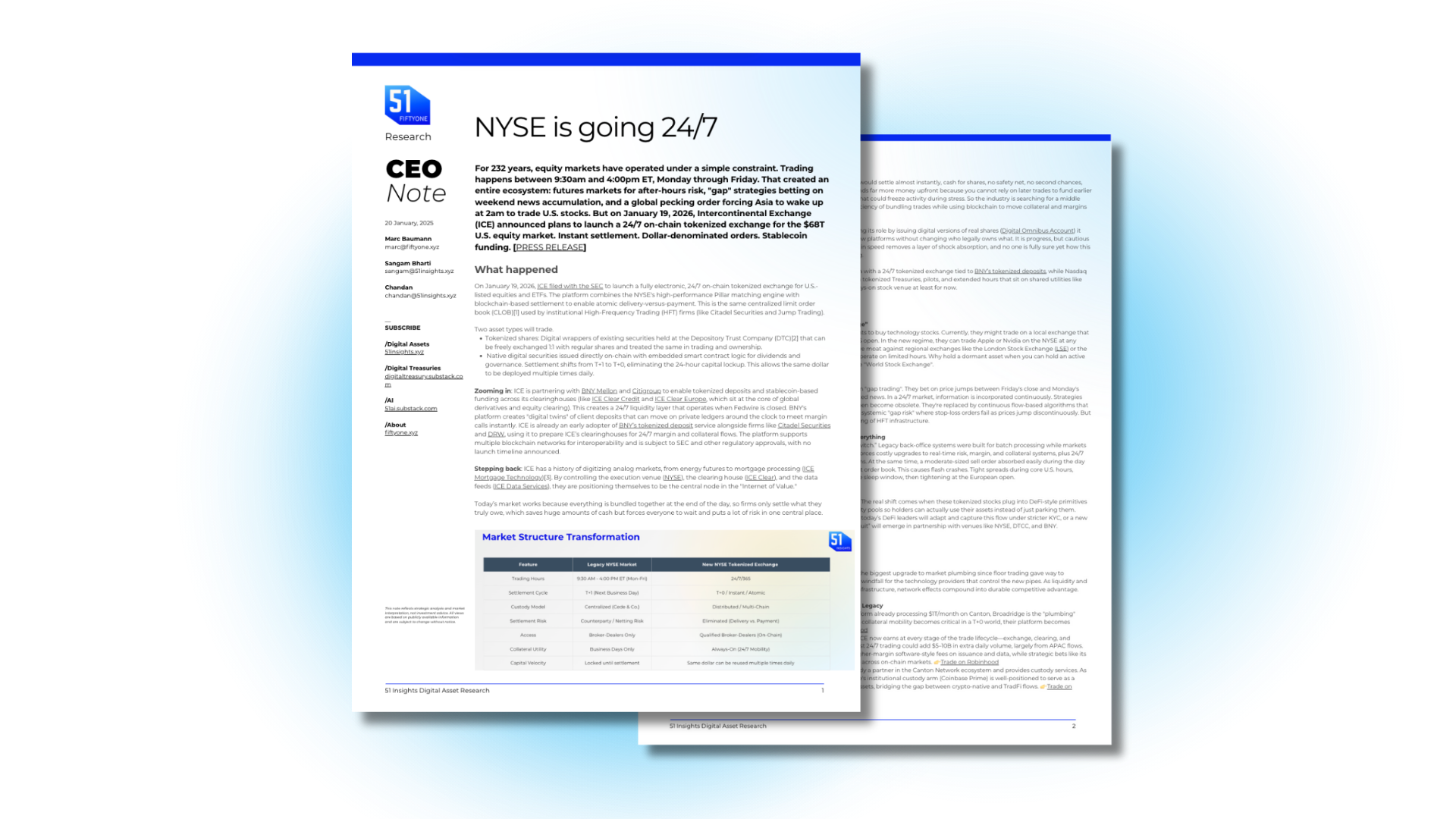
For 232 years, equity markets have operated under a simple constraint. Trading happens between 9:30am and 4:00pm ET, Monday through Friday. That created an entire ecosystem: futures markets for after-hours risk, “gap” strategies betting on weekend news accumulation, and a global pecking order forcing Asia to wake up at 2am to trade U.S. stocks.
But on January 19, 2026, Intercontinental Exchange (ICE) announced plans to launch a 24/7 on-chain tokenized exchange for the $68T U.S. equity market. Instant settlement. Dollar-denominated orders. Stablecoin funding. [PRESS RELEASE]
This is likely one of the most important events in the history of modern capital market infrastructure. Let’s unpack.
👉PRO: Download the PDF at the bottom
What Happened
On January 19, 2026, ICE filed with the SEC to launch a fully electronic, 24/7 on-chain tokenized exchange for U.S.-listed equities and ETFs. The platform combines the NYSE’s high-performance Pillar matching engine with blockchain-based settlement to enable atomic delivery-versus-payment. This is the same centralized limit order book (CLOB)1 used by institutional High-Frequency Trading (HFT) firms (like Citadel Securities and Jump Trading).
Two asset types will trade.
Tokenized shares: Digital wrappers of existing securities held at the Depository Trust Company (DTC)2that can be freely exchanged 1:1 with regular shares and treated the same in trading and ownership.
Native digital securities issued directly on-chain with embedded smart contract logic for dividends and governance. Settlement shifts from T+1 to T+0, eliminating the 24-hour capital lockup. This allows the same dollar to be deployed multiple times daily.
Zooming in: ICE is partnering with BNY Mellon and Citigroup to enable tokenized deposits and stablecoin-based funding across its clearinghouses (like ICE Clear Credit and ICE Clear Europe, which sit at the core of global derivatives and equity clearing). This creates a 24/7 liquidity layer that operates when Fedwire is closed.
How it works: BNY’s platform creates “digital twins” of client deposits that can move on private ledgers around the clock to meet margin calls instantly. ICE is already an early adopter of BNY’s tokenized deposit service alongside firms like Citadel Securities and DRW, using it to prepare ICE’s clearinghouses for 24/7 margin and collateral flows. The platform supports multiple blockchain networks for interoperability and is subject to SEC and other regulatory approvals, with no launch timeline announced.
Go deeper:
 Marc Baumann
 Marc Baumann
Stepping back: ICE has a history of digitizing analog markets, from energy futures to mortgage processing (ICE Mortgage Technology). By controlling the execution venue (NYSE), the clearing house (ICE Clear), and the data feeds (ICE Data Services), they are positioning themselves to be the central node in the “Internet of Value.”

Today’s market works because everything is bundled together at the end of the day, so firms only settle what they truly owe, which saves huge amounts of cash but forces everyone to wait and puts a lot of risk in one central place.
The new model flips this:
Every trade would settle almost instantly, cash for shares, no safety net, no second chances, which sounds safer but actually demands far more money upfront because you cannot rely on later trades to fund earlier ones. That creates a liquidity squeeze that could freeze activity during stress. So the industry is searching for a middle ground, trying to keep some of the efficiency of bundling trades while using blockchain to move collateral and margins in real time.
Be smart: At the same time, the DTCC is protecting its role by issuing digital versions of real shares (Digital Omnibus Account) it already holds, letting them trade on new platforms without changing who legally owns what. It is progress, but cautious progress, because every improvement in speed removes a layer of shock absorption, and no one is fully sure yet how this system behaves when things go wrong.
Zooming in: NYSE is pushing the front end on‑chain with a 24/7 tokenized exchange tied to BNY’s tokenized deposits, while Nasdaq is moving more cautiously, focusing on tokenized Treasuries, pilots, and extended hours that sit on shared utilities like DTCC and Canton instead of a full always‑on stock venue at least for now.
Why It Matters
Becoming the “World Stock Exchange”
Consider a European investor who wants to buy technology stocks. Currently, they might trade on a local exchange that closes at 5:00 PM CET or wait for the US open. In the new regime, they can trade Apple or Nvidia on the NYSE at any hour. This creates a massive competitive moat against regional exchanges like the London Stock Exchange (LSE) or the Tokyo Stock Exchange (JPX) that still operate on limited hours. Why hold a dormant asset when you can hold an active one? The NYSE effectively becomes the “World Stock Exchange”.
The death of the weekend gap
For decades, hedge funds profited from “gap trading”. They bet on price jumps between Friday’s close and Monday’s open caused by 48 hours of accumulated news. In a 24/7 market, information is incorporated continuously. Strategies predicated on volatility spikes at the open become obsolete. They’re replaced by continuous flow-based algorithms that operate without pause. This eliminates systemic “gap risk” where stop-loss orders fail as prices jump discontinuously. But it also demands complete re-engineering of HFT infrastructure.
Institutional nightmare: Real-time everything
A 24/7 market kills the overnight “off switch.” Legacy back‑office systems were built for batch processing while markets slept, so moving to always‑on trading forces costly upgrades to real‑time risk, margin, and collateral systems, plus 24/7 staffing and fully automated liquidations. At the same time, a moderate-sized sell order absorbed easily during the day could cascade through a thin overnight order book. This causes flash crashes. Tight spreads during core U.S. hours, widening during the Asia lunch/Europe sleep window, then tightening at the European open.
DeFi primitives are the next layer
Tokenization is just the opening move. The real shift comes when these tokenized stocks plug into DeFi-style primitives borrowing, lending, staking, and liquidity pools so holders can actually use their assets instead of just parking them. Depending on how rules evolve, either today’s DeFi leaders will adapt and capture this flow under stricter KYC, or a new class of regulated, on‑chain “DeFi in a suit” will emerge in partnership with venues like NYSE, DTCC, and BNY.
Investor Alpha
The move to 24/7 tokenized trading is the biggest upgrade to market plumbing since floor trading gave way to electronic matching. It creates a major windfall for the technology providers that control the new pipes. As liquidity and DeFi-style applications build on their infrastructure, network effects compound into durable competitive advantage.
The Trade: Long Infrastructure, Short Legacy
- Broadridge (BR): With its DLR platform already processing $1T/month on Canton, Broadridge is the “plumbing” provider for this new ecosystem. As collateral mobility becomes critical in a T+0 world, their platform becomes indispensable. 👉 Trade on Robinhood
- Intercontinental Exchange (ICE): ICE now earns at every stage of the trade lifecycle—exchange, clearing, and tokenization. Pilot estimates suggest 24/7 trading could add $5–10B in extra daily volume, largely from APAC flows. The tokenization stack supports higher‑margin software‑style fees on issuance and data, while strategic bets like its stake in Polymarket deepen its role across on‑chain markets. 👉 Trade on Robinhood
- Coinbase (COIN): Coinbase is already a partner in the Canton Network ecosystem and provides custody services. As tokenized securities grow, Coinbase’s institutional custody arm (Coinbase Prime) is well-positioned to serve as a qualified custodian for these new assets, bridging the gap between crypto-native and TradFi flows. 👉 Trade on Robinhood
- Chainlink (LINK): If NYSE is the venue and BNY is the vault, Chainlink is the bridge. You cannot have tokenized assets moving between private bank chains and public markets without a standard messaging/oracle layer. Chainlink is already working with institutional networks like Canton, and many investors expect oracle and cross‑chain plumbing to sit underneath NYSE‑style platforms as they scale. 👉 Trade it on Gate
Watchlist:
- Jan 27: Federal Reserve two-day meeting, rate decision
- Jan: SEC Crypto Innovation Exemption window
- Jan: Spot crypto ETF decisions for altcoins
- Feb 2: Bank of Japan (BoJ) Summary of Opinions (Jan meeting)
- Feb 4–5: ECB Governing Council monetary policy meeting
- Feb 5–6: Digital Assets Forum 2026, London
- Feb 9: Liquidity Summit 2026, Hong Kong
- Feb 10–12: Consensus Hong Kong (CoinDesk)
- Feb 11: US CPI (Jan) release
- Feb 12: US PPI release
- Feb 17–21: ETHDenver 2026
- Feb 18: FOMC minutes for Jan 27–28 meeting
- Q1’26: Kraken IPO window
- Q1’26: Hong Kong stablecoin licensing regime
- Q1’26: Singapore stablecoin framework launch
Market signals
- Hong Kong Securities Group Opposes Proposed Digital Asset Management Regulations [Link]
- Coinbase and Circle to provide digital asset infrastructure to Bermuda [Link]
- Coinbase CEO Brian Armstrong to work on market structure bill in Davos [Link]
That’s it for now.
Marc & Team
Centralized limit order book (CLOB): A CLOB is a trading system where all buy and sell orders sit in one shared order book and are matched by price and time. It lets every participant see the same bids, offers, and sizes, and trade directly with each other instead of going through a dealer. ↩
Depository Trust Company (DTC): The main U.S. securities depository. It holds stocks and bonds in electronic form for brokers and banks and keeps records of who owns what. ↩