
Morgan Stanley is building a full-stack crypto bank
Morgan Stanley is transitioning from a distributor of third-party crypto products to a direct issuer and platform provider. And, it is going to become the first U.S. bank to issue an ETF directly. In March 2026, the firm filed an amended S-1 for its own spot Bitcoin ETF. That filing landed one month after the bank applied to the OCC for a federally chartered crypto trust subsidiary. Beyond Bitcoin, they are also focusing on yield and filed for Ethereum and Solana ETFs in January 2026. [FILING]
Let’s unpack. [RELEASE]
👉PRO: Download the PDF below
The Signal: Morgan Stanley is building the pipes that every crypto dollar flows through, and locking the door behind it.
What happened
Morgan Stanley’s second S-1 amendment confirmed that the Morgan Stanley Bitcoin Trust will list on NYSE Arca under the ticker MSBT. The fund will use a basket size of 10,000 shares, with an initial seed of 50,000 shares expected to raise approximately $1M.
Morgan Stanley purchased two shares on March 9 for auditing purposes.
- BNY Mellon will serve as cash custodian, administrator, and transfer agent.
- Coinbase will handle bitcoin custody and act as prime broker.
The fund uses the CoinDesk Bitcoin Benchmark for daily pricing at 4 PM New York time. If approved, MSBT would be the first spot bitcoin ETF directly issued by a major U.S. bank.

Stepping back: Morgan Stanley also filed spot Ethereum and Solana ETF applications in January, though only the bitcoin filing has received amendments, suggesting it is furthest along in SEC review. Separately, OCC records show the agency received Morgan Stanley’s application for a national trust bank charter on February 18, 2026. The proposed entity, Morgan Stanley Digital Trust National Association, would custody digital assets and conduct incidental banking activities including purchase, sale, swap, and transfer of digital assets, plus client staking on a fiduciary basis. The public comment period closes today, March 20.
Zooming in: Morgan Stanley has invested in Zero Hash’s $104 million Series D-2 round and plans to use the firm’s infrastructure to offer spot BTC, ETH, and SOL trading to E*Trade’s 7 million+ brokerage clients in H1 2026.
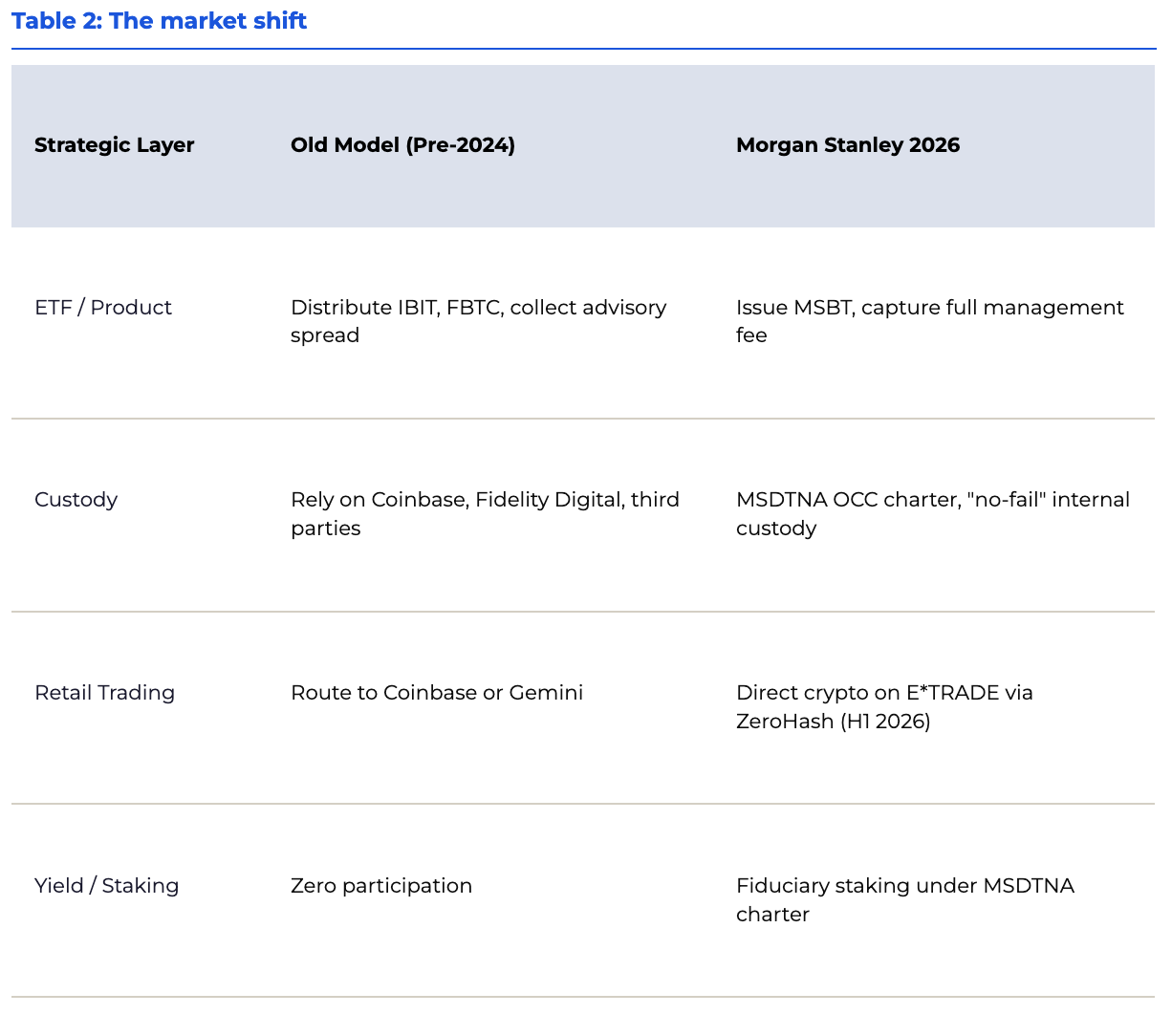
The integrated stack: ETFs for passive allocation. E*Trade for active trading. A federally chartered trust bank for custody and staking. A proprietary wallet for client engagement. Morgan Stanley is moving toward a vertically integrated in-house model.
“Even the distribution of these ETFs, about 80% of what we see on our platform, is coming through the self-directed business,” Amy Oldenburg said.
Meaning: 80% of Morgan Stanley’s crypto ETF volume sits outside advisor workflows. That is the TAM for MSBT. If Morgan Stanley’s own advisors shift even a fraction of that self-directed flow into proprietary products, the fee capture is enormous. The firm’s 15,000+ financial advisors have been cleared since early 2026 to proactively recommend bitcoin ETFs to clients. [CEO Notes]
Why it matters
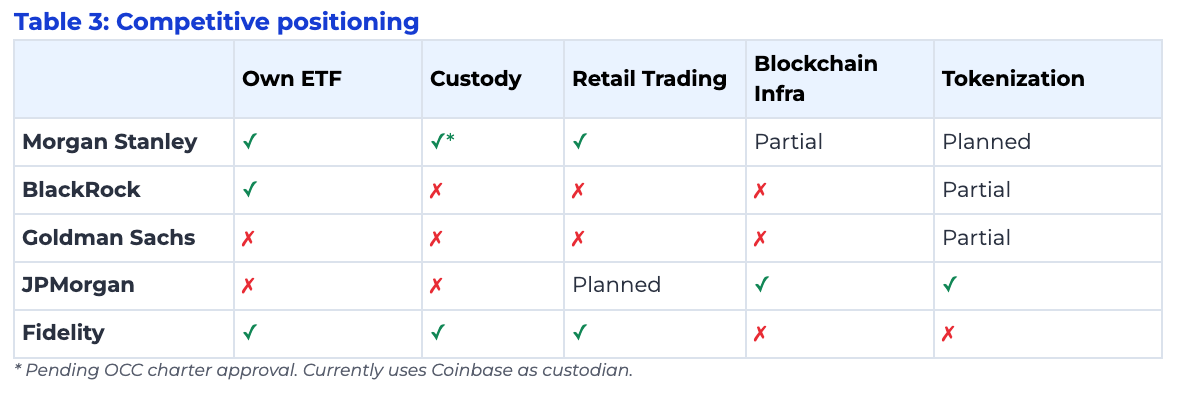
- The real play is vertical integration. BlackRock’s IBIT dominates spot bitcoin ETFs with $54B in AUM. Fidelity’s FBTC holds roughly $20B. Morgan Stanley entering the ETF race alone would be a footnote. What makes this different: Morgan Stanley is the first bank to simultaneously build the product (MSBT), the infrastructure (OCC trust charter for custody/staking), and the distribution (E*Trade for 7M+ retail accounts). Goldman Sachs holds $1.1 billion in bitcoin ETF positions but distributes other firms’ products. JPMorgan builds blockchain rails (Kinexys processes $1B+ daily) but doesn’t touch retail crypto. Morgan Stanley is doing both.
- The OCC charter changes the cost structure. Morgan Stanley currently pays Coinbase to custody bitcoin for its products. The Digital Trust charter, if approved, creates an in-house, federally supervised custody entity. That eliminates third-party fees, gives the firm direct control over client assets, and opens the door to staking revenue. The OCC has conditionally approved eight crypto-focused trust charters since December 2025, including Circle, Ripple, BitGo, Fidelity Digital Assets, Paxos, Stripe’s Bridge, Protego, and Crypto.com.
- This is about tokenization, not just Bitcoin. Amy Oldenburg told Bloomberg that “the digital asset trend has shifted from a focus solely on cryptocurrencies to exploring the tokenization of all assets.” A federally chartered trust entity doesn’t just custody bitcoin. It can custody tokenized treasuries, tokenized money market funds, tokenized private credit. Morgan Stanley’s planned digital wallet, expected in H2 2026, supports crypto and “future tokenized assets.” Connecting the dots, the trust charter is the legal foundation for a tokenized asset custody business.
Investor Alpha
In March 2026, the SEC and CFTC officially classified 16 tokens (including SOL and AVAX) as commodities, clearing the runway for yield-bearing ETFs. BlackRock’s ETHB ETF now delegates underlying assets and distributes a 2-4% staking yield directly to shareholders. [CEO notes]
- Coinbase (COIN): Coinbase is simultaneously custodian for both MSBT and IBIT — it’s the default institutional Bitcoin vault for U.S. spot ETFs. As ETF AUM grows, Coinbase Prime’s custody revenue compounds without additional risk.
- BlockRock (BK): ETHB is the template for what’s next: yield-bearing, regulated crypto ETF wrappers. BlackRock already proved the playbook with IBIT ($80B AUM in 374 days).
- Morgan Stanley (MS): . If the OCC approves it and the BPI lawsuit fails, Morgan Stanley internalizes the full digital asset value chain for its $4T+ wealth management client base. The custody and staking revenue that currently flows to Coinbase and crypto-native firms lands on Morgan Stanley’s own balance sheet.
Our Take
Morgan Stanley’s initiatives in the digital space are very strong. They aren’t just building infrastructure but also capturing the market. Morgan Stanley already questioned DAT companies like Microstrategy. In July 2025, it rolled out its competing note, called the “Dual Directional Auto-Callable Trigger PLUS,” tied to IBIT. Overall, they have been building instruments and pipes to run them.
However, the Bank Policy Institute, whose members include JPMorgan, Goldman, and BofA, is preparing a lawsuit against the OCC over these narrow trust charters. So, even though the trust bank charter is the real weapon, the litigation can impact Morgan Stanley’s MSDTNA (Morgan Stanley Digital Trust, National Association) application to establish a national trust bank focused on digital assets.
51 Intelligence Stack: Recommended Reading
- Morgan Stanley enters crypto issuance
- Bank of America embraces Bitcoin
- The SEC sort the tokens
- Spoiler: Wall Street loves Bitcoin (fees)
Watchlist:
- Apr 28–29: FOMC meeting. Second rate decision window
- Jul 1: MiCA universal deadline
- Q1-Q2 2026: SEC final decision on Nasdaq tokenized trading rule change (SR-NASDAQ-2025-072)
- H2 2026: DTCC tokenization pilot launch
That’s it for now.
Missed last week? Access all our CEO notes here.
Marc & Team