
Morgan Stanley enters crypto issuance
For a decade, Wall Street played the safe game. They sold you BlackRock’s ETF, collected a ticket charge, and kept their hands clean.
That era is over.
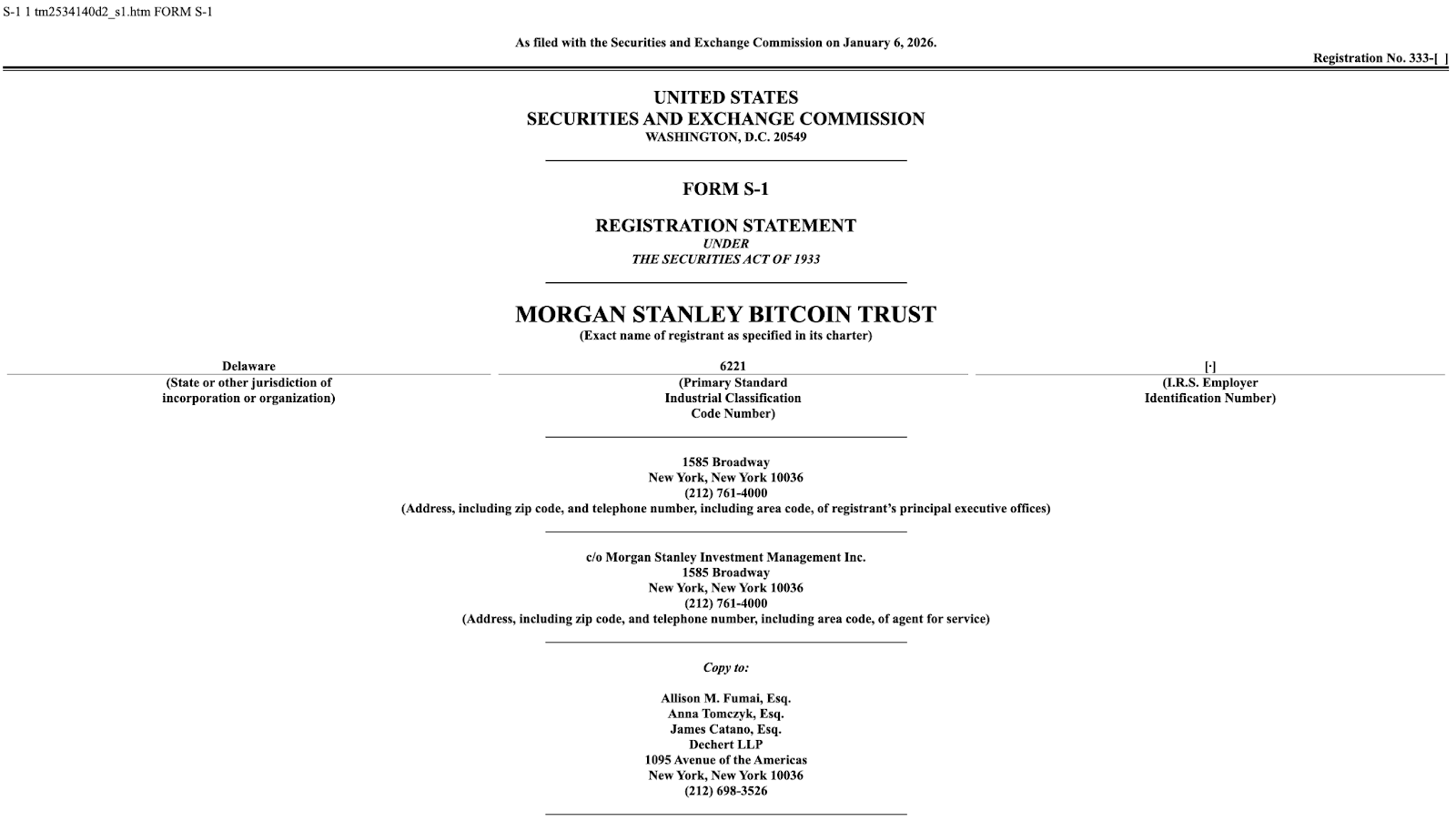
Morgan Stanley ($1.5T in wealth management assets) just became the first major U.S. bank to issue its own crypto ETFs, Bitcoin and Solana, not just distribute it. They just filed to launch their own Bitcoin and Solana ETFs. They aren’t just facilitating the trade anymore, they are capturing the issuance fees, the custody economics, and the staking yields. [SEC filing]
The white gloves are off. Let’s unpack.
👉Download the PDF
What happened
Morgan Stanley filed S-1 registration statements to sponsor proprietary Bitcoin and Solana Trusts, explicitly including a mechanism to stake Solana assets for yield via third-party providers. This pivot coincides with the Office of the Comptroller of the Currency (OCC) issuing Interpretive Letter 1188, which permits national banks to execute “riskless principal” crypto trades without the prohibitive 1250% capital risk weight. [Read full story]
Be smart: Simultaneously, on January 7, MSCI decided not to exclude “Digital Asset Treasury” companies like Strategy from major indices, preserving the viability of the corporate Bitcoin-holding model.
Zooming in: These moves were enabled by three regulatory gatekeepers:
In September 2025, the SEC approved new generic listing standards for cryptocurrency exchange-traded products. It also rescinded Staff Accounting Bulletin 121 (SAB 121), which previously imposed strict balance sheet requirements for institutions providing crypto custody.
In November 2025, the IRS issued Revenue Procedure 2025-31, clarifying that staking within ETF structures is permissible without violating tax-exempt trust status.
On December 9, 2025, the OCC issued Interpretive Letter 1188, confirming that national banks can engage in “riskless principal” crypto transactions without incurring the 1250%1 risk-weight penalty under Basel III.
These three decisions, SEC acceptance, IRS clarity, and OCC enablement, collapsed the infrastructure friction that previously made crypto a niche business.
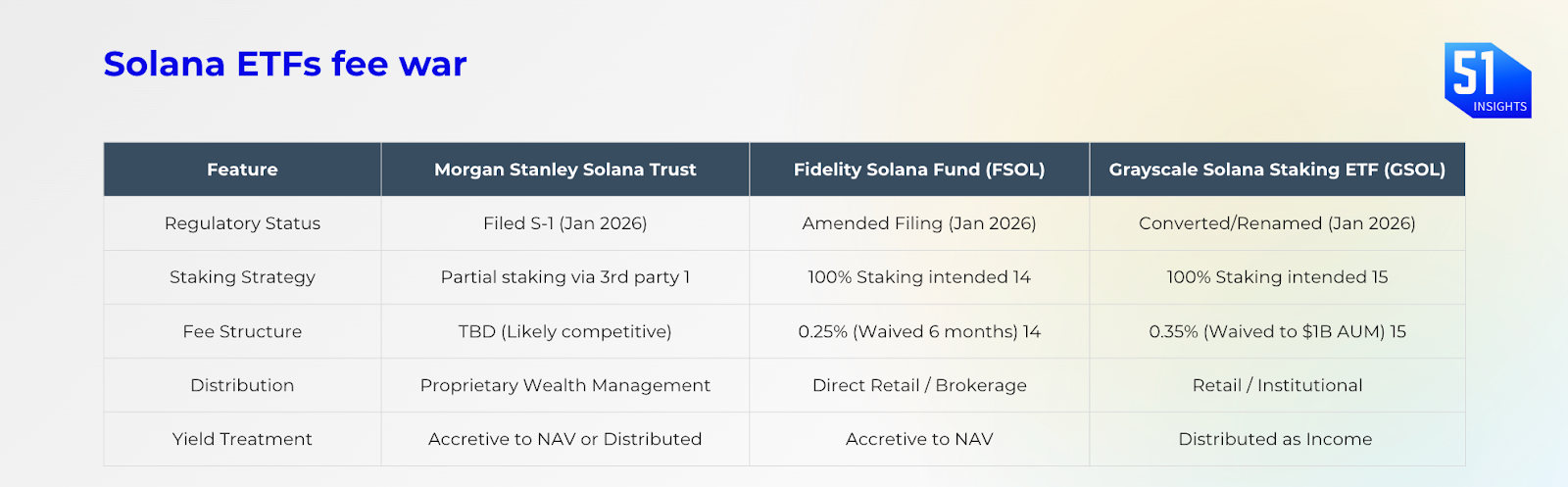
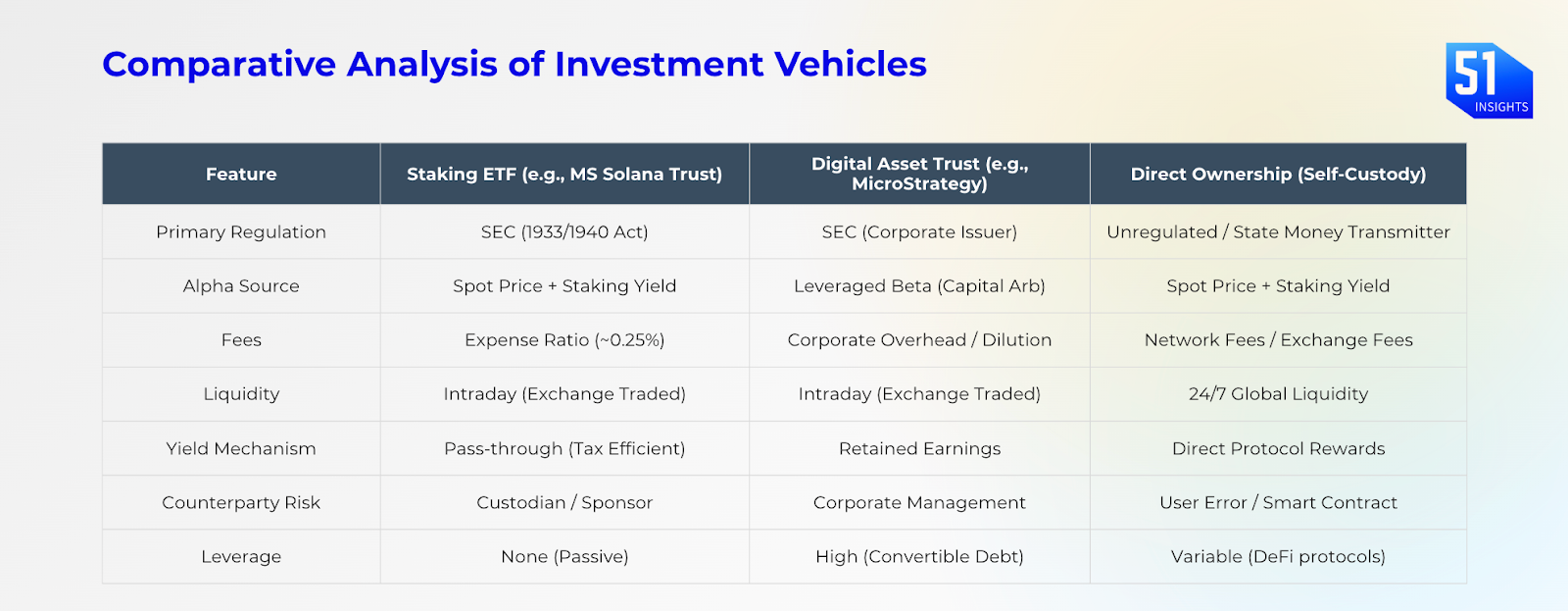
Staking war: The Morgan Stanley filing explicitly states the intention to utilise third-party staking service providers to stake a portion of the fund’s assets to generate passive yield. In a staking ETF, the underlying asset generates a yield (historically 6-8% for Solana) that can offset the management fee and potentially provide a net positive carry. This structure aligns the ETF more closely with a high-yield bond fund or a dividend equity fund than a commodity product.
Why it matters
- Staking transforms the product: Morgan Stanley is restructuring the asset class. The Solana filing is the critical differentiator. By incorporating staking, the bank transforms a digital commodity into a yield-bearing instrument comparable to a high-yield bond. With a historical yield of ~6-8%, a Solana ETF effectively creates a “yield floor.” In a flat market, a standard ETF returns -0.50% (fees); a staking ETF returns +6.50% (yield minus fees).
- The return of banks: The OCC’s “riskless principal“ guidance is a blow to pure-play crypto exchanges. Previously, Basel III capital rules sidelined banks. Now, Morgan Stanley can execute client trades as a riskless principal, holding the asset for mere microseconds, bypassing capital penalties. Institutional investors generally prefer ISDA-backed bank counterparties over crypto exchanges. This grants banks a structural cost advantage and the ability to settle trades using tokenized commercial bank money, bypassing T+1 cycles.
- Morgan Stanley’s distribution: Morgan Stanley manages $6.4 trillion and employs 15,000 financial advisors who gained crypto access in October. Fidelity and BlackRock have distribution, but Morgan Stanley uniquely combines wealth management depth with institutional sales coverage and retail brokerage reach. Grayscale saw this coming, it rebranded to “Grayscale Solana Staking ETF” and cut fees days before Morgan Stanley’s filing. What matters more is that Morgan Stanley’s entry validates the asset class with the demographic most skeptical of crypto: fiduciaries managing retirement capital.
- The timing matters. Bank of America enabled 15,000 Merrill advisors to recommend Bitcoin ETFs starting January. Morgan Stanley’s filing plus E*Trade crypto trading (launching H1 2026) signals coordinated Wall Street entry. When banks move, they move together.
Investor Alpha
There is a shift from fee to yield. Investors should no longer evaluate these products solely on expense ratios. In a staking ETF, the Net Staking Yield (Gross Yield minus Expense Ratio minus Validator Performance Penalties) is the only metric that matters. A fund with a higher fee but superior validator selection (zero slashing, high uptime) will outperform a “cheap” fund that suffers from inefficient staking execution.
- Long Solana (SOL): The launch of staking ETFs is a massive catalyst. As institutions monetize the “net yield” thesis, demand will strip supply. The asset ranges from “commodity” to “yield-bearing instrument.”
- Keep an eye on Morgan Stanley (MS): The bank is capturing the entire value chain, issuance, custody, and execution. Plus, not to forget they’ve also taken control of digital asset treasuries by MSCI’s decision to retain MicroStrategy (MSTR) in its indices.
- Grayscale (GSOL): As Grayscale converts its Solana Trust to an ETF to compete with Morgan Stanley, any remaining discount to NAV should evaporate. If initial institutional demand outstrips the creation mechanism’s speed, these ETFs could briefly trade at a premium, offering a short-term tactical entry.
Watchlist:
- Jan: USAT launch by Tether (expected)
- Jan: Clarity Act (H.R.3633) Senate vote (expected)
- Jan 13: Consumer Price Index data for December 2025; heavily influence the January 27-28 meeting
- Jan 15: Senate committee vote
- Jan 27: The Federal Reserve will convene for two days, with the rate decision
- Jan: SEC Crypto Innovation Exemption
- Jan: Spot crypto ETF approvals for altcoin
- Q1’26: Kraken IPO
- Q1’26: Hong Kong Stablecoin licensing
- Q1’26: Singapore Stablecoin framework
Market signals
- Wyoming issues state-backed stablecoin on SOL. Link
- Senate committees to vote on Jan 15 on crypto bill. Link
- WLFI seeks bank charters to bring USD1 onshore. Link
- Total AUM of tokenised stocks surpasses $1B. Link
That’s it for now.
Marc & Team
For every dollar of exposure, a bank must hold $12.50 in capital (1250% of $1) to cover potential losses. ↩