
The U.S. crypto battlefield
Hey, it’s Marc & 51 team,
Jamie Dimon interrupted Brian Armstrong’s coffee with Tony Blair at Davos. The JPMorgan CEO got in Armstrong’s face and told him he was “full of sh*t” for claiming banks were sabotaging crypto legislation.
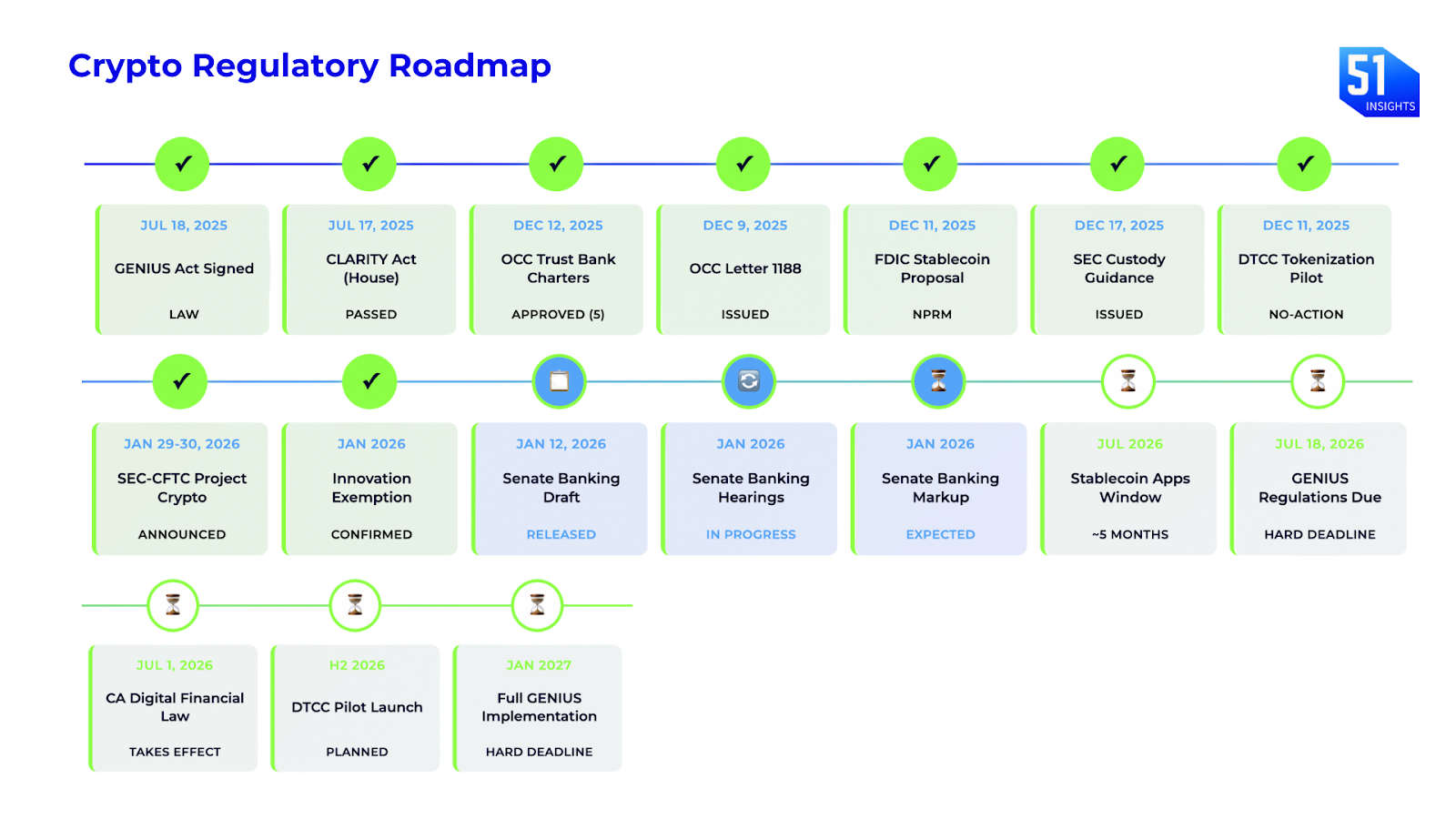
While CEOs traded insults in Switzerland, SEC Chair Atkins is building the regulatory framework: the GENIUS Act is live. Project Crypto just formalized SEC-CFTC coordination. DTCC launched its tokenisation pilot. OCC greenlit five crypto-focused national trust banks.
Everything is moving except one thing: Congress can’t agree on where to draw the line between securities and commodities. And that stall is costing the industry billions in legal ambiguity. [CLARITY Act]
Here’s the full map of what’s moving, what’s stuck, and what actually matters for builders, banks, and allocators right now.
👉PRO: Download the PDF at the bottom
What happened
The US regulatory machine is undergoing a three-part transformation of how cryptocurrency is regulated.
Pillar 1: Monetary - The GENIUS Act (Done)
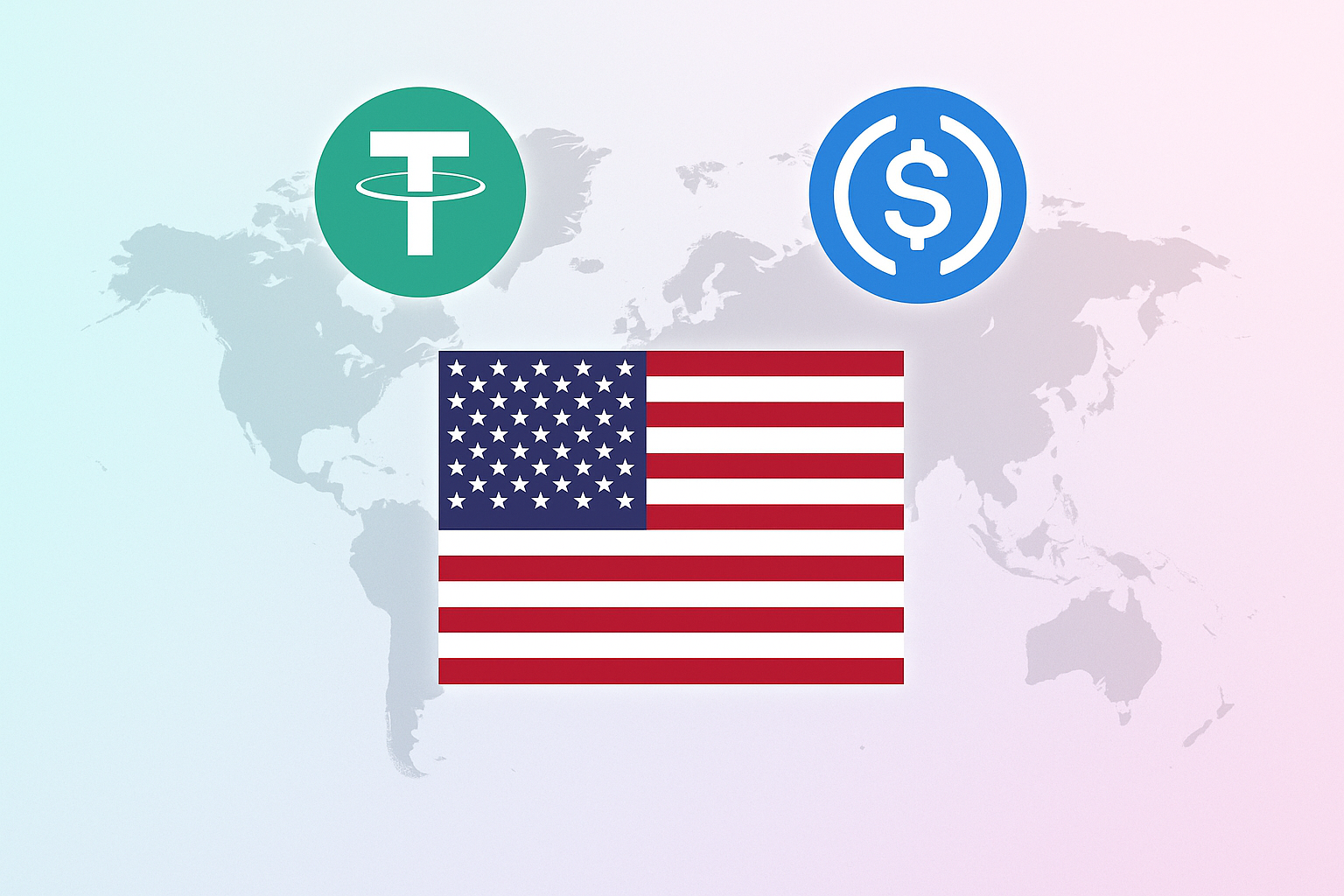
The GENIUS Act was signed into law July 18, 2025. It created the first federal framework for stablecoins, bifurcating jurisdiction between federal banking regulators and state authorities under a unified federal floor. The structure: three pathways to become a stablecoin issuer.
- Federal Qualified Nonbank Issuers (OCC oversight): On December 12, 2025, the OCC granted conditional approval to five major entities, including Ripple, BitGo, Paxos, Circle, and First National Digital Currency Bank, allowing them to establish national trust banks. This is federal preemption: these firms now operate across all 50 states without state-by-state money transmitter licenses. [RELEASE]
- IDI Subsidiary Issuers (Bank subsidiaries): On December 16, 2025, the FDIC board approved a Notice of Proposed Rulemaking (NPRM) to establish application procedures for state-chartered banks seeking to issue stablecoins through subsidiaries. The deadline for public comments is February 17, 2026. [RELEASE]
- State-Qualified Issuers (State supervision with federal floor): Entities under $10 billion in issuance operate primarily under state supervision; above that, the Feds take over. [MORE]
Stablecoin issuers will be able to submit applications to the relevant state or federal regulator starting one year after passage of the GENIUS Act (approximately July 2026), with full implementation by January 2027.
Further reading:
 Marc Baumann
 Marc Baumann
 Marc Baumann
 Marc Baumann
Pillar 2: Market Structure - The CLARITY Act (Stalled)
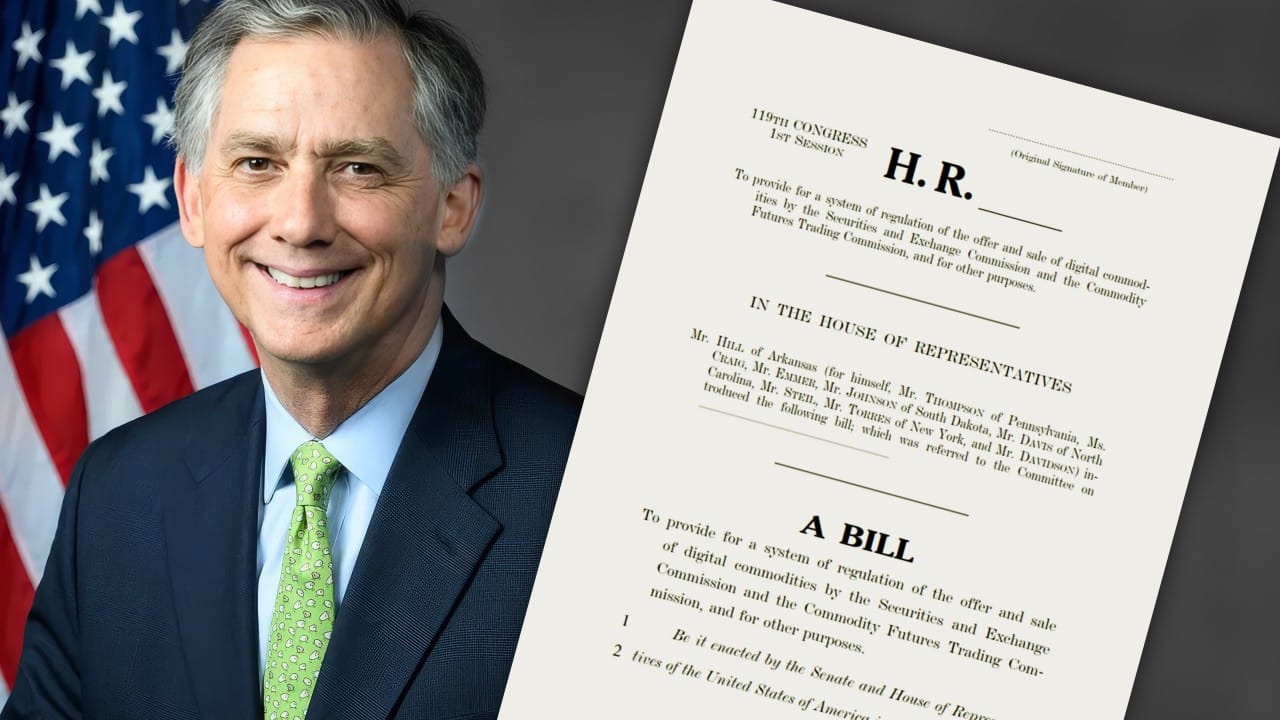
The CLARITY Act passed the House of Representatives in July 2025 with bipartisan support. However, it hit a wall in the Senate due to diverging philosophies between the Senate Banking Committee (favoring SEC oversight and strict investor protections) and the Senate Agriculture Committee (favoring CFTC oversight and spot market flexibility).
On January 29, 2026, Senate Agriculture Committee advanced the first-ever crypto market structure bill, voting to give the CFTC authority over digital asset spot markets, but a full Senate vote is still pending. [RELEASE]
“Advancing this bill brings us closer to a U.S. regulatory framework that protects consumers while allowing American innovation and businesses to thrive.”
— John Boozman, U.S. Senate Committee on Agriculture, Nutrition, and Forestry Chairman
Two competing drafts are now in play:
- Senate Banking Draft (Chair Tim Scott, released Jan 2026): Emphasizes SEC jurisdiction, strict investor protections, and restricts tokenized equities to traditional exchanges. [Read draft]
- Senate Agriculture Draft (Chair John Boozman, released Nov 2025): Emphasizes CFTC jurisdiction, permits more decentralization, treats tokens as commodities once networks are functional. [Read draft]
The sticking points:
- Yield on stablecoins. On January 12, 2026, the Senate Banking Committee released a new 278-page draft, which prohibits digital asset service providers from offering interest or yield to users for simply holding stablecoin balances, but allows for stablecoin rewards or activity-linked incentives. Coinbase’s $1.3B annual revenue stream from stablecoin yield rewards is directly threatened. The banking lobby argues this closes a loophole; crypto argues this stifles consumer choice.
- DeFi regulation. The Banking draft requires “front-end” websites for DeFi protocols to register as broker-dealers and perform KYC. Crypto developers call this a “ban on software development.”
- Where tokenized equities trade. Banking wants them only on traditional exchanges (NYSE/ NASDAQ). Agriculture is more permissive.
White House crypto adviser David Sacks has said that the Senate is expected to hold hearings about the market structure bill in January, and markup is coming in January. But negotiations are ongoing. The markup was forced to cancel as Coinbase withdrew support for the Senate version of the CLARITY Act. The bill stalled in late 2025 and remains stalled as of early February 2026.
Further reading:
Marc Baumann
Pillar 3: Infrastructure - Project Crypto & DTCC Tokenization (Moving Fast)
On January 27, 2026, SEC Chair Paul Atkins and CFTC Chair Michael Selig held a joint summit to announce Project Crypto, a historic joint initiative to harmonize U.S. cryptocurrency regulation. [Opening remarks]
On Jan 28, SEC released a statement saying stocks and other securities don’t avoid U.S. securities laws just because they’re issued or wrapped as tokens. It also drew a clear line between issuer-issued tokens and third-party “synthetic” versions, signaling tighter scrutiny of tokenized markets. [RELEASE]
Key components:
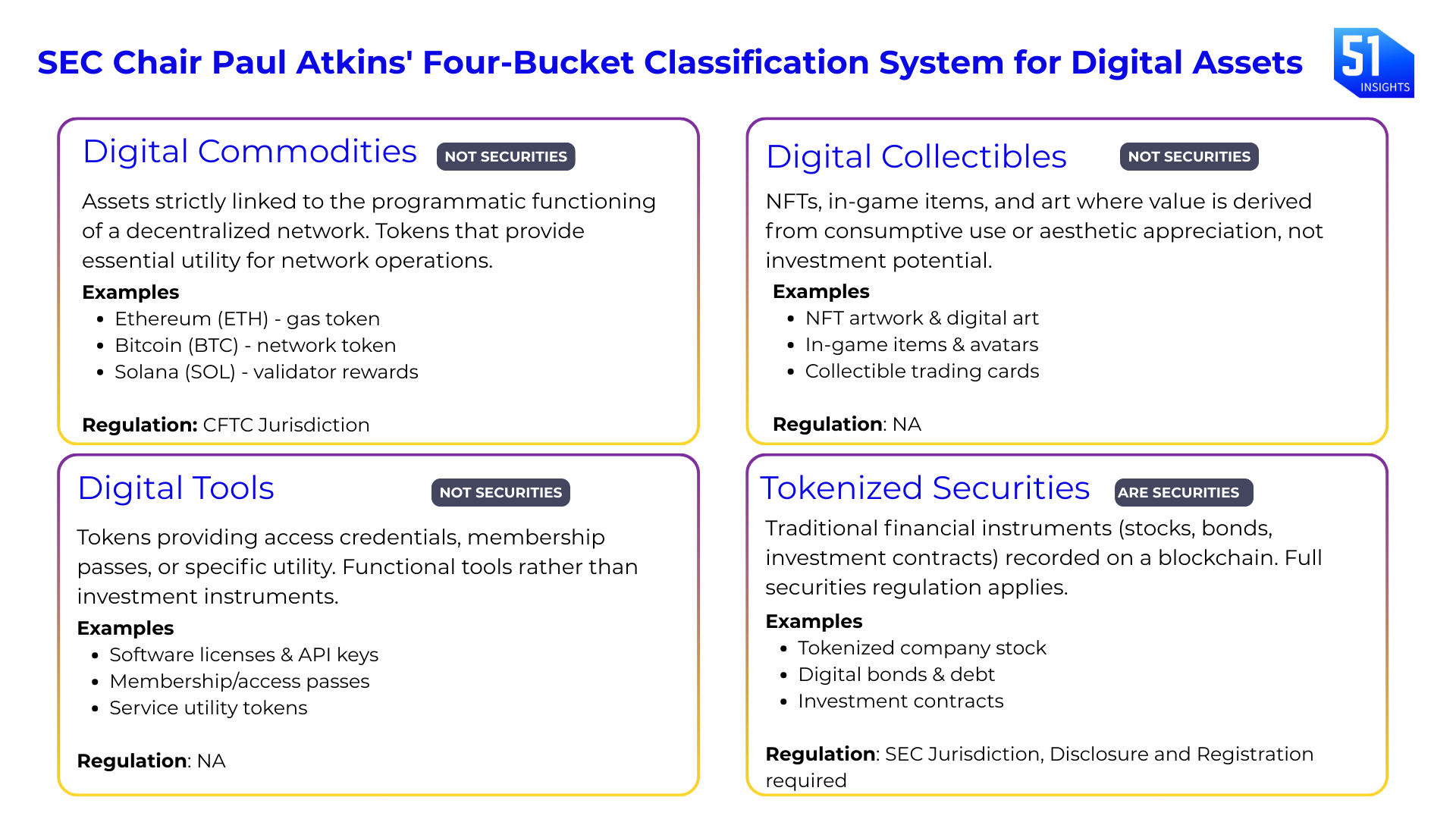
- Token Taxonomy: A four-bucket taxonomy replaces the ambiguous application of the Howey test: Digital Commodities/Network Tokens (not securities), Digital Collectibles (not securities), Digital Tools (not securities), Tokenized Securities (securities). This kills the legal ambiguity. [Analysis]
- SEC-CFTC Handover Protocol: For assets that start as securities (fundraising) and become commodities (post-decentralization), the agencies now have a formal process. You don’t get sued for changing classification midway. [Analysis]
- Innovation Exemption: The framework gives crypto and tokenization projects conditional relief from certain securities rules, allowing them to test business models under supervision. Crypto firms get a 3-year grace period to decentralize without full SEC registration, provided they disclose and bar insider trading. [Analysis]
- DTCC Tokenization Pilot: On December 11, 2025, the SEC Division of Trading and Markets granted a landmark No-Action Letter to the Depository Trust Company (DTC), permitting a 3-year pilot program to tokenize securities, specifically U.S. Treasury securities, Russell 1000 equities, and major ETFs. DTC aims to launch the pilot in the second half of 2026. [Analysis]
Traditional finance is moving onto blockchain rails. For asset managers, this means atomic settlement, intraday collateral moves, and capital freed from settlement float.
Be smart: California’s new Digital Financial Assets Law (”DFAL”) licensing requirement is set to begin on July 1, 2026. The state’s Digital Financial Assets Law requires anyone who engages in “digital financial asset business activity” with a California resident to obtain a license. Regulators are expected to promulgate final implementing regulations under GENIUS by July 18, 2026, ahead of the full January 2027 implementation deadline.
This means: Even if Congress stays deadlocked, the administrative machinery is moving. The real deadline is July.
Why it matters
- The bank lobby’s last stand: The banking industry is fighting a rear-guard action on yield. Treasury data shows $6.6T in deposits are “at risk” of flowing out of traditional banks into interest-bearing stablecoins. If a risk-free stablecoin backed by Treasuries offers 4.5% and your savings account only gives 0.1%, smart investors will take action. But here’s the asymmetry: the GENIUS Act is already law. It bans issuers (Circle) from paying yield directly. The banking lobby is now fighting to expand that ban to intermediaries (Coinbase, Kraken). That battle is happening in CLARITY. If CLARITY stalls indefinitely, which it might, issuers and platforms could continue operating in the current gray zone. The real risk: CLARITY passes with yield restrictions, killing Coinbase’s revenue model. Coinbase has already threatened to withdraw support for the broader bill.
- The executive branch is doing what Congress cannot: Atkins is moving at scale through Project Crypto without waiting for Congress. The token taxonomy? That’s unilateral. The Innovation Exemption? The SEC has the authority under existing law. The DTCC pilot? Already approved. SEC Chair Paul Atkins has stated, “My goal now is to make people feel they can build in the United States without fearing unclear regulations.“ This is the inverse of Gensler’s “sue first, define later“ doctrine. It’s clarification-first. The bet: If you build under the Innovation Exemption framework and comply with the taxonomy, you’re protected from retroactive enforcement. Firms don’t need Congress to innovate; they need to trust the SEC won’t reverse course.
- The competitive reopening: Entities with OCC national trust bank charters can now apply for direct access to the Federal Reserve Master Account, though this remains a separate hurdle involving the Federal Reserve. Banks that previously avoided crypto (JPMorgan, Goldman, BNY Mellon) can now offer custody and trading desks without regulatory retribution. The repeal of SAB 121 means banks can now custody crypto off-balance-sheet, treating it like any other custodial asset, making the economics of crypto custody viable for global banks. This is infrastructure. And infrastructure is where the money flows.
Investor Alpha
Regulation is moving. The biggest bottleneck is capital deployment.
- Long custody & settlement infrastructure. COIN (Coinbase Custody will see AUM inflows), BNY Mellon, BitGo (now a National Trust Bank with federal charter). DTCC tokenization pilot opens custody for traditional assets. 👉 Trade on Robinhood
- Long traditional banks re-entering crypto. JPM, GS, BLK can now offer crypto trading and custody desks without fear. OCC Interpretive Letter 1188 permits national banks to engage in riskless principal transactions for crypto assets, allowing banks to run crypto brokerage desks for clients without balance-sheet risk. 👉 Trade on Robinhood
- Watch legislative-dependent crypto plays. Any token or platform that depends on CLARITY Act carve-outs (DeFi front-ends, tokenized equity exchanges) faces pressure.
The firms that leverage federal charters, integrate with DTCC settlement, and build under the Innovation Exemption framework will own the 2026-2028 cycle. The ones waiting for CLARITY to pass will be late to market.
Watchlist:
- Feb 10–12: Consensus Hong Kong (CoinDesk)
- Feb 11: US CPI (Jan) release
- Feb 12: US PPI release
- Feb 12: FCA consultation on applying handbook rules to cryptoasset firms
- Feb 17–21: ETHDenver 2026
- Feb 18: FOMC minutes for Jan 27–28 meeting
- Feb: CLARITY‑style market‑structure bills and stablecoin implementation
- Q1’26: Kraken IPO window
- Q1’26: Hong Kong stablecoin licensing regime
- Q1’26: Singapore stablecoin framework launch
- Q1’26: Bitmine MAVAN (Made-in-America Validator Network) rollout
Market signals
- Hong Kong to start granting stablecoin issuer licenses in March 2026. Link
- Wall Street giant CME Group is exploring issuing its own ‘CME Coin’. Link
- Ripple Prime adds Hyperliquid. Link
That’s it for now.
Marc & Team
👉 DOWNLOAD THE PDF