Nasdaq ate crypto and called it an upgrade
Hey, it’s Marc,
Crypto promised to kill the middleman.
The middleman just hired crypto instead.
Nasdaq and Kraken are turning every Nasdaq-listed stock into a blockchain token, same CUSIP, same rules, just faster.
Through Kraken’s xStocks, NASDAQ has access to 68% of the tokenized equities market with $25B+ in transaction volume across 85,000 unique holders. [RELEASE]
The stock market is about to run 24/7. Let’s unpack.
👉PRO: Download the PDF below
 Marc Baumann
What happened
Nasdaq and Payward will co-develop an integration layer that converts existing Nasdaq-listed equities into blockchain-recorded tokens. Unlike third-party tokenized stock products (which create derivative wrappers), Nasdaq’s model uses issuer-sponsored tokens that maintain the same CUSIP identifiers1 and NBBO pricing2 obligations as their traditional counterparts. The tokens exist as records in the issuer’s official share registry. The only difference is that the record now lives on a blockchain instead of in a 1970s-era clearinghouse.
Zooming in: Right now, if you buy a stock on a Friday afternoon, you don’t actually own it until Monday. This upgrades the behind-the-scenes plumbing — clearinghouses, settlement systems, record-keeping, for tokenised stocks.
Here’s what that actually changes for you: With blockchain-recorded tokens, that entire chain collapses into minutes. Ownership transfers instantly, automatically, and with a permanent record that everyone can verify. And, all of this takes place instantly with no 2 days of waiting.
What this unlocks:
- Trade at 2am on a Saturday. Markets don’t have to close anymore. A retail investor in Tokyo and a fund manager in London can trade Apple shares at 2am on a Saturday.
- Sell today, spend today. Sell a stock today, use the proceeds today, not two days from now.
- Lower costs. Fewer intermediaries means fewer fees eating into your returns.
- $50 buys you Apple. Fractional ownership becomes easier to manage, meaning someone with $50 can own a slice of a $500 stock with the same legal protections as an institutional investor.
And critically, nothing about the stock itself changes. It’s still the same Apple share, with the same rights, the same price, the same legal protections. The only thing changing is the infrastructure underneath it.
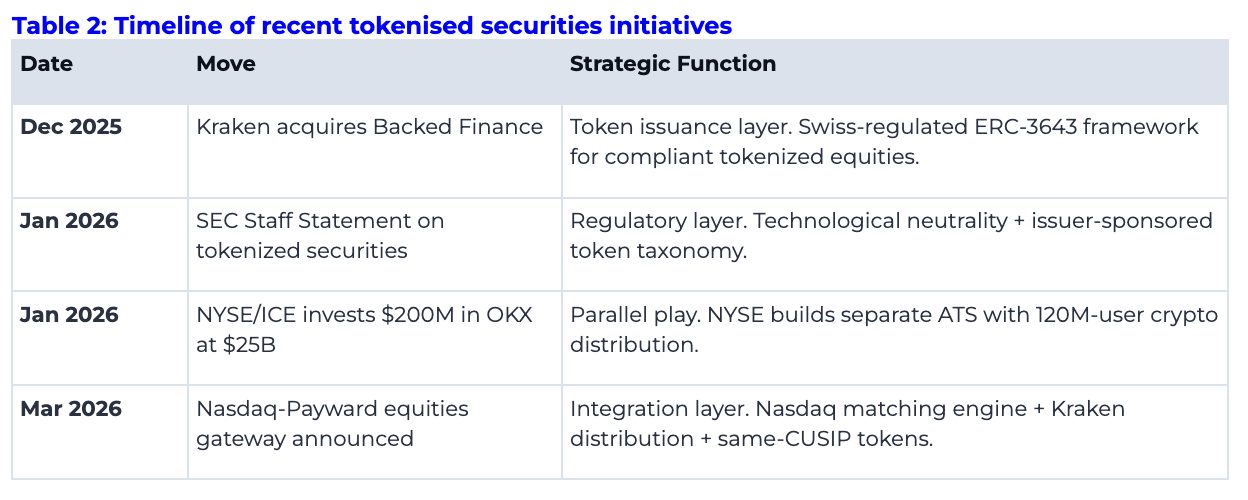
Zooming in: The partnership builds on Kraken’s acquisition of Backed Finance in December 2025, the Swiss-regulated token issuer behind the xStocks framework. Backed’s ERC-3643 permissioned smart contract architecture gives Kraken a ready-made compliance layer that satisfies European MiCA requirements. The target go-live is H1 2027.
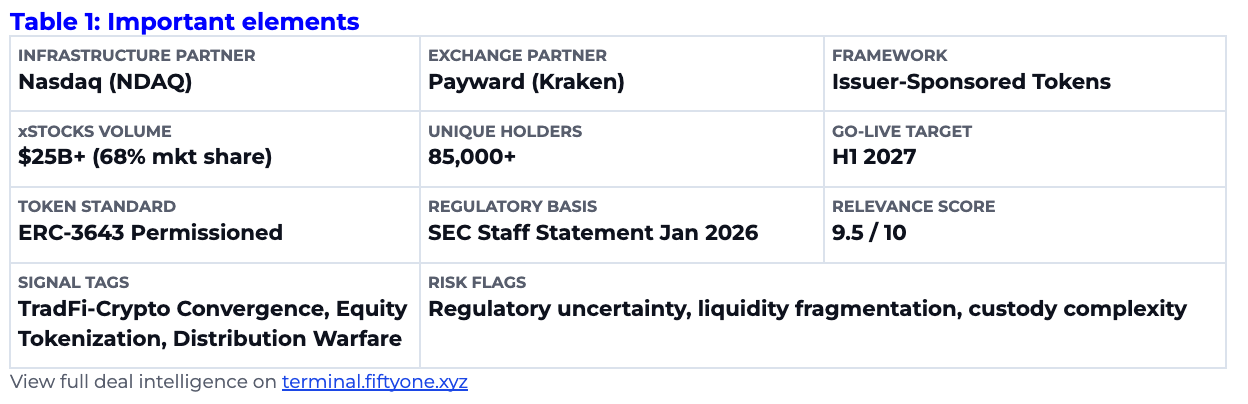
The SEC’s January 30, 2026 Staff Statement on tokenised securities provides the regulatory foundation. That statement established a taxonomy distinguishing issuer-sponsored tokens (same regulatory treatment as traditional securities) from third-party sponsored tokens (subject to additional obligations). Nasdaq’s framework targets the first category.
Two exchanges. Two bets. One is wrong
Nasdaq and NYSE are racing for the same prize: 24/7 stock trading with institutional-grade compliance. They picked opposite strategies. Nasdaq chose integration: same CUSIP, same pricing, blockchain as the record-keeper. NYSE chose separation: a $200M investment in OKX, a new venue, crypto-native infrastructure built from scratch. Nasdaq's bet says the future looks exactly like the present, just faster. NYSE says the future needs its own plumbing. One of them is wrong, and the loser writes off billions.
The SEC already chose a side
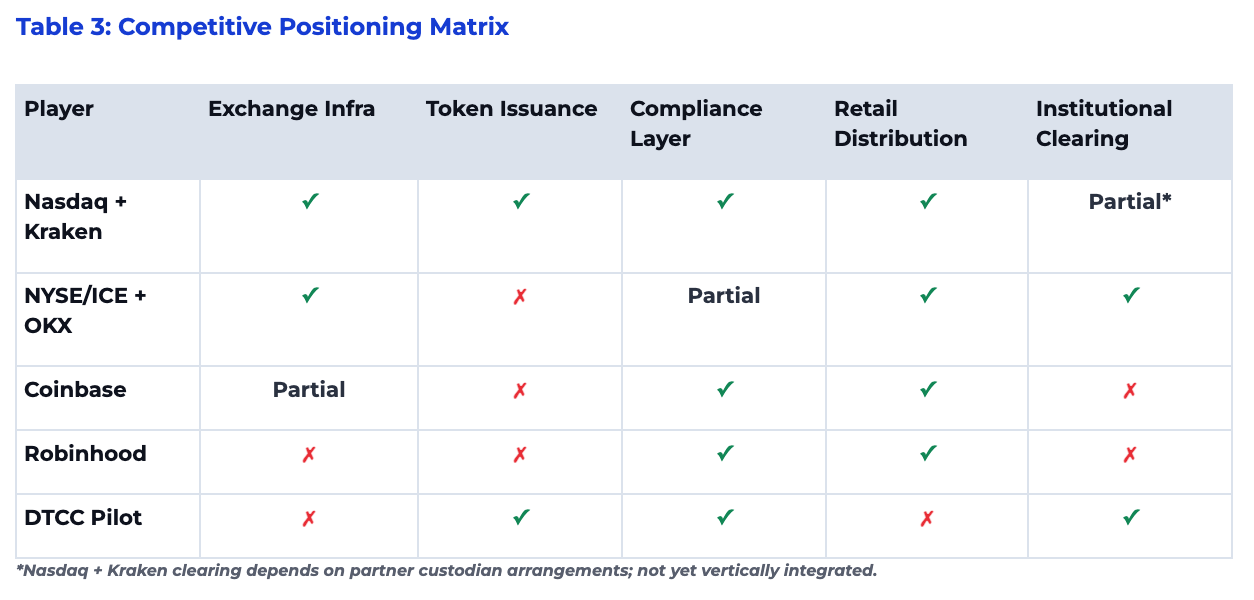
- Nasdaq’s power move.The Payward partnership is not a crypto initiative. It is an equity settlement upgrade that happens to use blockchain. That distinction matters because it removes every institutional objection: same CUSIP, same NBBO, same regulatory treatment, same share registry. The only thing that changes is the ledger.Here is why that is dangerous for everyone else. NYSE built a $200M bridge to OKX’s 120 million users. Coinbase is pitching wrapped equity products. Robinhood is exploring tokenized stock trading through its existing brokerage license. All of them are building new products. Nasdaq is making the existing product better. In financial infrastructure, the upgrade always beats the rebuild. The RWA market is projected to reach $16-20T by 2030-2033, depending on whose model you trust. Tokenized equities are the largest addressable segment within that.
- Prime brokers are the most exposed. JPMorgan’s Tokenized Collateral Network (TCN), BNY Mellon and State Street’s unified custody dashboards are survival pivots. If clients can self-custody tokenized equities and post them directly to DeFi protocols, the traditional prime brokerage fee structure collapses.
- The SEC already picked a winner. Its January 28, 2026 Staff Statement explicitly endorsed issuer-sponsored tokenization (Nasdaq’s model) and flagged SPV-wrapper structures (Robinhood’s European product) as carrying elevated credit, liquidity, and bankruptcy risk.
Investor Alpha
The tokenization super-cycle doesn’t reward the asset, it rewards the toll booth. Exchanges, custodians, oracle networks, and cross-chain messaging protocols are the compounding infrastructure plays here.
- Nasdaq (NDAQ): The gateway positions Nasdaq as the primary regulated on-ramp for tokenized U.S. equities globally, a structural upgrade to listing fees, data revenues, and market infrastructure dominance. Many investors underweight the long-term fee capture from 24/7 tokenized trading volume layered on top of existing Nasdaq matching engine economics. 👉 Trade on Robinhood
- Coinbase (COIN): Coinbase’s Base L2 network is positioned as settlement infrastructure for tokenized assets, and Coinbase Custody is the likely custodian for institutional tokenized collateral. The regulatory clarity from the SEC’s January 2026 statement accelerates institutional on-boarding directly through Coinbase’s stack. 👉 Trade on Robinhood
Watchlist:
- Mar 1–2: Crypto Expo Europe (Bucharest)
- Mar 11: US CPI (Feb) release – critical for Fed rate cut expectations
- Mar 17–18: DC Blockchain Summit (Chamber of Digital Commerce)
- Mar 18: FOMC Interest Rate Decision & Summary of Economic Projections
- Apr 28–29: FOMC meeting. Second rate decision window
- Jul 1: MiCA universal deadline
- Q1-Q2 2026: SEC final decision on Nasdaq tokenized trading rule change (SR-NASDAQ-2025-072)
- H2 2026: DTCC tokenization pilot launch
That’s it for now.
Missed last week? Access all our CEO notes here.
Marc & Team
Recommended Reads
- He ran the NYSE, now he’s putting it on a blockchain, with Michael Blaugrund, VP at ICE
- The end of the closing bell
- Kraken isn’t building a crypto exchange
- Kraken vs. PayPal vs. Revolut
- Stocks will be tokenized
- SEC & DTCC: the $100 trillion green light
- DTCC, Goldman, Citadel pick Canton: Why Wall Street chose a private blockchain
A CUSIP ID (Committee on Uniform Securities Identification Procedures) is a unique nine-character alphanumeric code assigned to North American financial securities, including stocks, bonds, and mutual funds, to facilitate, clear, and settle trades. Managed by the American Bankers Association and S&P, these codes are critical for identifying specific issuers and security types. ↩
The National Best Bid and Offer (NBBO) represents the highest bid price and lowest ask price for a security across all U.S. exchanges, designed to ensure investors receive the most favorable price. Under the SEC’s Regulation NMS (National Market System), brokers have strict obligations to prioritize these prices for customer orders. ↩