Florida's stablecoin bill
Hey, it’s Marc,
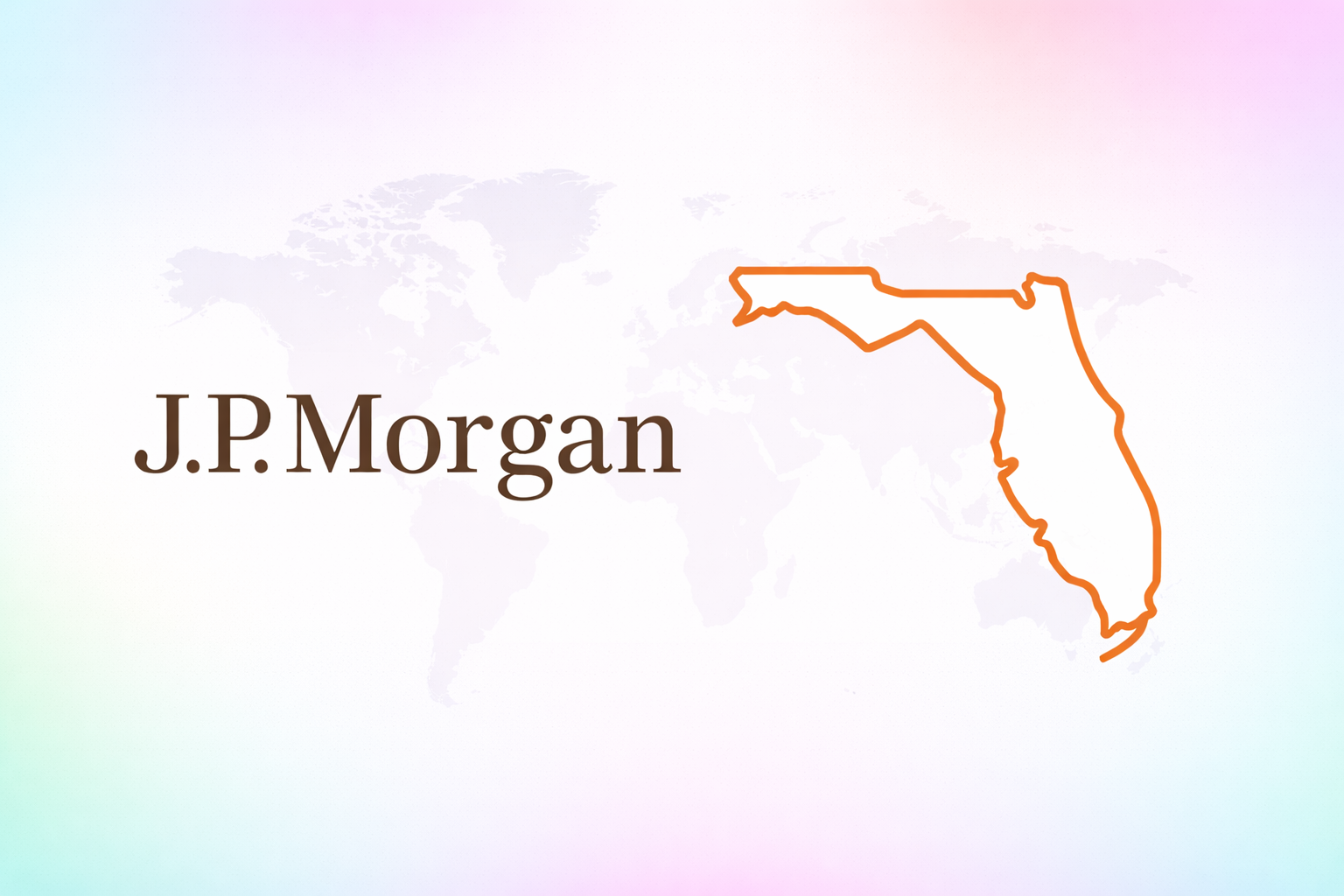
JPMorgan closed Trump’s accounts. Congress froze on crypto regulation. Whereas, Florida just built the first state-level stablecoin regulatory system in America.
And it did it unanimously.
In one legislative sprint, the state passed a stablecoin issuance framework, authorized a potential $24B+ sovereign digital asset allocation, and launched a pilot to accept crypto for state taxes. It’s a live fork of the U.S. financial system. [RELEASE]
👉PRO: Download the PDF below
Speaking of Florida… and exclusive offering for 51 readers:
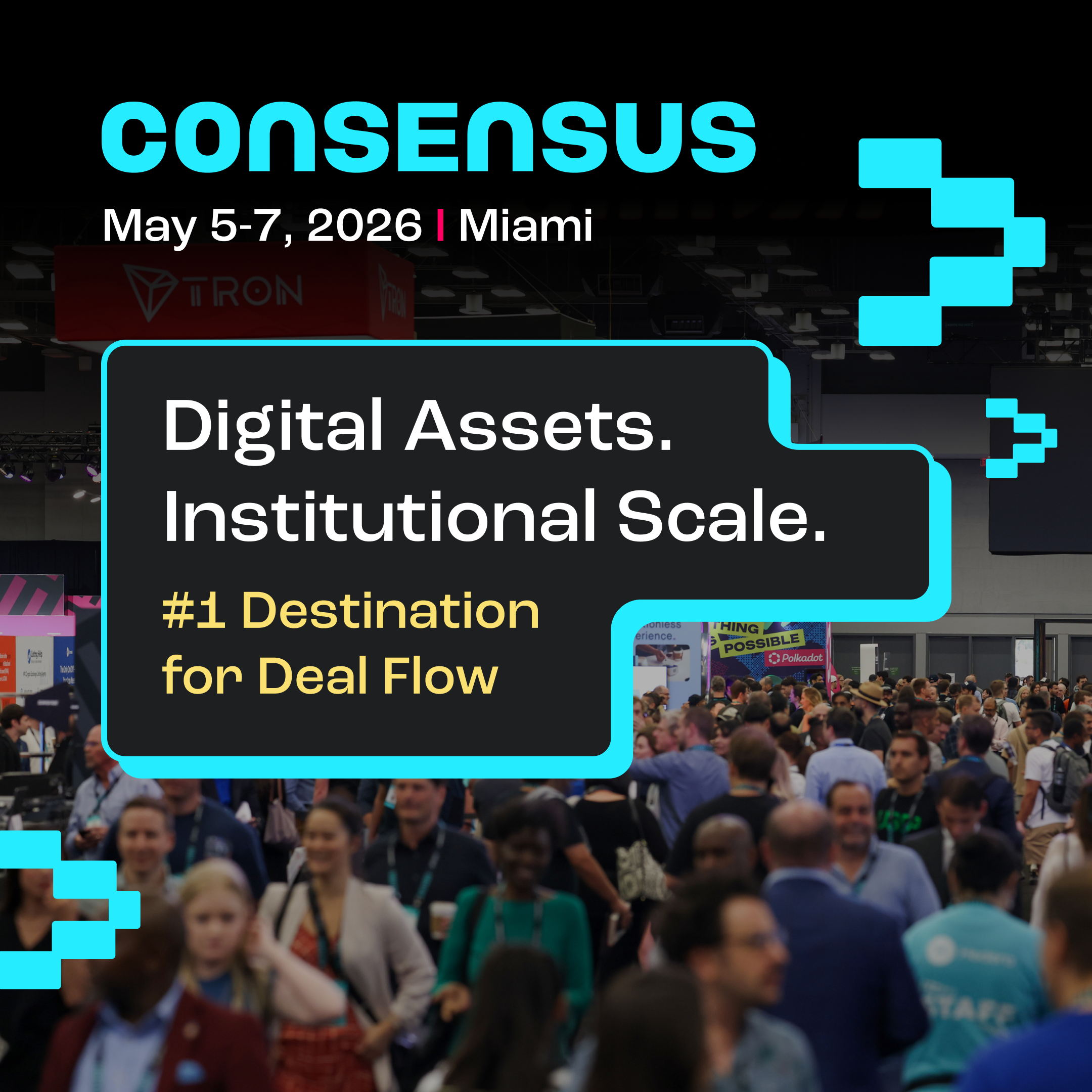
✅ Register for Consensus Miami, May 5-7, 2026, and get in the room where the people moving that money actually meet.
🎟️ 20% Discount Code: MARC
🔗 Auto-applied discount link: https://go.coindesk.com/3NLCAAd
(get up to $900 off)
I’ll be there too, and I want to meet you!
What happened
On March 6, 2026, Florida’s Senate passed SB 314 unanimously, making the state the first in the U.S. to enact a dedicated stablecoin regulatory framework. The bill amends Florida’s anti-money laundering statutes to classify stablecoins as “monetary value,” requires issuers to register with the Office of Financial Regulation (OFR), and mandates 1:1 reserves backed by cash or short-term Treasuries. Critically, qualifying stablecoins will not be classified as securities under state law.
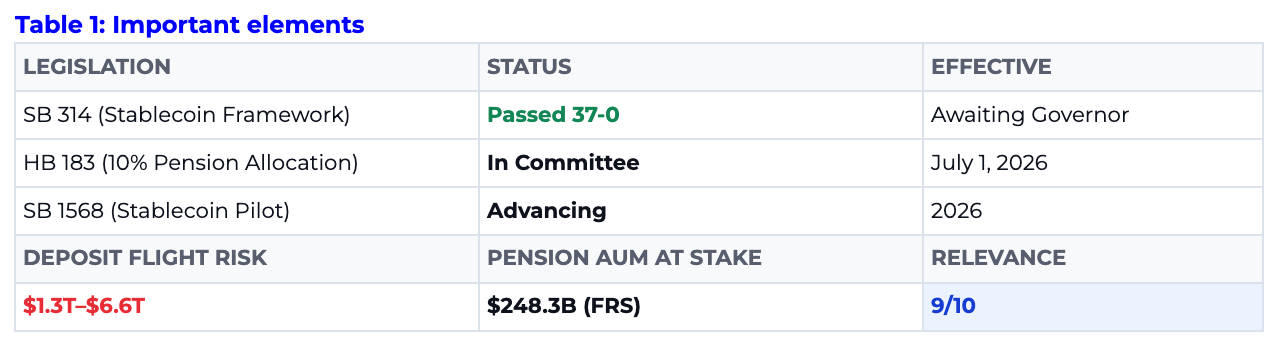
The bill creates a tiered oversight model: issuers hitting $10 billion in outstanding tokens must transition to federal oversight, unless a waiver is granted by Washington or Florida’s regime is deemed sufficiently rigorous. That waiver clause is the most important sentence in the legislation. It gives Tallahassee a permanent seat at the regulatory table, even as issuers scale to systemically important size.
Simultaneously, HB 183 would authorize the Florida State Board of Administration to allocate up to 10% of public funds, including the $225.6 billion FRS Pension Plan, into digital assets: Bitcoin, crypto ETPs, and tokenized securities. And, SB 1568 launches a stablecoin pilot program enabling Floridians to pay state taxes and licensing fees via digital wallets, with instant fiat conversion protecting the General Revenue Fund.
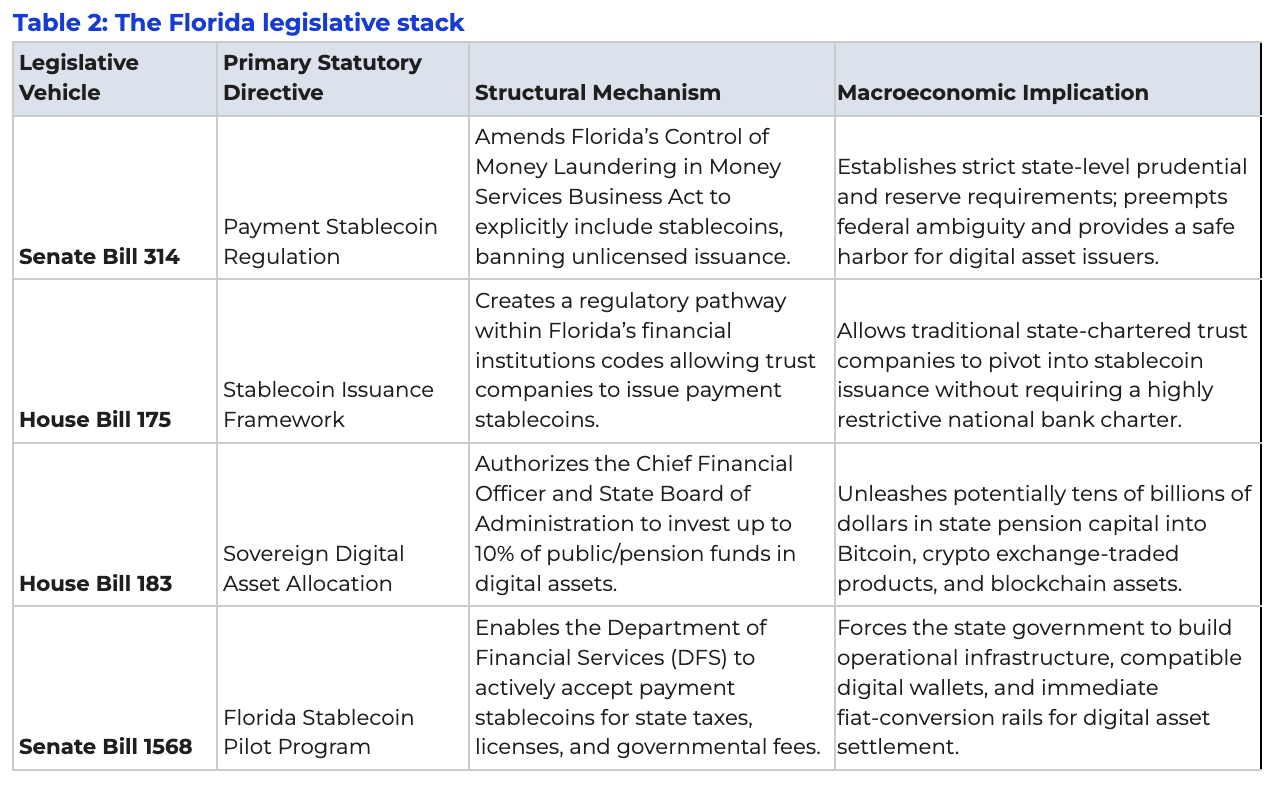
The integrated stack: Florida is not just regulating stablecoins. It is regulating them (SB 314), enabling their issuance (HB 175), capitalizing the ecosystem with sovereign money (HB 183), and building state-government payment rails to accept them (SB 1568). No other state has attempted this level of vertical integration.
Also: Circle (~$75B, 2nd highest by market cap) received conditional OCC approval for a national trust bank charter — a federal move that lets it bypass state-by-state licensing entirely, including Florida’s OFR. SB 314 anticipates this: it exempts federal-qualified issuers from state licensure.
Our opinion: If JPMorgan can cut off a president…
- The banks are terrified. The GENIUS Act, signed into law in July 2025, prohibits stablecoin issuers from paying yield directly to holders. But it left a gaping loophole: third-party platforms like Coinbase can still offer yield-like rewards on stablecoins held on their exchanges. This loophole has paralyzed the CLARITY Act in the Senate, because the banking lobby, led by the ABA and ICBA, wants it closed. The math scares them. The ICBA estimates that yield-bearing stablecoins would drain $1.3 trillion from community bank deposits and shrink local lending capacity by $850 billion. A separate Federal Reserve analysis warns the upper bound could reach $6.6 trillion. When a retail customer can hold USDC on Coinbase and earn 4–5% backed by T-bills, zero-yield checking accounts become economically irrational. Florida’s SB 314 navigates this minefield precisely. It bars issuers from paying yield if federal law prohibits it, maintaining compliance while positioning the state to pivot instantly if restrictions are lifted.
- The $5B lawsuit. In January 2026, Trump sued JPMorgan Chase for $5B in Florida state court, alleging his business accounts were closed for political reasons post-January 6 with just 60 days’ notice. JPMorgan says accounts are cut for regulatory risk, not politics. The legal outcome is irrelevant. The signal is not: if the largest U.S. bank can unilaterally terminate the accounts of a former president, no institutional treasury is safe from the same treatment. It’s counterparty risk. Florida’s regulatory embrace of permissionless stablecoin rails is the direct institutional hedge.
- Florida is competing with Washington, not waiting for it. Most analysts frame SB 314 as a complement to federal law. It is not. Florida’s waiver clause, allowing issuers above $10 billion to stay under state oversight if Tallahassee’s regime passes muster, creates direct jurisdictional competition with the OCC and federal regulators. Circle already has conditional OCC approval for a national trust bank charter. That federal charter bypasses state-by-state money transmitter licensing entirely. If Florida and other states don’t offer competitive, streamlined frameworks, every major issuer defaults to federal charters, permanently draining states of regulatory oversight, tech innovation, and fee revenue. SB 314 is as much a defensive economic play as a regulatory one.
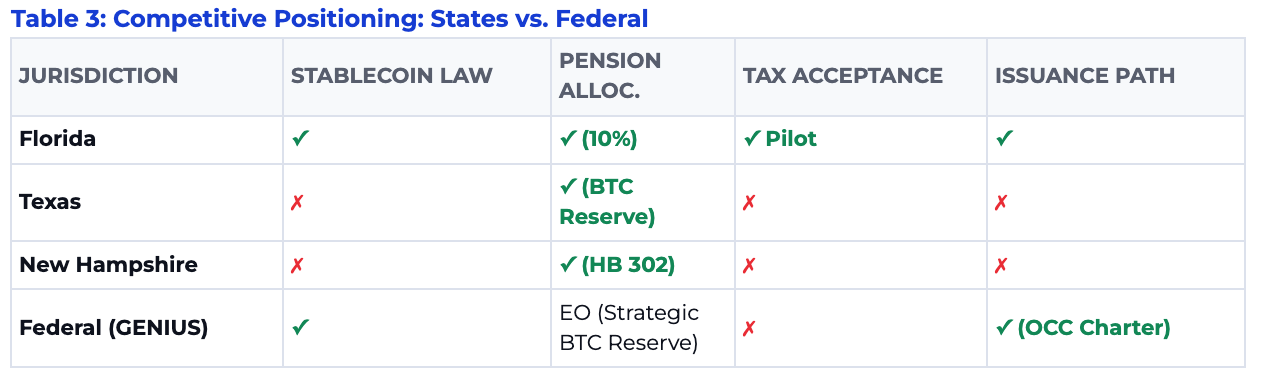
What Tallahassee passed in March 2026 is the most vertically integrated state-level digital asset strategy in U.S. history with issuance, regulation, government adoption and four bills.
Investor Alpha
- Circle (CRCL): OCC trust charter approval positions USDC as the only stablecoin that can be held as a clean cash equivalent on a public company balance sheet. Florida’s framework accelerates institutional onboarding. 👉 Trade on Robinhood
- Bitcoin (BTC): 16 U.S. states have now introduced strategic reserve legislation. Texas already has SB 21. Florida’s HB 183 takes effect July 1, 2026. If even 5% of the Florida Retirement System’s $248B moves in, that’s ~$12B in sovereign capital entering a ~$1.9T market. 👉 Trade on Robinhood
Watchlist:
- Mar 1–2: Crypto Expo Europe (Bucharest)
- Mar 11: US CPI (Feb) release – critical for Fed rate cut expectations
- Mar 17–18: DC Blockchain Summit (Chamber of Digital Commerce)
- Mar 18: FOMC Interest Rate Decision & Summary of Economic Projections
- Apr 28–29: FOMC meeting. Second rate decision window
- Jul 1: MiCA universal deadline
- Q1-Q2 2026: SEC final decision on Nasdaq tokenized trading rule change (SR-NASDAQ-2025-072)
- H2 2026: DTCC tokenization pilot launch
That’s it for now.
Missed last week? Access all our CEO notes here.
Marc & Team