Crypto's $2.1B Custody IPO
Hey, it’s Marc,
Crypto custody has come a long way from scribbled seed phrases and anonymous exchanges. Today, it’s a multi‑billion‑dollar institutional industry led by players like BitGo, which now safeguards over $100 billion in digital assets.
BitGo just accomplished what few thought possible on Wall Street: becoming a $2.1 billion federally chartered custody bank and now, with its $212.8 million IPO last week, it’s taking crypto infrastructure into the institutional era. This isn’t just a crypto company anymore; it’s a custody powerhouse built for Wall Street. [PRESS RELEASE]
When Goldman Sachs and Citigroup lead your underwriting, the only question left is: which infrastructure play captures the $10T tokenization wave? Let’s unpack.
👉PRO: Download the PDF
What happened
On Jan 22, BitGo Holdings (NYSE: BTGO) successfully priced its initial public offering of 11.8M Class A shares at $18.00 per share, beating the marketed range of $15-$17 according to reports and closed its first day of trading at $18.68 per share, just above its IPO price.
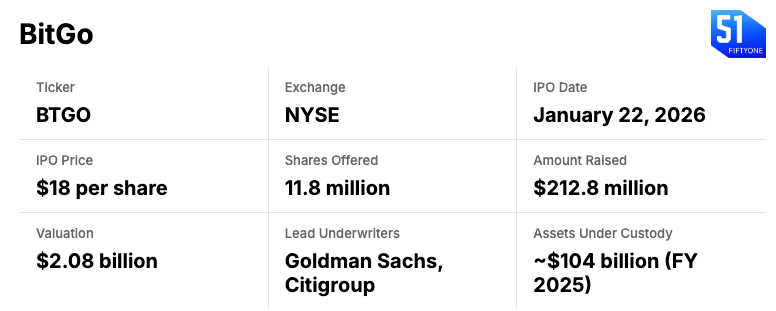
The offering raised approximately $212.8M , with only 6.7% of the IPO’s shares being sold by existing stockholders. Goldman Sachs and Citigroup as lead underwriters.
Zooming in: This pure-play custody debut values BitGo at $2.6B on close, with 94.9M shares out, 46.8M float. Custody and staking now make up roughly 60–80% of BitGo’s real economic revenue, and most of that is steady, fee-based income on assets under custody.
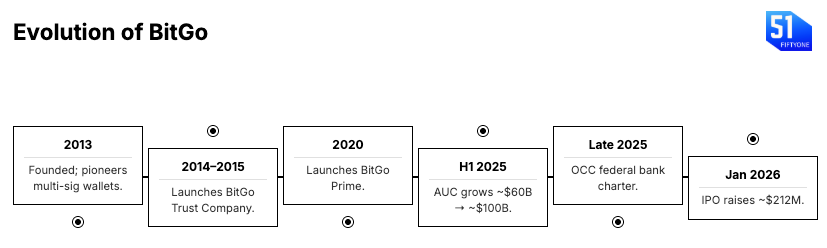
Stepping back: Over the past decade, BitGo has evolved from a 2013 multi‑sig wallet startup into a full‑stack institutional platform, adding trust‑company status, prime services, and ultimately transforming into a federally chartered, publicly listed digital asset bank that safeguards over $102B in crypto assets for institutions.
BitGo advantage: BitGo combines a decade‑long track record, support for 1,500+ assets, and its Go Network settlement rails which keep assets in qualified cold custody while enabling 24/7, off‑exchange, delivery‑versus‑payment settlement across USD and digital assets making it uniquely suited for complex altcoin and DeFi strategies for institutions.
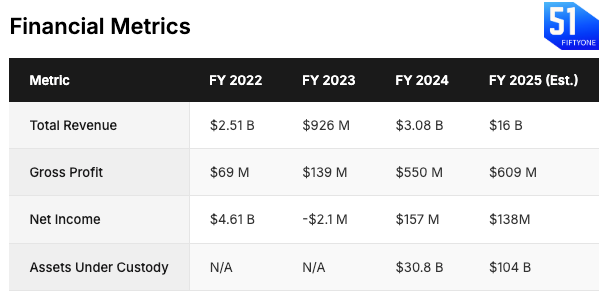
By the numbers: BitGo’s $16B revenue figure represents the gross transaction volume of its agency trades as mandated by GAAP ASC 6061, whereas its actual core economic revenue from high-margin services like custody, staking, and subscriptions is estimated at ~$170M. The net margin has compressed from 2.76% in early 2024 to 0.30% in the first half of 2025 because of aggressive scaling that is reflected in Assets Under Custody (AUC) and when measured against its core economic revenue of ~$170 million, the normalized EBITDA margin is approximately 7.4%.
First mover in 2026: BitGo is the first crypto IPO of the year, serving as a litmus test for a pipeline that includes Kraken (targeting Q1 2026 at a $20B valuation), Grayscale, and potentially Ripple.
Why it matters
The OCC charter is the real moat. BitGo’s national bank status eliminates 50 state money transmitter licenses and replaces them with a single federal supervisor. The Office of the Comptroller of the Currency (OCC)2 approval places BitGo under the same capital adequacy, cybersecurity, and fiduciary standards as traditional national banks. Traditional custodians like BNY Mellon and State Street operate across jurisdictions with fragmented compliance frameworks. BitGo doesn’t. The regulatory arbitrage is worth $100M+ in annual compliance overhead savings, which flows directly to margin and opens Institutional access many of whom can only allocate to custodians that meet fiduciary‑grade, federally supervised standards.
Assets Under Custody (AUC) as the North Star. BitGo managed $104B in AUC by end-2025, up 237% from $30.8B in 2024. This matters because:
Each dollar of AUC3 generates recurring fee income (~$160-170M annually) regardless of token price
The 20-30% market share in institutional custody is defensible
A zero-loss security record across 12 years = brand moat
The IPO valuation of $2.1B implies roughly 12-14x revenue multiples on core economic revenue ($160-170M). That’s a premium versus Coinbase (7-8x on core, but more correlated to volatility).
The DeFi Inflection Point. For years, the institutional have to choose: safety (cold storage, 0% yield) or growth (DeFi, high risk). BitGo just broke the trade-off. Through the Go Network and WalletConnect, institutions can now stake, swap, and vote directly on-chain while leveraging Go Network for security. This changes the game. BitGo is no longer just a passive vault; it is a productive gateway. The OCC charter provides the “sovereign air cover” needed to move billions of dormant capital off the sidelines and into on-chain yield.
Tokenization Unified Asset Hub. As traditional financial instruments, including U.S. equities, real estate, and private credit, migrate to public blockchains, BitGo provides the critical infrastructure to manage these diverse portfolios. By consolidating traditional assets and digital-native ones onto a single, federally chartered platform, BitGo eliminates “vendor sprawl” and the fragmented compliance risks that previously forced institutions to juggle multiple custodians. This creates a seamless “all-in-one” workflow where tokenized RWA holdings benefit from the same institutional-grade security, 24/7 DeFi composability, and atomic settlement as Bitcoin, effectively making BitGo the central operating system for the $10T tokenization wave.
Our view
If you think digital assets and tokenized securities will exist in size, you are implicitly long custody. BitGo’s IPO is your first liquid way in 2026 to express that view directly, not through exchanges or proxy trades. The risk isn’t that custody disappears. It’s that you wait until after the market has already priced in “how valuable” this plumbing really is.
Investor Alpha
The market is currently pricing crypto equities based on their correlation to Bitcoin’s price. This is lazy. The smart money differentiates between “casinos” (exchanges reliant on retail volume) and “vaults” (custodians reliant on sticky institutional assets). BitGo is a pure-play on the institutionalization of the asset class. The alpha here is in the boring, sticky nature of custody. Once a $10B fund integrates BitGo’s cold storage, they aren’t leaving because of a 30% dip in BTC.
- Long BitGo (BTGO): This is the “picks and shovels” play for the 2026 cycle. You are buying the landlord of the crypto economy. With the OCC charter, they are the default choice for the next wave of ETF issuers and conservative endowments. 👉 Trade it on Gate or Coinbase.
- Long DeFi Primitives (UNI, AAVE, LDO): As the “security and compliance” bottleneck gets solved, the floodgates are open for institutional capital to move beyond simple custody and into on-chain yield. The blue-chip DeFi primitives like Uniswap, Aave, and Lido are primed for an explosive expansion in both Total Value Locked (TVL) and protocol revenue. 👉 Trade it on Gate or Coinbase.
Watchlist:
- Jan 28: Fed FOMC meeting
- Jan 29: SEC-CFTC joint event
- Jan: SEC Crypto Innovation Exemption window
- Jan: Spot crypto ETF decisions for altcoins
- Feb 2: Bank of Japan (BoJ) Summary of Opinions (Jan meeting)
- Feb 4–5: ECB Governing Council monetary policy meeting
- Feb 5–6: Digital Assets Forum 2026, London
- Feb 9: Liquidity Summit 2026, Hong Kong
- Feb 10–12: Consensus Hong Kong (CoinDesk)
- Feb 11: US CPI (Jan) release
- Feb 12: US PPI release
- Feb 17–21: ETHDenver 2026
- Feb 18: FOMC minutes for Jan 27–28 meeting
- Q1’26: Kraken IPO window
- Q1’26: Hong Kong stablecoin licensing regime
- Q1’26: Singapore stablecoin framework launch
- Q1’26: Bitmine MAVAN (Made-in-America Validator Network) rollout
Market signals
- Revolut scraps US merger plans in favour of push for standalone licence. Link
- Ethereum treasury firm ETHZilla ETHZ 0.00%↑ purchased two jet engines for $12.2M. Link
- Binance and OKX will introduce tokenised U.S. stock products. Link
- Ondo launches tokenized stocks on SOL. Link
- BitGo raises $213m in IPO, $2b+ valuation. Link
- US M2 supply hits $22.3T. Link
That’s it for now.
Marc & Team
US GAAP ASC 606 is the core accounting standard from the Financial Accounting Standards Board (FASB) (FASB) that provides a universal, principles-based framework for recognizing revenue from customer contracts, replacing older, inconsistent rules by focusing on the transfer of control of goods or services to the customer. ↩
An OCC charter (.gov) is a federal license issued by the Office of the Comptroller of the Currency (OCC) that allows financial institutions to operate as national banks or federal savings associations ↩
Assets Under Custody (AUC) refers to the total market value of financial assets (securities, cash) that a financial institution, such as a bank, holds in safekeeping on behalf of its clients. ↩