

who owns the agent economy?
Hey, it’s Marc,
The entire $10T global commerce stack was engineered for humans with credit and debit cards. Apple and Google have been extracting a 30% tax on the internet simply by owning the checkout screen for digital goods.
But, the next generation of consumers are not going to use screens or interfaces at all. We just entered the “Silent Economic Singularity.” AI agents now observe, reason, and crucially spend money autonomously. And, Stripe is building for them, combining stablecoins with AI agents with the Machine Payment Protocol. [RELEASE]
The Signal: The traditional App Store tollbooth is collapsing. The execution layer of the internet is shifting from human interfaces to machine-to-machine APIs. Stripe’s MPP is not the only one framework for A2A (agent to agent) payments. OpenAI and Google have been building separate frameworks: ACP and UCP simultaneously.
👉PRO: Download the PDF Reprot below
 Marc Baumann
🚀 Build credibility. Drive pipeline. Win in digital assets. We produce institutional-grade research that positions you as the authority in your category, then distribute it to 100,000+ decision-makers who act on what we publish. Let’s talk.

What happened
On March 18, 2026, Stripe and Tempo co-released the Machine Payments Protocol, an open specification for machine-to-machine payments. Simultaneously, Tempo launched its mainnet, a purpose-built blockchain backed by $500 million from Paradigm, Thrive Capital, and other investors at a $5 billion valuation. [RELEASE]
It revives the dormant HTTP 402 “Payment Required” code: an agent requests a resource, receives a payment prompt, pays cryptographically, and unlocks access in milliseconds.
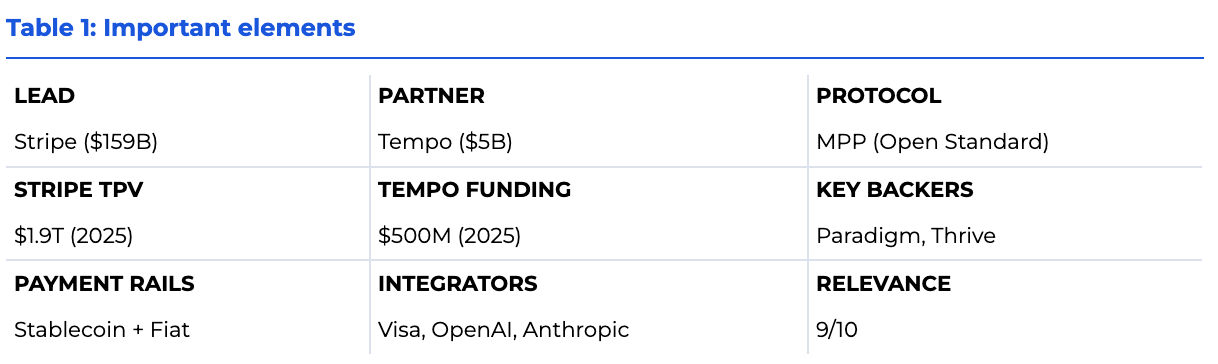
Zooming in: MPP supports both fiat and crypto. Stripe’s Shared Payment Tokens (SPTs) let agents pay via Visa, Mastercard, or BNPL on a user’s behalf, without exposing card data. Tempo settles the stablecoin leg with sub-second finality and tens of thousands of TPS. Early live deployments include Browserbase (cloud compute), PostalForm (AI-to-physical mail), and Prospect Butcher Co. in New York City, which now accepts sandwich orders from AI agents.
Competitive landscape
The agent payment landscape in 2026 is converging around three distinct but complementary layers.
- Payment rail layer: Stripe’s MPP and Coinbase’s x402. Low-level primitives for actually moving money between machines, with MPP covering both fiat and stablecoins at 100k+ TPS via session-based authorization, and x402 embedding sub-cent USDC payments directly into HTTP requests
- Trust and authorization layer: Google AP2, Visa Trusted Agent Protocol, and Mastercard Agent Pay. They don’t move money themselves but define who an agent is, what it’s allowed to spend, and how that mandate is cryptographically signed and revoked.
- Commerce layer: OpenAI ACP and Google UCP. They handle product discovery, checkout UX, merchant-of-record rules, and the structured negotiation between a buying agent and a selling service.
In practice, these layers stack rather than compete: a transaction might use AP2 mandates to authorize an agent, MPP to settle the payment, and ACP or UCP to structure the commerce interaction around it, which is why Stripe, Google, Visa, Mastercard, and OpenAI are all listed as design partners on each other’s protocols.
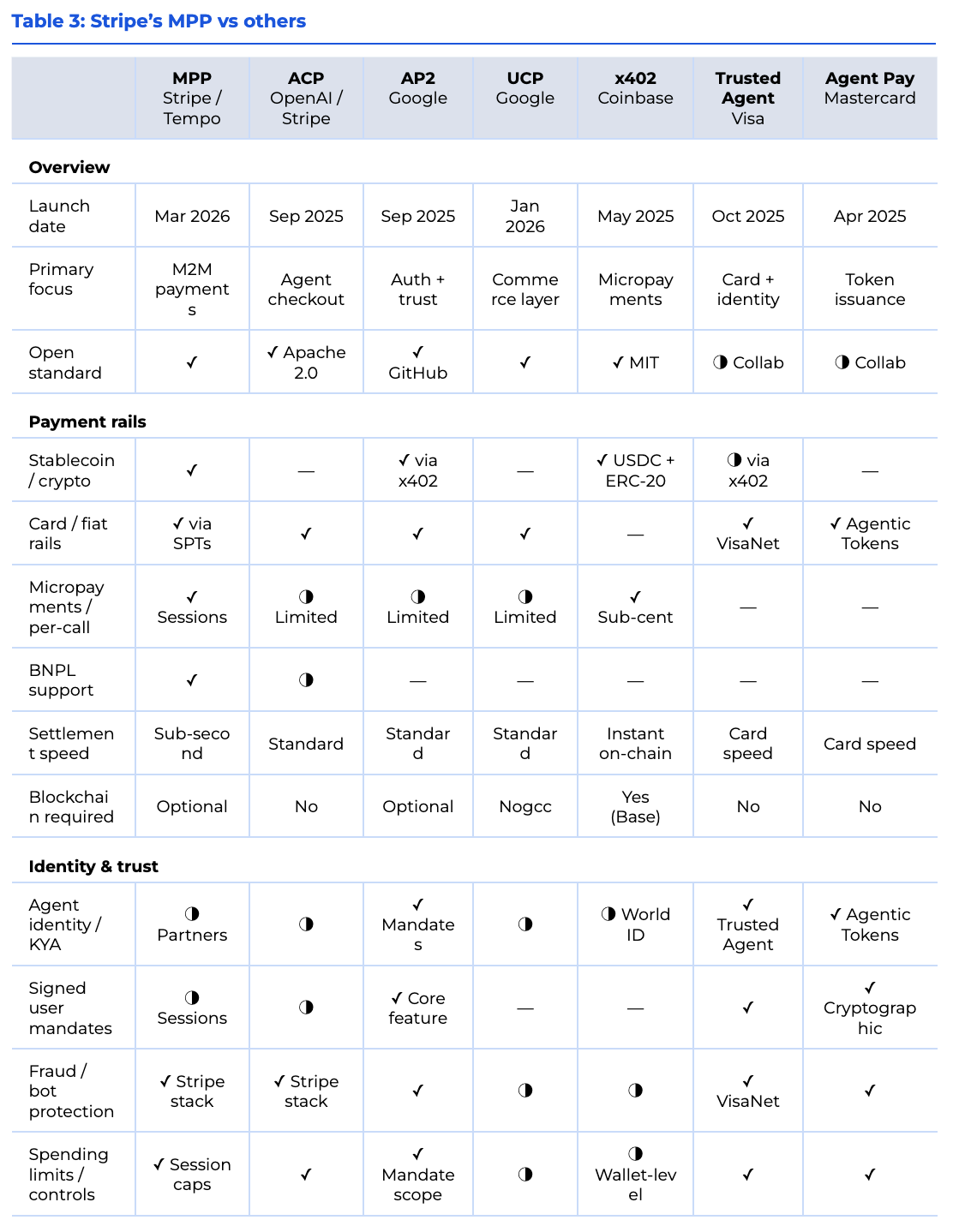
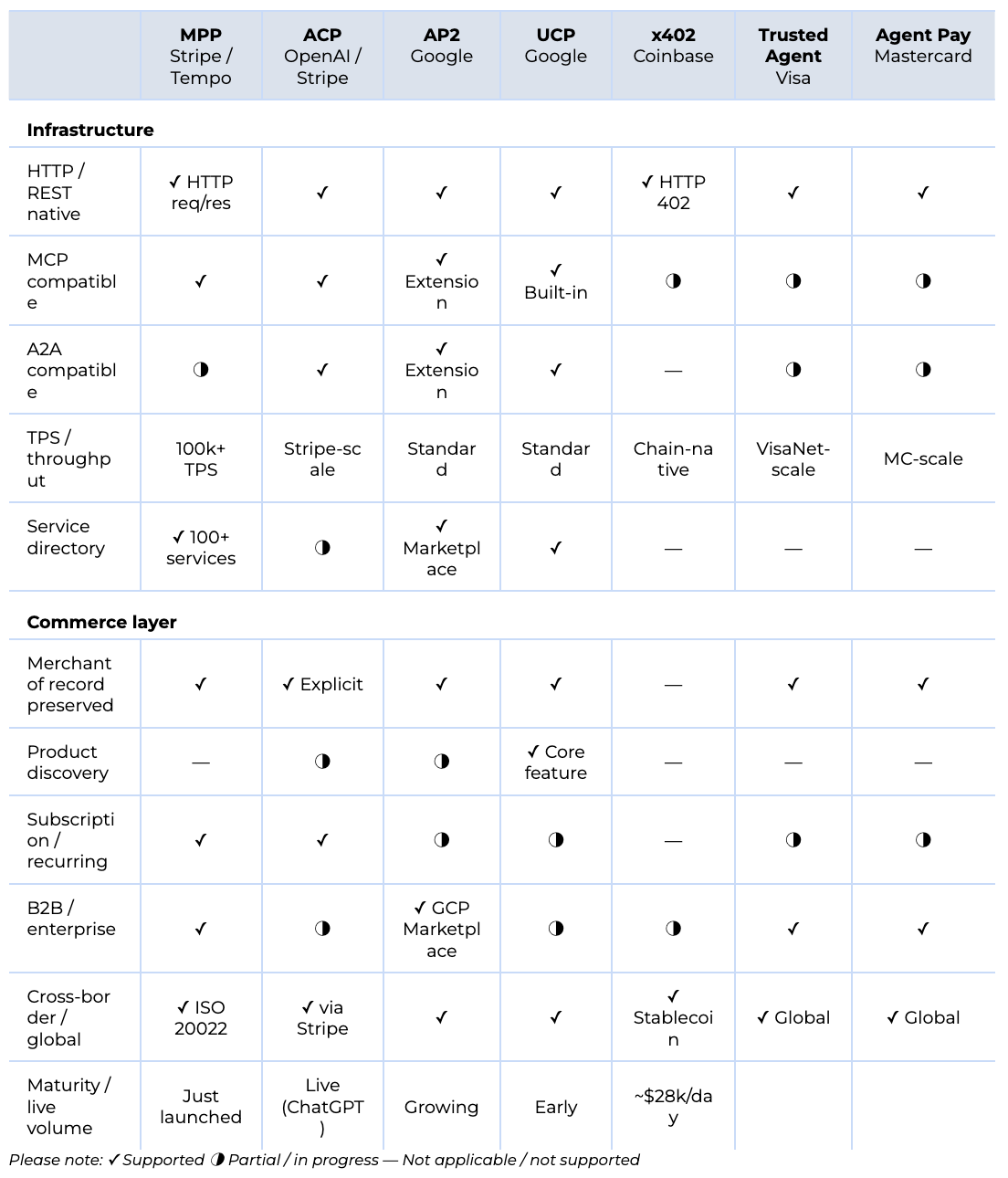
The most likely outcome is a split: regulated commerce stays on card rails, while machine-to-machine payments; agents hiring agents, paying per API call, buying compute on demand, migrate to stablecoins because the economics demand it.
3 things you should know
- Stripe controls both sides of the ledger. Most agent payment protocols pick a lane. Coinbase’s x402 is crypto-native. Mastercard’s Agent Pay is card-native. Stripe’s MPP accepts both stablecoins and fiat (cards, BNPL) through a single integration. This is the critical difference. Stripe doesn’t force merchants or agent developers to choose a rail. It abstracts the payment method entirely.
- Visa’s involvement is the signal. Visa helped write the specification for how agents pay with credit and debit cards. When a card network co-authors an open standard that also supports stablecoins, it tells you something: the incumbents see agent payments as an existential channel, not an experiment. Mastercard, Anthropic, OpenAI, and Shopify are also on the integrator list. This is the broadest coalition any agent payment protocol has assembled to date. And, Visa itself has Visa Intelligent Commerce that enables AI agents to securely make payments on behalf of consumers. This provides a secure, card‑backed payment rail and tokenization layer to Stripe’s MPP.
- The real competition is with HTTP 402. Right now, from Stripe to Coinbase, all are in the same boat. The HTTP 402 status code (”Payment Required”) has been reserved since 1997. It was never implemented. Now two competing standards want to own it: Coinbase’s x402 and Stripe’s MPP. Both use the same HTTP handshake pattern. But x402 processes roughly $28,000 in daily on-chain volume, much of it from testing. MPP launches with Stripe’s $1.9 trillion annual payment volume as its distribution backbone. So, the market needs to be captured but the technology is complementing each other in the agent economy.
Investor alpha
The agentic commerce buildout favors infrastructure over application bets. Alpha lives in the picks-and-shovels layer: settlement rails, wallets, compliance middleware, and the banks that rewire for programmable money.
- Stripe (Private): At $159B valuation, Stripe is pricing in dominant payment processing. MPP and the agentic commerce stack represent upside that secondary market pricing hasn’t fully absorbed. Every agent transaction on MPP feeds Stripe’s core revenue flywheel.
- V (Visa, NYSE): Visa’s co-authorship (built a card-native extension) of MPP (Machine Payment Protocol) protects the card network’s relevance in agent commerce. Cards remain the funded instrument for most consumer-authorized agent purchases. Visa wins as long as fiat rails stay in the mix. 👉 Trade on Robinhood
- Coinbase (COIN): x402 is becoming the permissionless M2M (Machine-to-Machine) payment standard, and Base is where most of it clears. More agentic volume means more Base gas, more USDC demand (co-issued by Coinbase), and more custody revenue. This is structural, not cyclical.👉 Trade on Robinhood
- Adyen (ADYEN.NA): Stripe’s MPP is private. For public-market exposure to the enterprise agentic standard, Adyen is a core design partner in Google’s AP2 consortium and already processes institutional cross-border flows. If AP2 becomes the B2B backbone, Adyen is inside the plumbing.
Our take
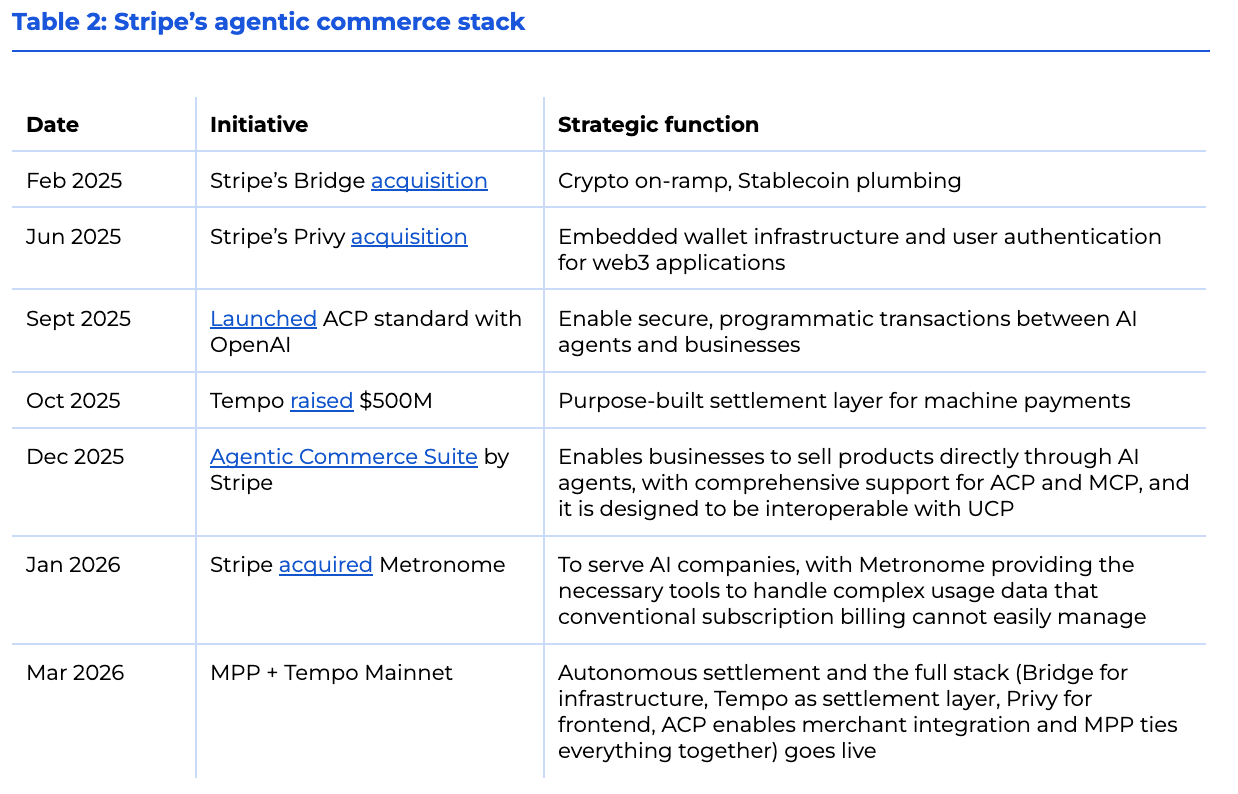
Stripe is the only company right now that checks all the boxes: crypto rail, fiat rail, merchant base, AI protocol (both payment rails and commerce), Web3 interface (Privy), AI billing (Metronome), trust bank charter (Bridge) and blockchain (Tempo). It’s Stripe’s bid to become the default financial infrastructure for the agent economy, the same way it became the default for human e-commerce. This will compound if Stripe goes public in 2026.
The agent economy TAM is enormous. McKinsey projects $3-5T in agentic commerce revenue by 2030. The AI agents market is expected to hit $52.6B by 2030. But, this will be driven by companies owning the payment layer. And, we need to keep an eye on Circle as well with its Arc blockchain and USDC nanopayments.
Watchlist:
- Mar 18: FOMC Interest Rate Decision & Summary of Economic Projections
- Apr 28–29: FOMC meeting. Second rate decision window
- May 5-7: Consensus Miami
- Jul 1: MiCA universal deadline
- Q1-Q2 2026: SEC final decision on Nasdaq tokenized trading rule change (SR-NASDAQ-2025-072)
- H2 2026: DTCC tokenization pilot launch
That’s it for now.
Missed last week? Access all our CEO notes here.
Marc & Team