

Google kills the checkout
Hey, it’s Marc.
Since my post on Google’s “AI shopping” went viral, we decided to go deeper.
Google just nuked the $5.5T e-commerce stack:
Last week, Google didn't just streamline checkout, they eliminated it entirely. Their new "agentic checkout" lets AI bots shop and buy for humans without ever visiting merchant websites. Search, discover, buy, done. All from Google.
Remember when Amazon's 1-Click was revolutionary? This is on a whole other level.
And Wall Street noticed: Shopify dropped 5% within hours of the announcement.
We're witnessing the quiet assassination of the entire e-commerce stack.
What happened: Google's Gemini 2.5 now handles the entire shopping journey—from discovery to checkout—without you ever leaving search or visiting a retailer's website. The system can track prices, negotiate on your behalf, and complete purchases using Google Pay, all while you're doing something else entirely.
Zooming in: Online agents are already shopping for people. Google’s AI Mode can answer complex queries (“bags for rainy trips in Portland”) by fanning out searches, then shows products and “track price” options. Tap “Buy for me,” and Google will load your chosen item into the merchant cart and pay via Google Pay.
At the same time, Visa, Mastercard (and even PayPal/ Perplexity) have launched tokenised AI‑payment APIs (Visa’s Intelligent Commerce, Mastercard’s Agent Pay) so bots can pay with your cards after you consent. Amazon is quietly piloting its own “Buy for Me” agent in-app.
Why it matters: The $5.5T e-commerce industry just discovered its customers might not need them anymore.
We help teams like Avalanche, Near, and MoonPay turn complex products into compelling narratives – strategic research to earn institutional trust and drive deal flow. Curious how it could work for you?
From automation to elimination
Everyone’s framing this as an automation story. They’re wrong.
Yes, AI agents can complete checkouts, scan barcodes, and replace cashiers. But that’s missing the real shift. What’s happening now is work is being removed from the consumer journey entirely — not just streamlined.
Retail has spent two decades optimizing checkout. 1-click orders. Fast lanes. Mobile wallets. But all of that still assumes the shopper is doing something — searching, comparing, clicking.
Now, AI flips the script. Instead of speeding you through the funnel, it collapses the funnel altogether.
AI isn't helping you shop. It's shopping.
👉 AI operator? Subscribe to our newsletter & join 30k+ others
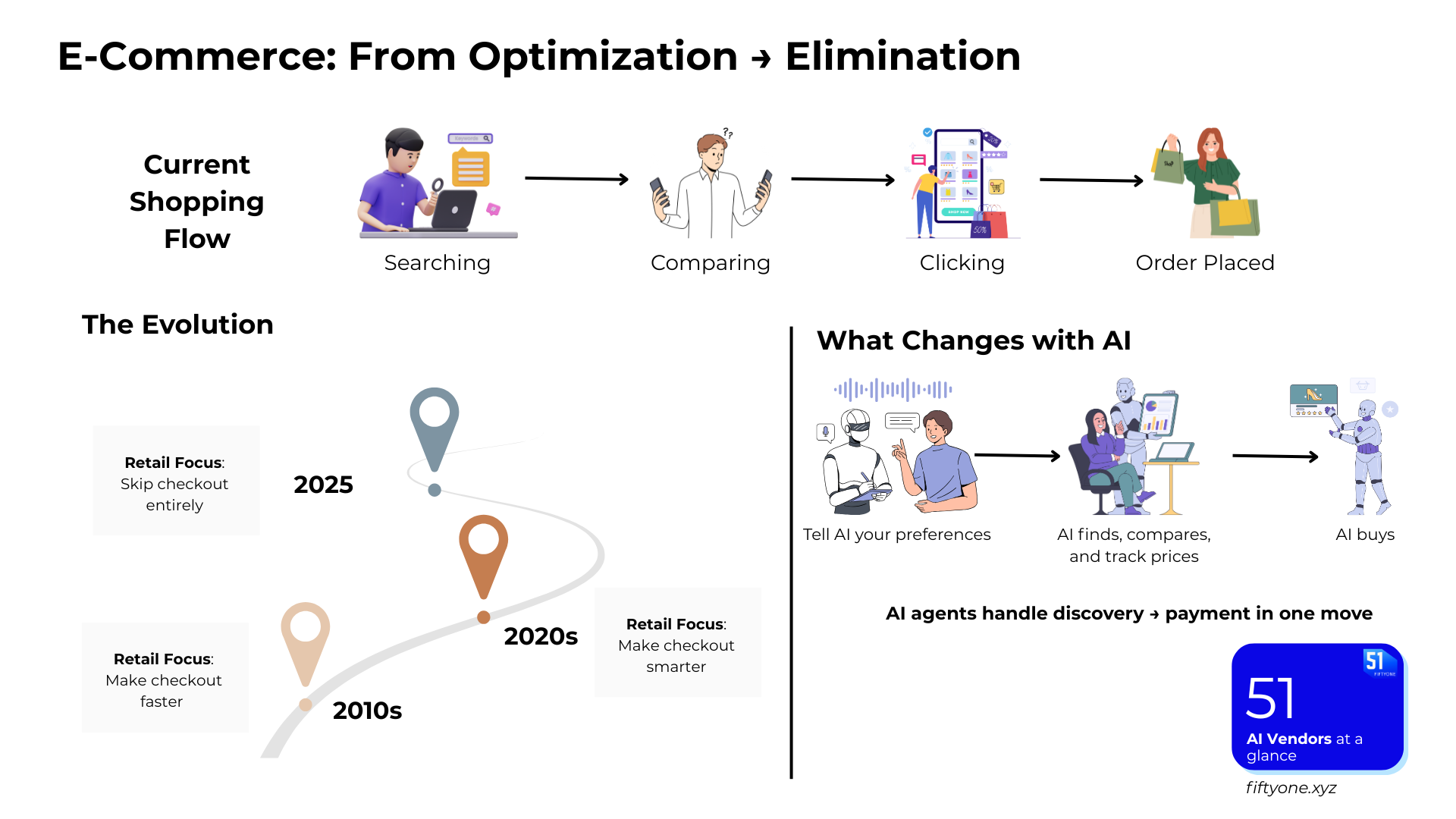
Think about it: If AI handles discovery, comparison, and purchase—what exactly do brands, checkout pages, and even platforms like Shopify actually do? Google's Shopping Graph contains over 50B product listings that refresh every hour, making it the world's largest, most current product database. When the AI has perfect information and buying power, everything else becomes... decoration.
Let's dig in. The three-step execution that changes everything:
- Intent capture at source: Instead of "search → visit → buy," it's "tell AI → AI finds → AI buys." Google's AI Mode uses conversational search to understand complex shopping requests and handle the entire process.
- Data becomes the only moat: Your beautiful product pages, emotional storytelling, brand experience? Much less relevant. AI agents scan for structured data—schema tags, availability, pricing. If your product feed is broken, you're invisible.
- Trust transfer: Customers aren't building relationships with brands anymore. They're building relationships with the AI that shops for them. Brand loyalty just shifted to algorithm loyalty. This is massive.
The brutal math: E-commerce platforms charge 2.9% + $0.30 per transaction. Google Pay charges 2.9%. But Google controls discovery, intent, AND transaction. That's not a payment play—that's a complete business model absorption.
👉 Get your brand in front of 30,000+ decision-makers — book your ad spot now.
The Best Experience is No Experience
Amazon’s “Just Walk Out” stores and smart carts remove steps: no lines, no scanning, no cashier. But online, it’s even more radical. With Google’s agentic commerce don’t need to browse, compare, or even visit a website.
Google’s AI Mode lets you set a preference once (“size M, price under $50”) and walk away. When the product hits your criteria, the agent notifies you and checks out automatically with Google Pay.
The ideal interface becomes no interface.
This isn't just happening in isolation. Perplexity and OpenAI are building similar agentic commerce capabilities. We're watching the entire paradigm shift from human-mediated to AI-mediated commerce. It's already rolling out to U.S. users.
Retailers, payment networks, marketplaces are all racing to become the zero-friction layer.
Zooming out: Most analysis focuses on convenience and user experience. That's missing the point. This is about control. When AI controls the buying decision, whoever controls the AI controls commerce. Google isn't trying to make shopping better, they're trying to make shopping theirs.
What this means for you:
- If you're an e-commerce brand: Your conversion optimization just became AI optimization. SEO is dead. GEO (Generative Engine Optimization) is everything. Can Google's AI find, understand, and recommend your product? If not, you don't exist.
- If you're a platform (Shopify, BigCommerce): You're about to become very expensive middleware. When transactions happen at discovery, what value do you provide? The smart money is already pivoting to AI-native commerce tools.
- If you're in payments: Google just positioned itself to capture the entire stack—from intent to transaction. PayPal, Stripe, and Square are about to face their Amazon moment.
What execs need to know
1. Your Website Is Now Just a Data Feed
AI agents don’t click, scroll, or admire branding. They scan structured product data. If your catalog isn’t machine-readable (schema, APIs, inventory feeds), you don’t exist.
2. The Checkout Stack Is Getting Nuked
Carts, checkout flows, even loyalty widgets? Bypassed. Google Pay, Amazon One, and Visa tokens are owning the last mile. If your checkout isn’t “agent-ready,” conversions leak to whoever is.
3. Loyalty Must Be Rebuilt for Bots
Agents don’t remember your brand. They don’t care about points—unless you train them to. Expect a shift from emotional loyalty to data-driven preference. Time to rewire your loyalty programs for agentic behavior.
4. Data Is Power, But Trust Is Fragile
Visa and Mastercard want agents to use transaction history to tailor purchases. But only 24% of U.S. consumers trust AI with their data. You need transparent consent flows, or you’ll lose the customer—and the agent.
5. The Risk Isn’t Just Fraud. It’s Loss of Control.
If an AI overspends or gets spoofed, who’s liable? Today’s payment systems don’t have a playbook. If you're a fintech or compliance leader, now is the time to define agent-level fraud rules and user protections.
6. This Is a $1.7T Land Grab
“Agentic commerce” is forecast to hit $1.7T by 2030, growing at 67% CAGR. Even a 5% shift of card volume to agents equals tens of billions. If you’re not building for this, someone else is.
Three moves smart operators are making right now
1. Next 30 Days: Audit your product data like it’s your homepage
If Google’s AI can’t read your product data cleanly, you’re out of the shortlist before the shopper even sees options.
Structured data is now your front door.
Action steps:
- Validate every feed in Google Merchant Center
- Use schema.org for every PDP
- Standardize formatting: bullets, specs, availability, price
- Eliminate fluff — AI rewards clarity
Why it matters: Features like Agentic Checkout don’t browse. They act. Clean data = eligibility. Messy data = disqualified.
2. Next 6 Months: Build direct relationships with AI models
In the AI commerce stack, visibility isn’t earned through rankings — it’s earned through references.
LLMs like ChatGPT, Gemini, and Claude now shape buyer decisions by citing sources directly. That’s a new kind of performance channel.
(P.S.: Google is moving fast and has a very strong presence in the AI value chain)
Action steps:
- Monitor where and how your brand shows up in AI responses (tools: Profound, Daydream, BrandRadar)
- Map your content to model-relevant topics and domains
- Partner with publishers and platforms already referenced by LLMs
Why it matters: If you’re not in the model’s memory, you’re not in the consideration set. Treat this like PR for algorithms.
3. Next 2 Years: Design your business for algorithmic customers
In an AI-first shopping journey, your real customer might be a bot.
Agentic interfaces already exist. They transact autonomously. And they don’t fall for banner ads or impulse upsells.
Action steps:
- Build APIs and structured logic that agents can interact with
- Rethink loyalty: wallet-based rewards, agent tokens, autonomous benefits
- Offer experiences that AI can’t replicate: gated access, timed drops, bundles
Why it matters: Your entire GTM stack — marketing, pricing, inventory, CX — must work for machines first, humans second.
To stay competitive in an AI-driven shopping world, businesses must optimize for agentic discovery and checkout now. Make your products agent-readable (structured data, fast APIs), test integrations with Google AI Mode or Alexa, and adapt loyalty programs to work with bots (think: agent tokens, wallet-integrated rewards). Differentiate beyond price with experiences agents can’t replicate, like subscriptions or exclusives. Be transparent about data use, build consumer trust, and prepare for compliance around AI-driven transactions.
Most importantly: track what AI features customers actually use—because the companies that understand this shift earliest will capture disproportionate value. on.
Keep building.
Thanks,
Marc & Team