
Meta's stablecoin comeback with Stripe
In 2021, U.S. regulators killed Facebook’s Diem stablecoin project with a phone call. No law, no court order, just the Fed’s General Counsel Mark Van Der Weide dialling Diem’s CEO Stuart Leve and its banking partners with a message that landed like a cease-and-desist.
Fast forward four years: Meta is back. But they aren’t minting a coin this time. Instead, they are renting Stripe’s stablecoin plumbing to turn WhatsApp, Instagram, and Facebook into a 3B user global settlement layer. And, this is the foundational infrastructure for a multi-trillion-dollar AI economy. [NEWS]
👉PRO: Download the PDF below
What happened
Meta is re-entering stablecoin payments in H2 2026. The company sent RFPs to third-party fintech firms and is tapping Stripe and its $1.1B Bridge acquisition to integrate dollar-pegged payments across WhatsApp, Instagram, and Facebook.
The playbook is unrecognisable from Diem (formerly Libra). No sovereign currency. No Swiss consortium. No proprietary token. Instead, Meta is running what amounts to Stablecoin-as-a-Service: outsourcing issuance, compliance, and reserve management to regulated partners while controlling the distribution layer across 3.58 billion daily active users.
The tell: Stripe CEO Patrick Collison joined Meta’s board in April 2025. Bridge received conditional OCC approval for a national trust bank charter in February 2026. And Stripe’s 2025 annual letter noted that Bridge’s transaction volume quadrupled last year.
Zooming in: The regulatory backdrop has shifted. The GENIUS Act, signed in July 2025, bars non-financial companies like Meta from issuing stablecoins directly but provides a clear federal framework for the partners that will. Just a week ago, the SEC slashed the broker-dealer net capital haircut on stablecoins from a punitive 100% down to 2%, treating them like money market funds. This greases institutional wheels, unlocking massive Wall Street liquidity. [Read in detail]
Meta reported FY2025 revenue of $201B (+22% YoY), net income of $60.5B, and is projecting $115B to $135B in capex for 2026 to build autonomous AI agents. That’s nearly double the $72.2B it spent in 2025. The stablecoin integration isn’t a side project. It’s the checkout layer for a multi-trillion-dollar AI economy.
Why it matters
- Stablecoins are the pipes for Agentic commerce. Human-operated credit cards and ACH are too slow, expensive, and manual for high-velocity, agent-to-agent (A2A) micro-transactions. When a Meta AI bot negotiates and buys a product for you, it needs programmable, instant money. Stablecoins provide the smart contracts required to execute these trades instantly without human friction.
- Telegram already did this. With 1.1B monthly active users and the TON Wallet live across major networks, Telegram is executing the exact frictionless in-app commerce playbook Meta is still preparing. X is building “Smart Cashtags“ for integrated crypto trading. Just this week, Telegram offered yield on Bitcoin, Ethereum and USDT staking on Ton Wallets. But Meta’s edge is scale and institutional credibility. With three billion users and a fully compliant structure, it offers a perfect place for enterprise merchants along with SMEs. Right now, WhatsApp Business API, is heavily utilized by major global and regional brands to handle customer service, marketing, and transactional notifications. It already supports native and third-party payment integrations and it will extend to stablecoin payments as well. [Deep dive on Telegram]
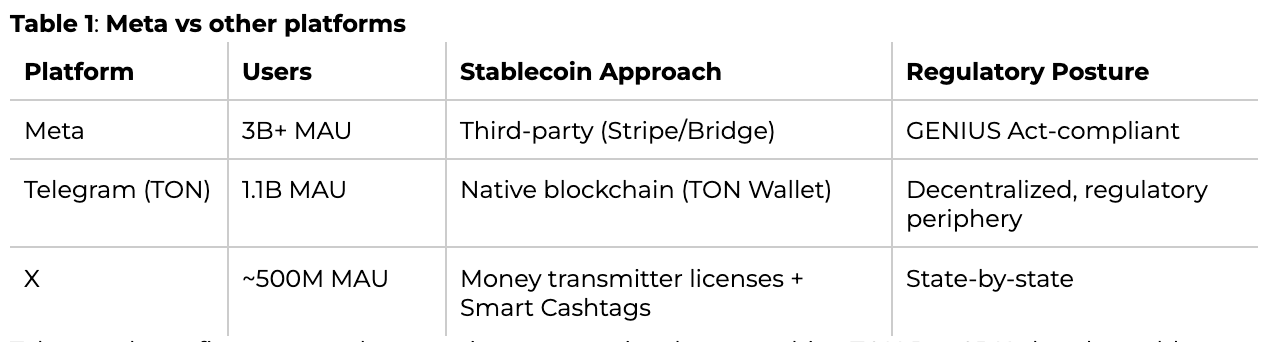
Telegram has a first-mover advantage in crypto-native demographics. TON Pay SDK already enables sub-second in-app checkouts. But Meta’s compliance posture is what unlocks the B2B volume.
- Huge distribution comes with a price: WhatsApp has near-universal penetration in countries like Nigeria, Brazil, Argentina, India, Philippines and others. In these emerging markets, where stablecoins are widely adopted among retails, WhatsApp can function as a “payments Trojan horse” for underbanked populations, providing a bridge between fiat and digital dollars. However, the IMF and BIS have flagged this explicitly: as citizens bypass local banking systems for digital USD wallets, domestic credit contracts, currencies depreciate faster, and central bank rate tools lose traction. Private dollarization, delivered by a social app can cause huge geopolitical risks.
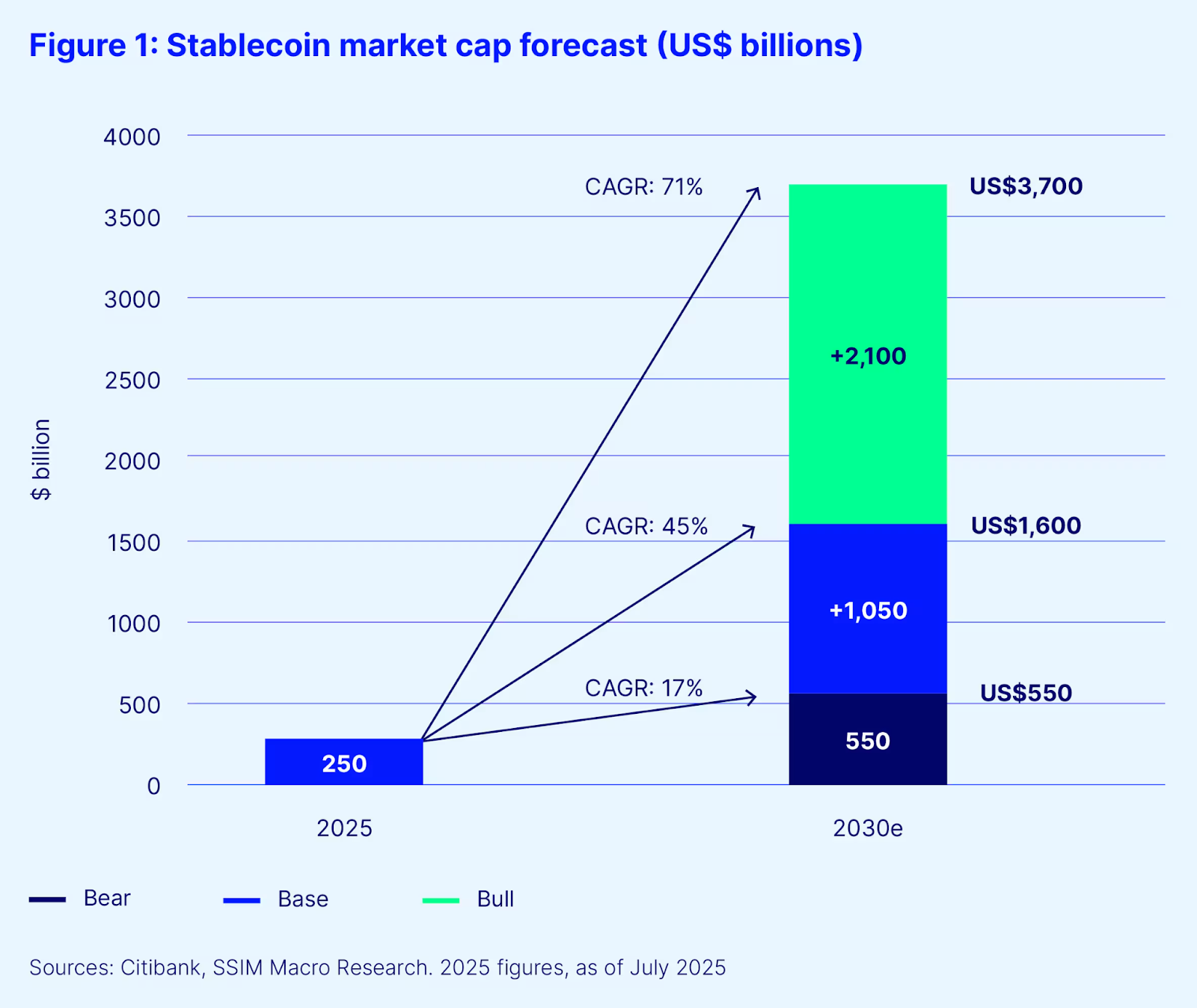
- The data gap is closing fast. In 2024, stablecoins saw $23T in volume, but only $390B was real-world utility like remittances. The rest was crypto trading. That ratio is set to shift dramatically. AI agents are projected to mediate $3T to $5T in consumer commerce by 2030. Global remittances still average 6.5% in fees and take 2-5 days. Stablecoins settle instantly for fractions of a cent.
Investor Alpha
The obvious trade is long META. It reported a strong performance in 2025 with $58.89B in revenue and $22.76B net income. And, it plans on spending heavily on infrastructure in 2026. But, apart from Meta, the real alpha lives two layers down, in the infrastructure absorbing $135B of annual capex and in the legacy networks. Visa just guided low double-digit adjusted net revenue growth for 2026, specifically citing agentic commerce integration.
- Stripe (pre-IPO exposure via secondary markets): The Bridge acquisition was built for exactly this moment. If Meta signs, Stripe becomes the settlement backbone for 3 billion users. It is also rumoured to go public in 2026 and weighing heavily on PayPal’s acquisition. 👉 Trade on Robinhood
- Visa (V) / Mastercard (MA): Consensus is wrong on disintermediation. Both networks are integrating stablecoin settlement on the back end while growing Value-Added Services (fraud, risk, advisory) at ~28% YoY. As agentic transaction velocity scales, so does demand for enterprise-grade fraud rails. Long networks. 👉 Trade on Robinhood
- Arista Networks (ANET) / Applied Materials (AMAT): Meta’s $135B capex lands somewhere. Dense compute clusters for Meta Superintelligence Labs require networking silicon and advanced materials at scale. [See news] 👉 Trade on Robinhood
Watchlist:
- Mar 1–2: Crypto Expo Europe (Bucharest)
- Mar 11: US CPI (Feb) release – critical for Fed rate cut expectations
- Mar 17–18: DC Blockchain Summit (Chamber of Digital Commerce)
- Mar 18: FOMC Interest Rate Decision & Summary of Economic Projections
- Mar 24–25: Next Block Expo (Warsaw)
- Mar 24–26: Digital Asset Summit (DAS) (New York City)
- Mar 25: Crypto Assets Conference (#CAC26 Frankfurt)
That’s it for now.
Missed last week? Access all our CEO notes here.
Marc & Team