Arizona is lending its Bitcoin
Hey, it’s Marc,
I've been tracking every state Bitcoin reserve bill for the past year. They all do the same thing: buy Bitcoin, hold Bitcoin, repeat. Arizona apparently found that boring.
Two bills just cleared committee that would let the state treasurer lend seized crypto for yield. Also, $7.43B of public pension money is now eligible for crypto. Celsius died doing this. Arizona wants to try it with retirement funds. [RELEASE]
Let’s unpack.
The Signal: U.S. public capital (treasuries and pensions) is starting to get explicit legal mandates and allocation bands for holding crypto directly, which de‑risks governance for other allocators to follow with small, policy‑backed exposures.
👉PRO: Download the PDF below
What happened
Two Arizona bills cleared the House Rules Committee.
- SB1649 creates a Digital Assets Strategic Reserve Fund, administered by Treasurer Kimberly Yee, who oversees $33.6B in state assets and explicitly authorizes her to loan seized or confiscated digital assets for yield.
- SB1042 permits public retirement systems to allocate up to 10% of portfolios into crypto via regulated ETPs.
By the numbers: The Arizona State Retirement System manages ~$50B while its PSPRS (Public Safety Personnel Retirement System) holds ~$24.3B. So, the combined maximum exposure: $7.43B from a single state.
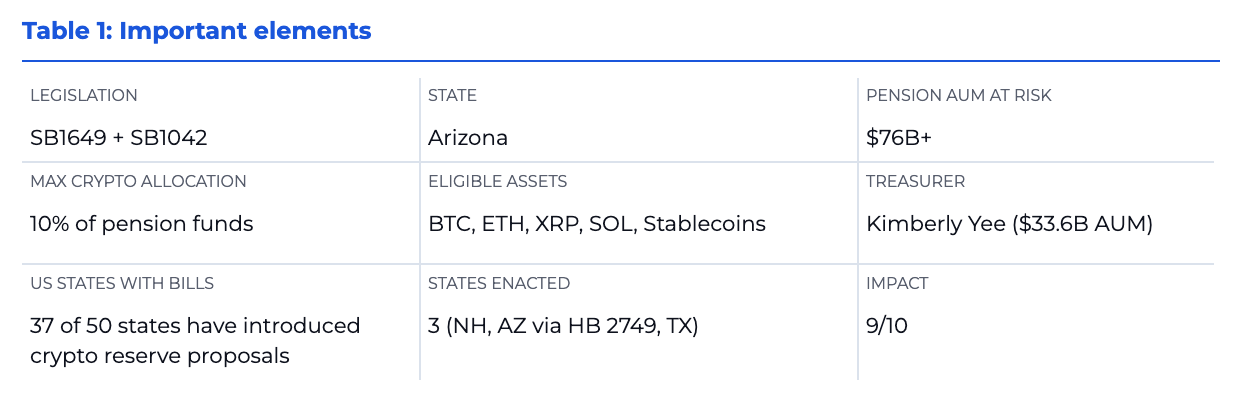
Zooming in: Governor Katie Hobbs vetoed SB1025 in May 2025, calling crypto “an untested investment“ unfit for retirement funds. Days later, she signed HB 2749, a narrower bill that lets Arizona hold unclaimed and seized digital assets in a Bitcoin and Digital Assets Reserve Fund. The new 2026 bills learned from that defeat. SB1649, introduced by Senator Mark Finchem, builds the reserve from seized, forfeited, and voluntarily surrendered assets. SB1042 takes the bolder step: 10% of public funds, including retirement system assets, in virtual currency. Both passed the Senate on partisan lines and are now on the House consent calendar.
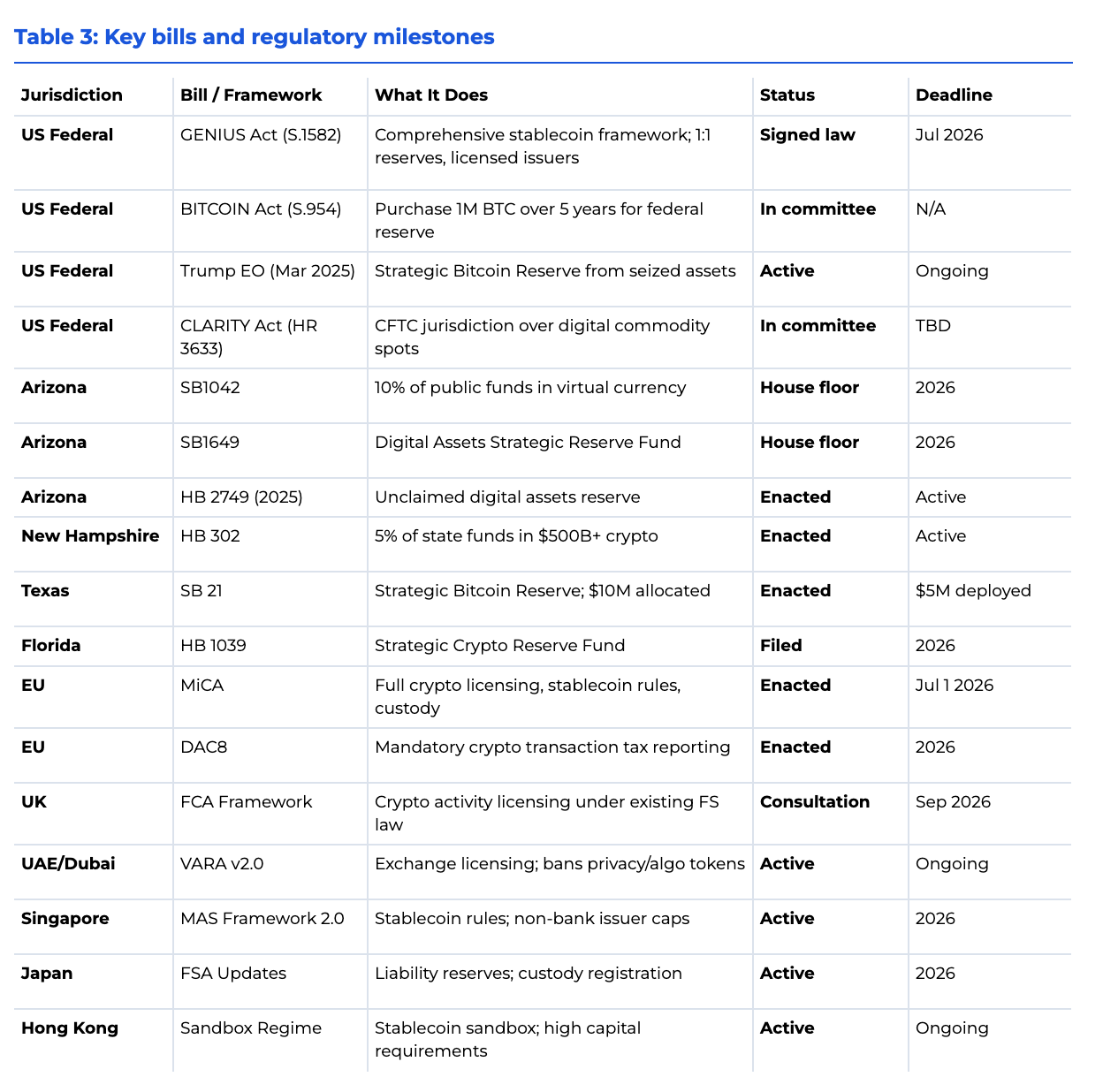
The Federal backdrop: President Trump signed an executive order on March 6, 2025 establishing the Strategic Bitcoin Reserve and US Digital Asset Stockpile. The federal government holds an estimated 328,372 BTC from criminal forfeitures. Senator Cynthia Lummis’s BITCOIN Act of 2025 proposes purchasing 1 million BTC over five years, funded through Federal Reserve remittances and gold certificate revaluations. The GENIUS Act, signed into law on July 18, 2025, created the first comprehensive US stablecoin framework. Its implementing regulations are due by July 18, 2026.
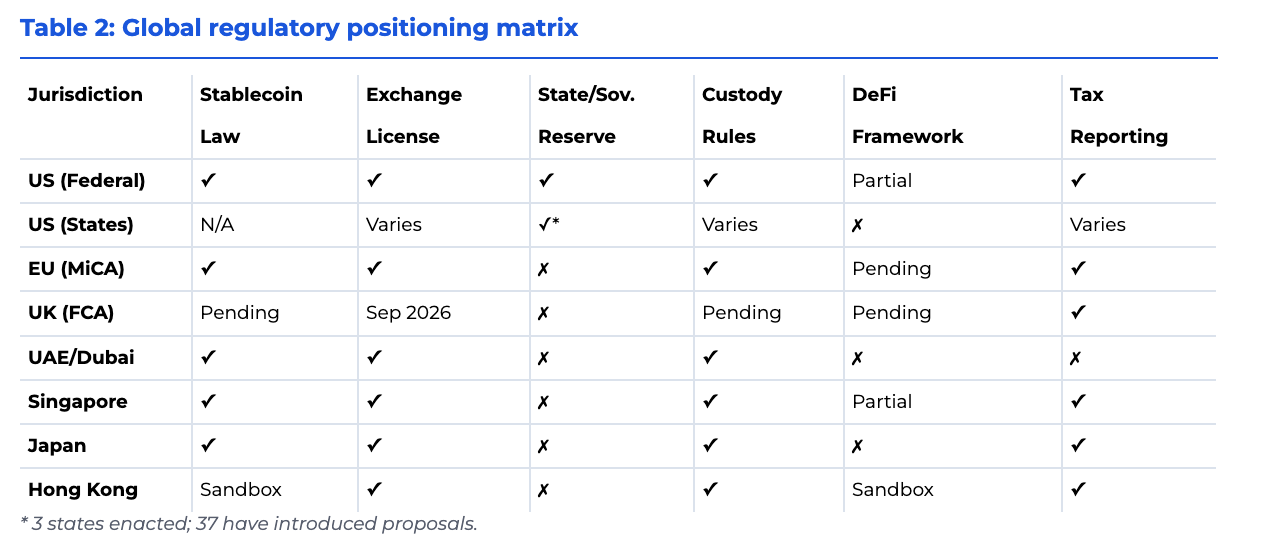
The state of sovereign crypto integration: State and sub‑sovereign actors are moving towards crypto as the regulated financial infrastructure.
- Florida: On March 6, 2026, Florida’s Senate passed SB 314 unanimously, making the state the first in the U.S. to enact a dedicated stablecoin regulatory framework. [Read more]
- Arizona: Apart from investment bill (SB1042) and strategic reserve bill (SB1649), Arizona has also pushed tax incentives and kiosk‑safety rules, differentiating itself from Texas (mining‑centric) and Florida (payments‑ and tax‑oriented) by tying crypto policy directly.
- Wyoming: It unveiled Frontier Stable Token (𝗙𝗥𝗡𝗧), the first state-backed stablecoin in U.S. history – backed by U.S. Treasuries.
- New Hampshire: It became the first state in the U.S. to establish a Strategic Bitcoin Reserve. (HB 302, signed May 6, 2025, allowing 5% of state funds in assets with $500B+ market cap)
- Texas: Governor Greg Abbott signed Senate Bill 21 (SB 21), officially titled the Texas Strategic Bitcoin Reserve and Investment Act.
Missouri, Ohio, Massachusetts, and South Dakota all have active proposals for crypto reserves. States like California, Connecticut, New York, Oregon, South Dakota, and Texas impose additional conduct or disclosure requirements on stablecoins and sometimes explicitly restrict state use of CBDCs or certain digital assets.
The pattern: The US is building crypto policy from the bottom up. States are the testing ground. Federal law (GENIUS Act) sets the floor. Executive action holds the assets.
Why it matters
- It is about lending, not holding. Every other state “Bitcoin reserve” bill in 2025 was about custody, just owning the asset. Arizona’s SB1649 is different. It turns the state into an active lender in crypto markets. The problem: crypto lending has no safety net. No central clearing. No standardized contracts. When Celsius, BlockFi, and Genesis collapsed, lenders lost everything because no one could see what was actually happening. Arizona’s Treasurer would need the same protections, overcollateralization, automated margin calls, real-time proof of solvency, that only a handful of sophisticated firms have built so far.
- Federalism as a feature: Arizona’s SB1042 is significant not because of the 10% allocation ceiling but because it treats digital assets as an investable asset class for public pension systems. That is a category shift. When New Hampshire authorized 5% of state funds for assets with $500B+ market caps, it effectively created a Bitcoin-only mandate. Texas funded its reserve through a BlackRock ETF, routing state capital through Wall Street’s infrastructure. Each state is running a different experiment and the federal government is watching.Also, if federal asset forfeiture law requires liquidation of seized digital assets, and Arizona mandates they go into a yield-generating reserve, you have a collision course headed for the Supreme Court. Arizona isn’t just making a crypto policy. It’s picking a constitutional fight over state financial sovereignty.
- Alpha generation. With the CLARITY Act explicitly classifying BTC, ETH, and SOL as commodities, and the PARITY Act deferring staking taxes for five years, staking is the new fixed income. Ethereum pays a mathematically guaranteed 3% to 5% native yield. It’s entirely uncorrelated to Fed rate cuts or corporate defaults. State fiduciaries aren’t buying ETH for the tech; they’re buying it because they can’t afford to miss the yield.
Investor Alpha
The Arizona bills are the demand signal that validates the entire institutional custody and ETP infrastructure buildout. The passage of GENIUS, the SEC/CFTC March 2026 taxonomy, and SAB 121’s rescission have created the legal scaffolding. Arizona just confirmed the sovereign client base is real.
- BNY Mellon (BK) / State Street (STT): Direct beneficiaries of state-level custody mandates. SB1649 requires qualified custodians using MPC architecture; both institutions have already launched Digital Asset Platforms targeting exactly this client profile. 👉 Trade on Robinhood
- BlackRock (BLK) / iShares Bitcoin ETF (IBIT): SB1042 explicitly channels pension exposure through ETPs. IBIT is the dominant institutional ETP by AUM. Every new state that passes a 10% pension bill is a structural inflow catalyst for BlackRock’s fee base. 👉 Trade on Robinhood
- Ethereum (ETH): The 70/22/8 institutional model allocates 22% to ETH. The PARITY Act’s five-year staking tax deferral converts 3–5% native protocol yield into a tax-advantaged fixed-income proxy. 👉 Trade on Robinhood
Our Take
Here’s what I think most people are missing.
Every conversation about crypto regulation in 2026 is about permission. Who’s allowed to hold what. Who can custody. Who can trade. That’s the wrong conversation.
It’s about plumbing.
When Texas bought $5M in BlackRock’s IBIT, they didn’t just buy Bitcoin. They validated a custody chain. State comptroller to ETF to institutional custodian. That’s a full-stack proof of concept. Arizona’s SB1042 goes further. It references the federal Strategic Bitcoin Reserve for storage. A state bill plugging into federal custody infrastructure. Read that again.
These aren’t isolated experiments. Three states are building the operational rails for government-held digital assets before the BITCOIN Act even gets a vote. By the time Congress debates whether to do this, it’ll already be done.
51 Intelligence Stack: Recommended Reading
- 401(k)s Open to Crypto
- Florida’s stablecoin bill
- America’s crypto power move
- Re-Engineering of US Derivatives Markets
- the SEC sorts its tokens
Watchlist:
- Apr 28–29: FOMC meeting. Second rate decision window
- May 5–6: Next FOMC policy meeting after April
- Mid-May: Kevin Warsh expected to take over as Fed Chair
- Jul 1: MiCA universal deadline
- Q1-Q2 2026: SEC final decision on Nasdaq tokenized trading rule change (SR-NASDAQ-2025-072)
- H2 2026: DTCC tokenization pilot launch
That’s it for now.
Missed last week? Access all our CEO notes here.
Marc & Team
Appendix