
Zelle, Western Union upgrade infra with blockchain
Two of the world’s biggest money movers: Zelle ($1T+ in transfers, 2,100 banks) and Western Union (500K+ outlets, 200+ countries), are going stablecoin. [RELEASE]
The goal: make transfers faster and cheaper. Zelle needs stablecoins to extend its U.S. bank network globally, while Western Union needs them to cut costs and boost margins.
The money movement industry is getting its biggest upgrade since PayPal and Stripe. Let’s unpack.
PRO: Download the PDF
What Happened
Western Union plans to use stablecoins for cross-border payments and its own treasury operations, aiming to cut fees and reduce settlement times. Zelle, backed by major U.S. banks, will use stablecoins to enable international transfers and is even considering launching its own. [NEWS]
Zooming in: Zelle’s network operator, Early Warning Services, plans to use stablecoins for international transfers and may launch its own token to expand beyond U.S. payments. The feature will be optional for any of the 2,100+ banks in the Zelle network.
Zelle also plans to issue its own bank-backed stablecoin to gain more control over compliance and liquidity, and to unlock new features like instant refunds and programmable transfers.
Meanwhile: Western Union is piloting stablecoin transfers to cut costs, speed up cross-border payments, free up capital, and boost efficiency as part of its broader move to modernize money movement (-6% Consumer Money Transfer revenue in Q2’25).
Zooming out: The GENIUS Act set clear federal rules for stablecoins, requiring full reserve backing, strict compliance with financial laws, and the ability to freeze assets when needed, giving institutions the confidence to adopt them. Now, money transmitters and payment networks are turning from a domestic US P2P app into a global, instant, 24/7 payment rail – with stablecoins.
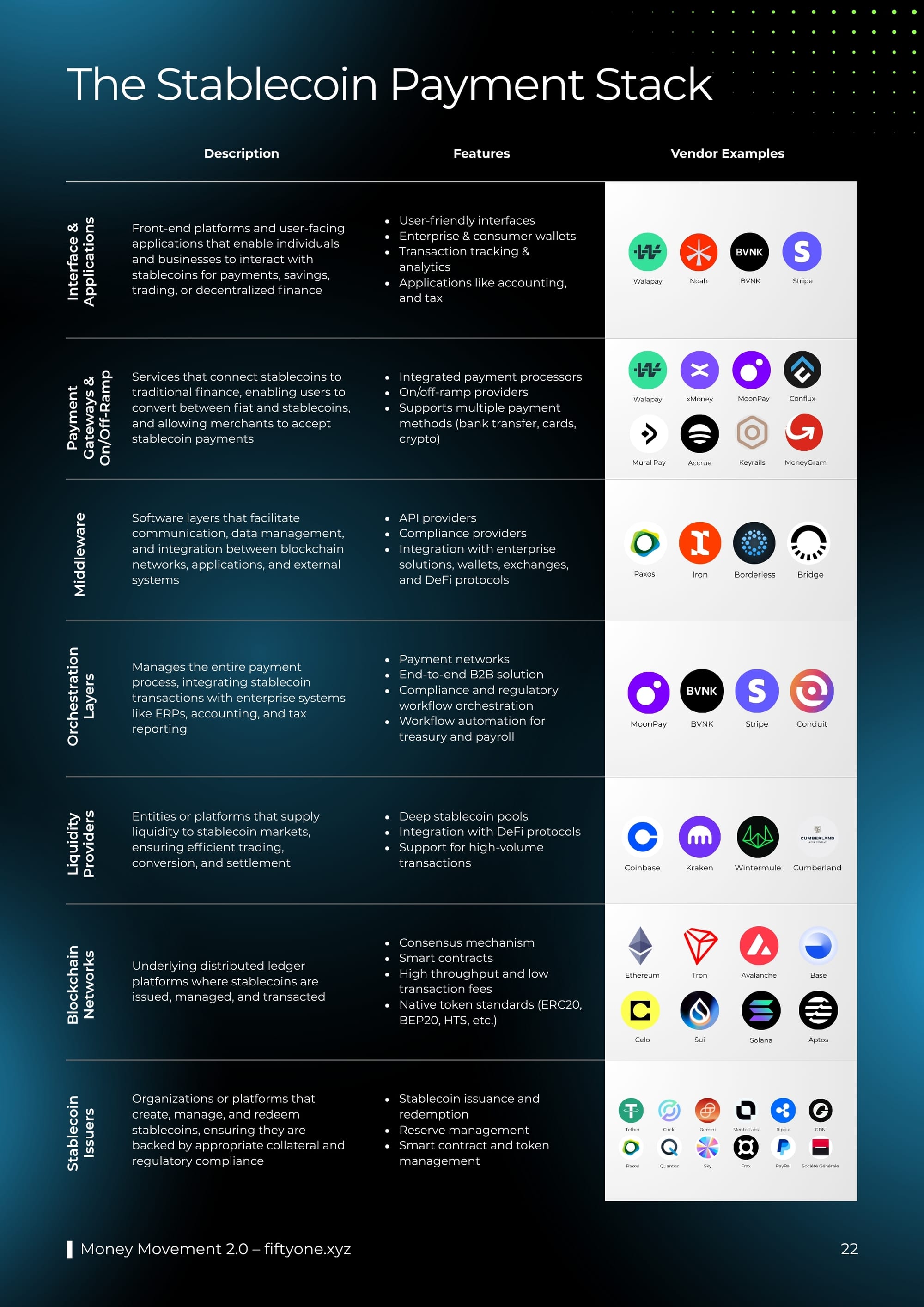
Why it matters
1. Banks go on offense
For years, PayPal, Wise, Tether and others dominated cross-border payments while banks watched from the sidelines. Now Zelle’s owners are building their own stablecoin rails and keeping those transaction fees in-house. Distribution is their moat: 100 MILLION (!) verified bank users will now get stablecoin rails without ever leaving their banking app (Zelle has over 74.8M active users, while Western Union serves over 150M customers worldwide, operating in 200+ countries).
2. SWIFT got a wake-up call
Western Union’s pilot program directly targets reducing its dependency on the legacy correspondent banking systems. The objective will be to shorten settlement windows and improve capital efficiency, compared to the DLT infrastructure being built by SWIFT. Zelle also poses a direct challenge to digital-native rivals like PayPal (issuer of PYUSD), MoneyGram (partnered with Stellar for remittances), and Remitly, combining scale with technology. Just weeks ago, SWIFT announced its own blockchain-based ledger with ConsenSys and 30+ global banks (we reported on that).
 Marc Baumann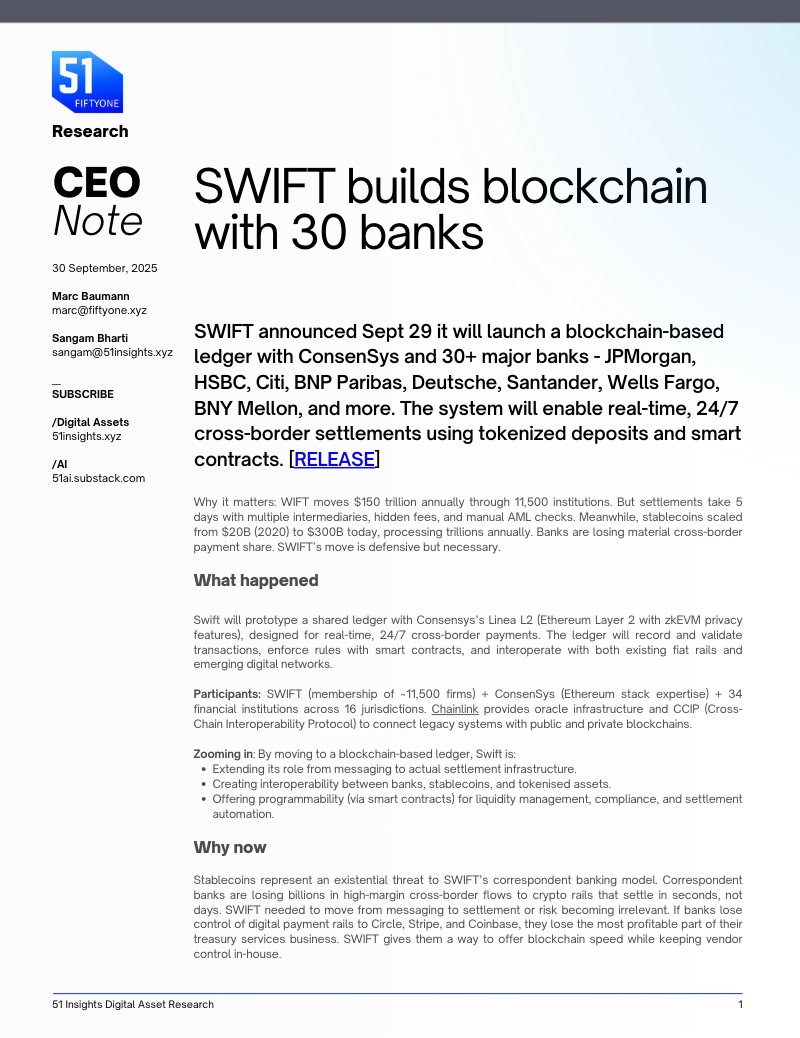
Our take
The shift underway is not simply about modernising payment rails, it’s about consolidating trust, distribution, and compliance under a blockchain-native infrastructure layer. With 100M+ verified users and direct integrations into 2,100 banks, Zelle is positioned to become the dominant stablecoin distribution channel in U.S. retail banking.
Meanwhile,Western Union’s stablecoin strategy is less about retail product innovation and more about optimizing back-end cost structures.
More broadly, we view these moves as validation of stablecoins as systemic infrastructure. From PayPal’s PYUSD to JPM Coin and now Zelle and WU, the competitive battleground is no longer crypto-native, it’s financial infrastructure modernization.
The key differentiator will not be technology alone, but the ability to embed programmable money into existing compliance frameworks at scale.
More analysis from 51:
Marc Baumann Marc Baumann
Today’s Market Signals
- JPYC Inc. launches first JPY-pegged stablecoin. Link
- Canary Capital to launch first US ETFs. Link
- Kyrgyzstan to launch stablecoin on BNB. Link
- Ant Group applied to register crypto trademarks. Link
- Apollo partners with Coinbase to unlock stablecoin lending business. Link
Take care,
Marc
🙌 Work with us: We create pioneering thought leadership that helps digital asset and technology companies lead the conversation, earn trust and win business.
