
SWIFT's picks Ethereum
SWIFT announced Sept 29 it will launch a blockchain-based ledger with ConsenSys and 30+ major banks - JPMorgan, HSBC, Citi, BNP Paribas, Deutsche, Santander, Wells Fargo, BNY Mellon, and more. The system will enable real-time, 24/7 cross-border settlements using tokenized deposits and smart contracts. [RELEASE]
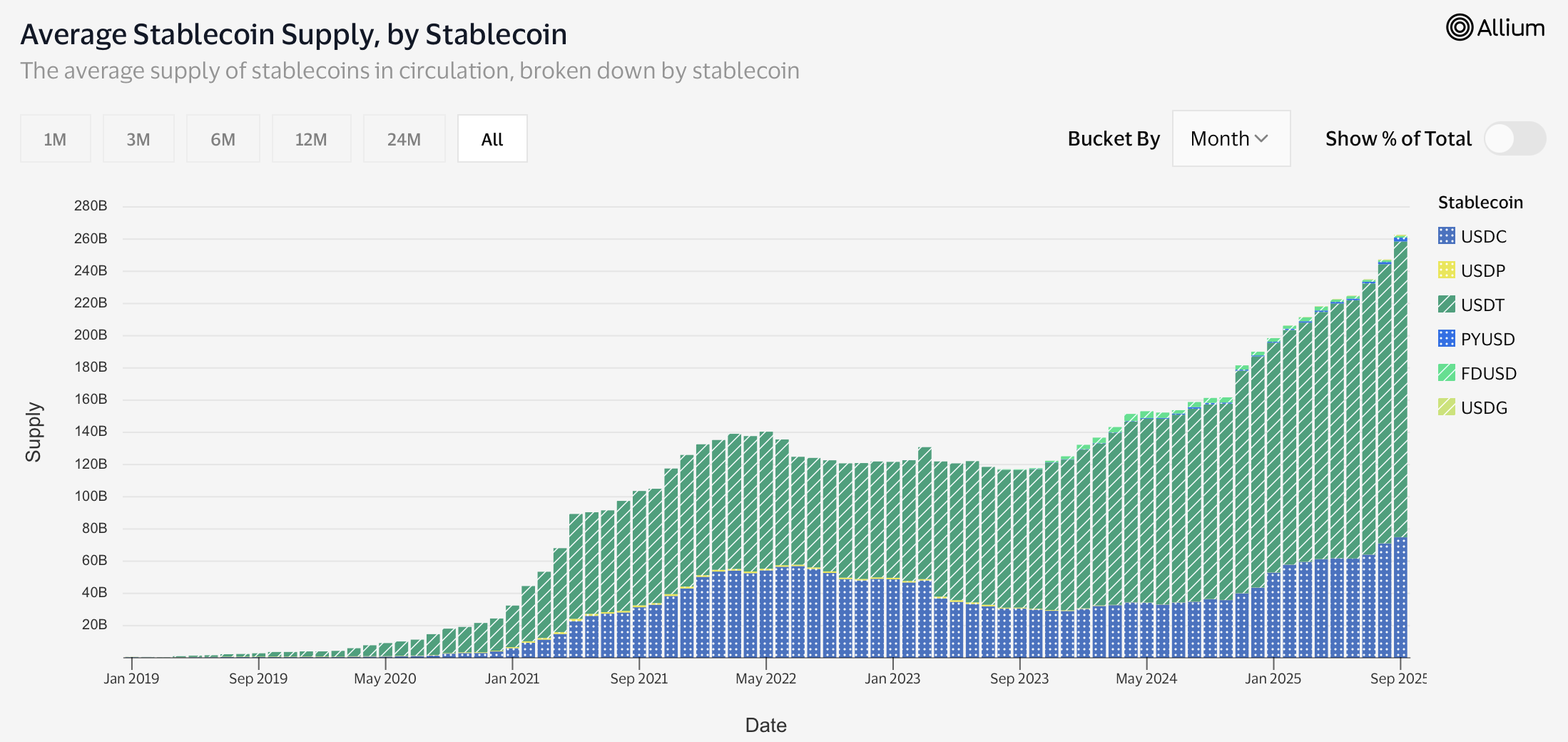
Why it matters: SWIFT moves $150 trillion annually through 11,500 institutions. But settlements take 5 days with multiple intermediaries, hidden fees, and manual AML checks. Meanwhile, stablecoins scaled from $20B (2020) to $300B today, processing trillions annually. Banks are losing material cross-border payment share. SWIFT’s move is defensive but necessary.
Let’s dig in.
What happened
Swift will prototype a shared ledger with Consensys’s Linea L2 (Ethereum Layer 2 with zkEVM privacy features), designed for real-time, 24/7 cross-border payments. The ledger will record and validate transactions, enforce rules with smart contracts, and interoperate with both existing fiat rails and emerging digital networks.
Participants: SWIFT (membership of ~11,500 firms) + ConsenSys (Ethereum stack expertise) + 34 financial institutions across 16 jurisdictions. Chainlink provides oracle infrastructure and CCIP (Cross-Chain Interoperability Protocol) to connect legacy systems with public and private blockchains.
Zooming in: By moving to a blockchain-based ledger, Swift is:
- Extending its role from messaging to actual settlement infrastructure.
- Creating interoperability between banks, stablecoins, and tokenised assets.
- Offering programmability (via smart contracts) for liquidity management, compliance, and settlement automation.
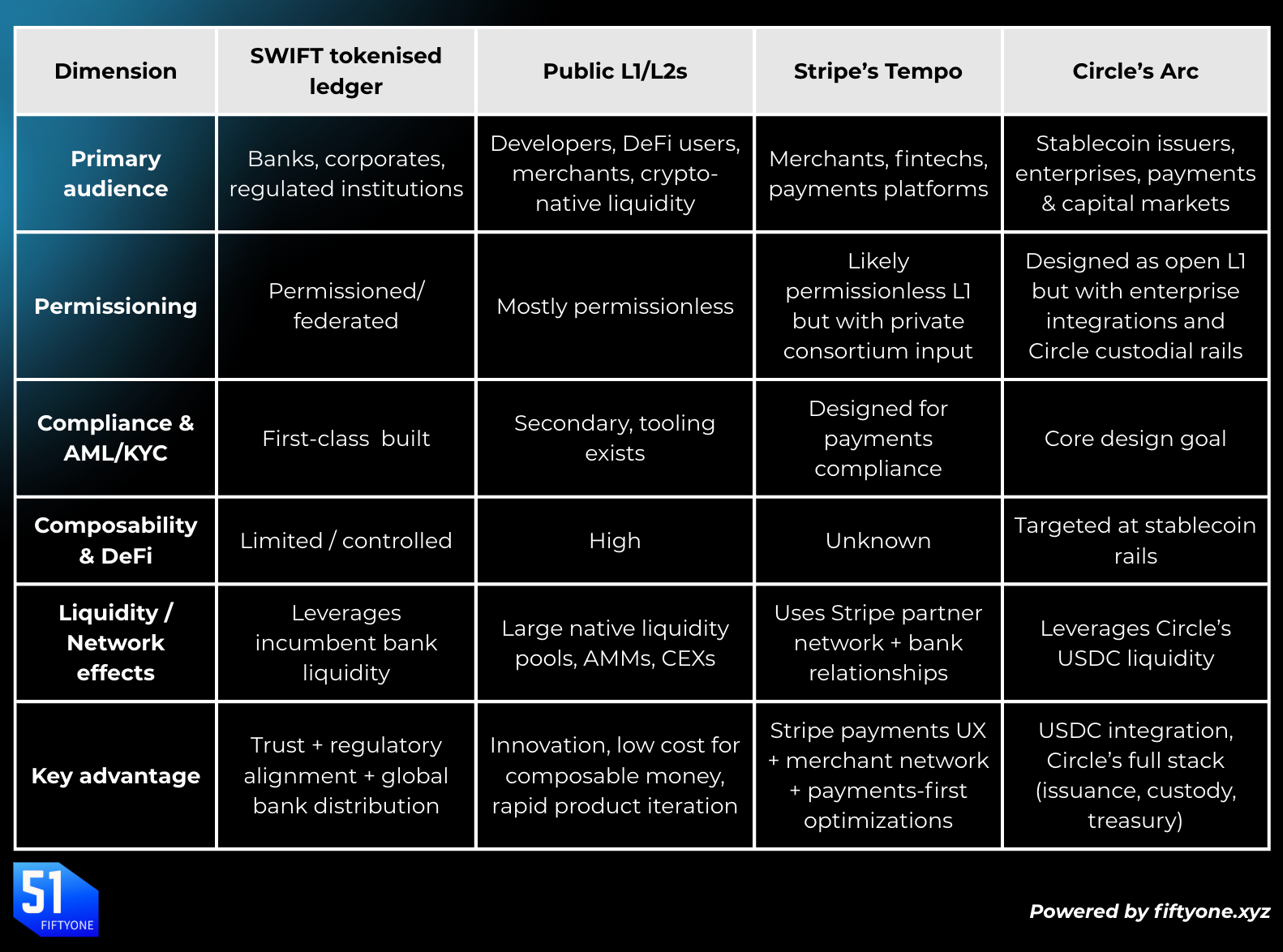
- Arc: optimisation for institutional capital market needs
- Tempo: payments-focused, optimised for commerce, payroll, and remittances
- SWIFT: integrating DLT with existing correspondent banking/ISO standards
Why now
Stablecoins represent an existential threat to SWIFT’s correspondent banking model. Correspondent banks are losing billions in high-margin cross-border flows to crypto rails that settle in seconds, not days. SWIFT needed to move from messaging to settlement or risk becoming irrelevant.
If banks lose control of digital payment rails to Circle, Stripe, and Coinbase, they lose the most profitable part of their treasury services business. SWIFT gives them a way to offer blockchain speed while keeping vendor control in-house.
Implications
- SWIFT shifts from messaging to settlement infrastructure.Today: SWIFT transmits payment instructions; settlement occurs through correspondent banks (3-5 days, batch processing, hidden intermediary fees).New model: Atomic settlement on shared ledger with instant finality, 24/7 availability, and programmable compliance. This materially expands SWIFT’s value capture in cross-border flows.
- Ethereum emerges as institutional blockchain standard.
SWIFT selected Ethereum L2 over competing protocols (Ripple, Solana, Hedera). This validates Ethereum as the preferred institutional stack and shifts the industry debate from “if blockchain” to “which blockchain.” The answer is Ethereum infrastructure with bank-controlled governance layers. - Multi-rail settlement environment requires interoperability infrastructure.The market is fragmenting into parallel systems: bank-controlled rails (SWIFT, JPMorgan Kinexys), fintech infrastructure (Circle Arc, Stripe Tempo), and public networks (Ethereum holds 70% of stablecoin supply). Corporates will operate multi-rail treasury functions. Chainlink’s CCIP positioning as cross-chain connectivity layer creates structural competitive advantage.
- We’re entering a hybrid future: Centrally controlled blockchains (Stripe Tempo, Circle Arc, Google GSUL, Tether Plasma). Permissionless networks such as Ethereum (holds 70% of stablecoin supply). Both will coexist.
Our Take
SWIFT’s move is largely defensive, aiming to safeguard its high-margin correspondent banking model while addressing fragmentation in the tokenised money ecosystem, preventing proprietary bank DLTs from operating in isolation.
The strategic edge for SWIFT lies in its unmatched trust, neutrality, and reach. By linking private DLTs, corporate L1s, and public L2s, SWIFT ensures regulated digital money flows seamlessly, preventing liquidity fragmentation and making interoperability, compliance, and connectivity the true axes of competition in the tokenized economy.
By 2030, every major bank will settle onchain. They won’t call it “blockchain.” They’ll call it “modernized infrastructure” or “instant payments.” This is about who owns the rails of global money in the next decade. The prize: multi-trillions in global payment flows.
Market Signals of Today
- Stablecoin market hits $300B. Link
- Kraken will raise at $20B valuation. Link
- UK banks pilot tokenised sterling deposits to enable programmable payments. Link
- Citi enables 24/7 interbank payments via tokenised deposits. Link
That’s all for today’s CEO Briefing.
Best,
Marc & Team
🙌 Work with us: We create pioneering thought leadership that helps digital asset and technology companies lead the conversation, earn trust and win business.
