

USDC’s Biggest Upgrade Yet
Circle just unified its $74B USDC economy pool into a single, portable standard across all blockchains. [RELEASE]
For years, USDC has been everywhere and nowhere at once. Circle is trying to solve that with a new interoperability layer, xReserve.
The Opportunity: If it works, the stablecoin world moves from a cluster of isolated ponds to one connected ocean.
Let’s unpack.
👉PRO readers: Download the PDF
What happened
USDC moves across dozens of chains, powering billions in daily settlements. But the secret? Most of that USDC isn’t actually native USDC. It’s bridged variants, wrapped, mirrored, and synthetic copies that don’t talk to each other. Liquidity splintered. UX fractured. Trust assumptions multiplied.
Circle’s new release, xReserve, is designed to collapse that sprawl. xReserve gives any blockchain the ability to issue its own USDC-backed stablecoin that is natively interoperable with real USDC, not a synthetic version.
Here’s how this works:
- Deposits of USDC on Ethereum → mint a chain’s native USDC-backed token.
- Burn the local token on Chain A → mint USDC (or another USDC-backed token) on Chain B.
- All actions verified through Circle-run attestations, not third-party bridges.
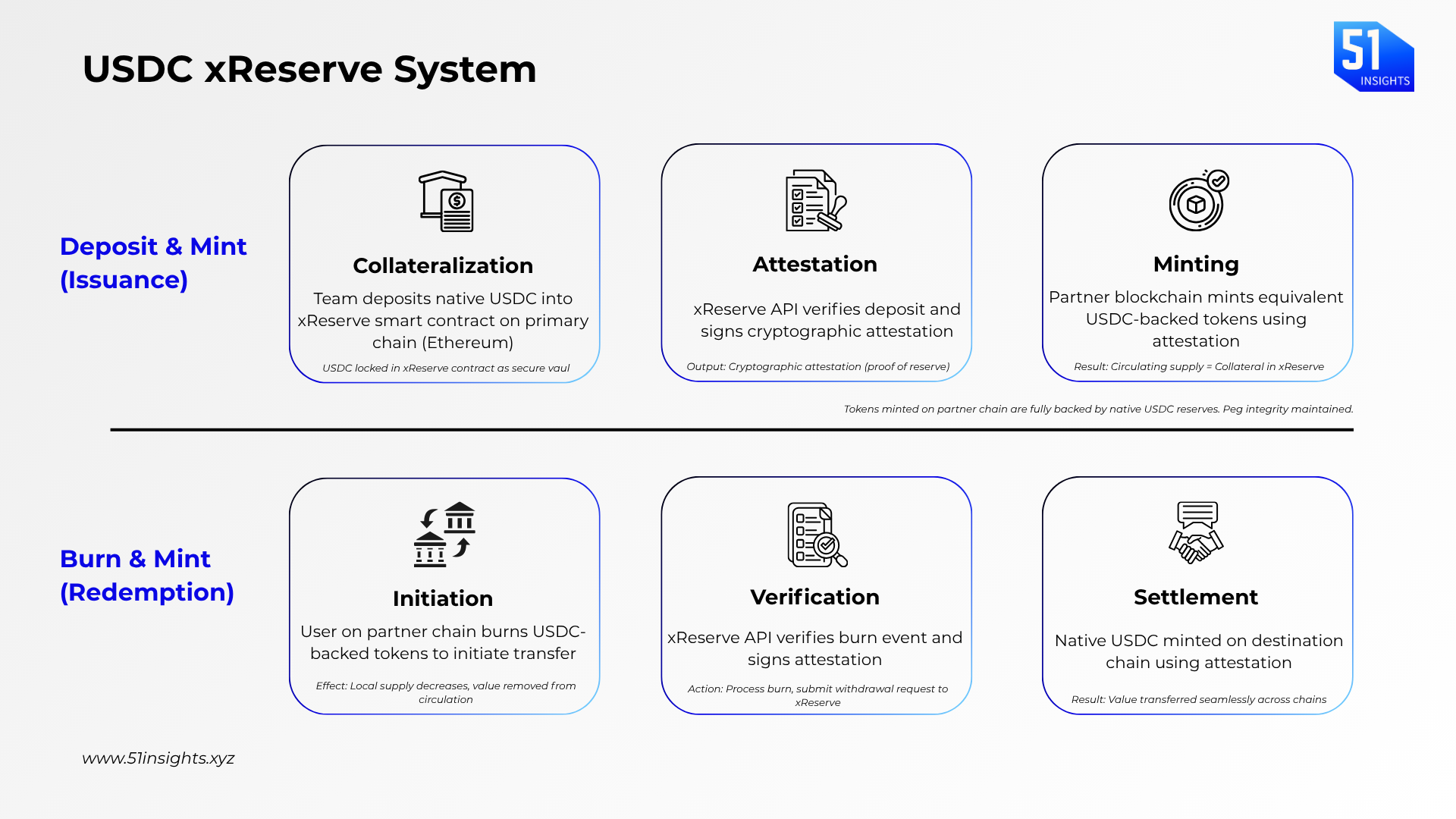
The thesis: As the digital asset economy matures, interoperability across disparate networks is a fundamental requirement. This bypasses the “lock-and-mint” bridges.
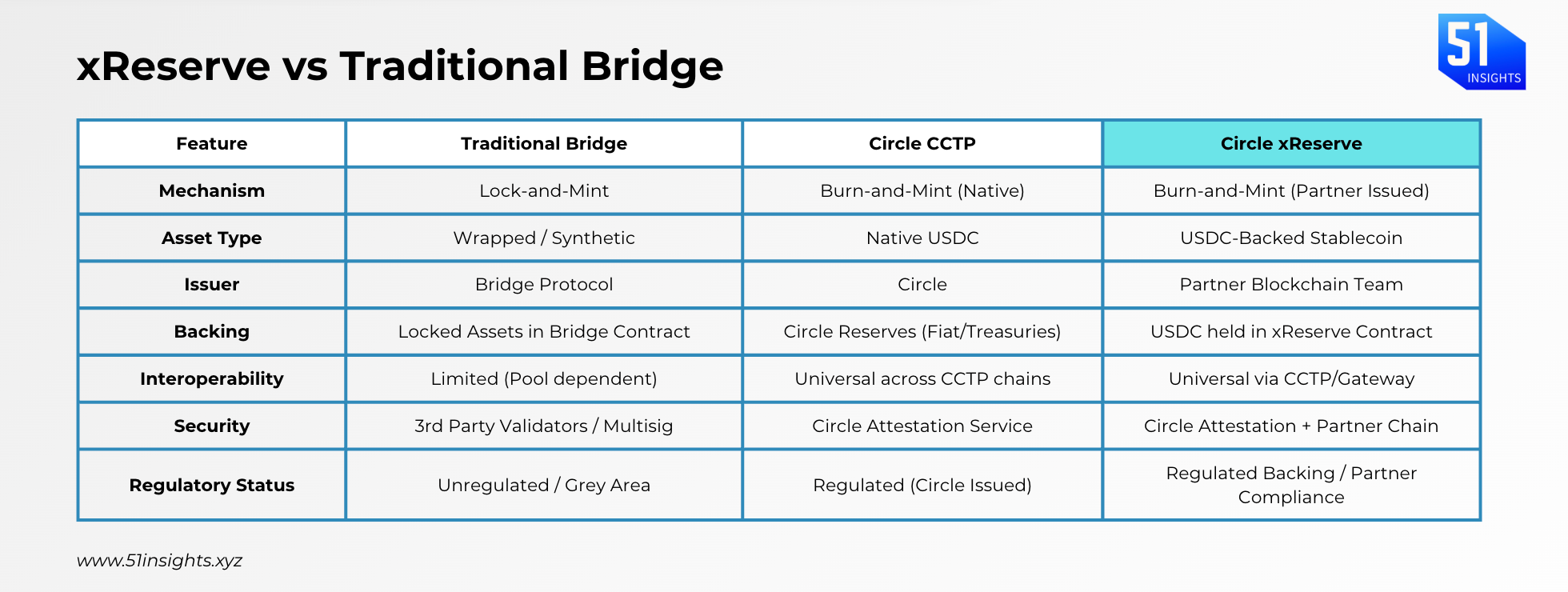
 Marc Baumann
🙌 Work with us: We arm financial institutions and digital asset leaders with bespoke research, thought leadership to shape the most important conversations, scale trust, and win business.
Why it matters
- Fixed fragmentation. Bridged USDC on Chain A (like “USDC.e”) doesn’t work interchangeably at the protocol level, so users need to swap between them using liquidity pools, which means fees, slippage, and extra steps. This also forces liquidity providers to spread capital across multiple pools for what is effectively the same asset. xReserve makes USDC fungible across chains again – no more “USDC.e” vs “native USDC”.
- The institutional launch. The launch on Canton Network ($1.5T repo transactions, $3.6T tokenised RWAs) brings USDC to the institutional ecosystem with major financial players like Goldman Sachs, J.P. Morgan, BNP Paribas and Franklin Templeton. Use Case: A bank on the Canton Network can execute a repo transaction where a tokenised US Treasury (UST) is swapped for the Canton-native USDC stablecoin. The key is the Circle-run attestation. Institutions don’t have to trust an anonymous bridge operator’s code or governance; they trust Circle, a regulated entity, to verify the burn on Chain A before the native-backed USDC is minted on Canton.
- The battle for full-stack. xReserve launch is a counter-manoeuvre in a broader war for vertical integration within DeFi. xReserve creates a transport layer that commoditizes the role of third-party bridges like LayerZero and Axelar and positions Circle as an infrastructure, not just an issuer. Circle effectively sets the rules for the “Internet of Value”.
Investor Alpha
The decline of wrappers: Mainstream adoption has 3 bigger issues- lack of interoperability, bridge hacks and fragmented liquidity. The era of “generic” liquidity bridging is drawing to a close, replaced by issuer-native transport layers. As compliant stablecoins gain preferential treatment, infrastructure like xReserve that ensures verifiable backing and transparent operations will become the gold standard.
xReserve is a strategic infrastructure play to solidify USDC as the HTTP of value exchange. It transforms USDC from a product into a platform. Now, the blockchain wars will be between liquidity standards as we enter the interoperability phase of the stablecoin infrastructure.
Marc Baumann
The Trade
- Long: Infrastructure. The future will be led by chains, DeFi full-stack protocols and infrastructure platforms controlling plumbing.
- Short: Bridges and chain-native issuers.
- Watch List: BTC DeFi. With an interoperable system, “exit liquidity” problem for BTC DeFi will be solved. Investors should look for key DeFi primitives on Stacks that are integrating sBTC and xReserve USDC, as these will likely be the primary beneficiaries of the liquidity influx.
Today’s Market Signals
- BlackRock’s bitcoin ETF posts record-setting outflows worth $523M. Link
- Fidelity launches Solana ETF. Link
- OCC confirms bank authority to hold crypto-assets to pay gas fees. Link
- Kraken bags $800M for expansion plans at $20B valuation. Link
- Korea plans 20-25% tax on crypto. Link
Take care,
Marc & team
Download the PDF