Tether isn’t what you think it is
Hey, it’s Marc.
When a stablecoin issuer starts calling itself “the best ally for the United States,” you pay attention. When it backs that claim with 500M users, $135B in Treasuries and $13B in yearly profits with a 99% profit margin, you listen harder.
Most people still think Tether is just a stablecoin company. That’s wrong.
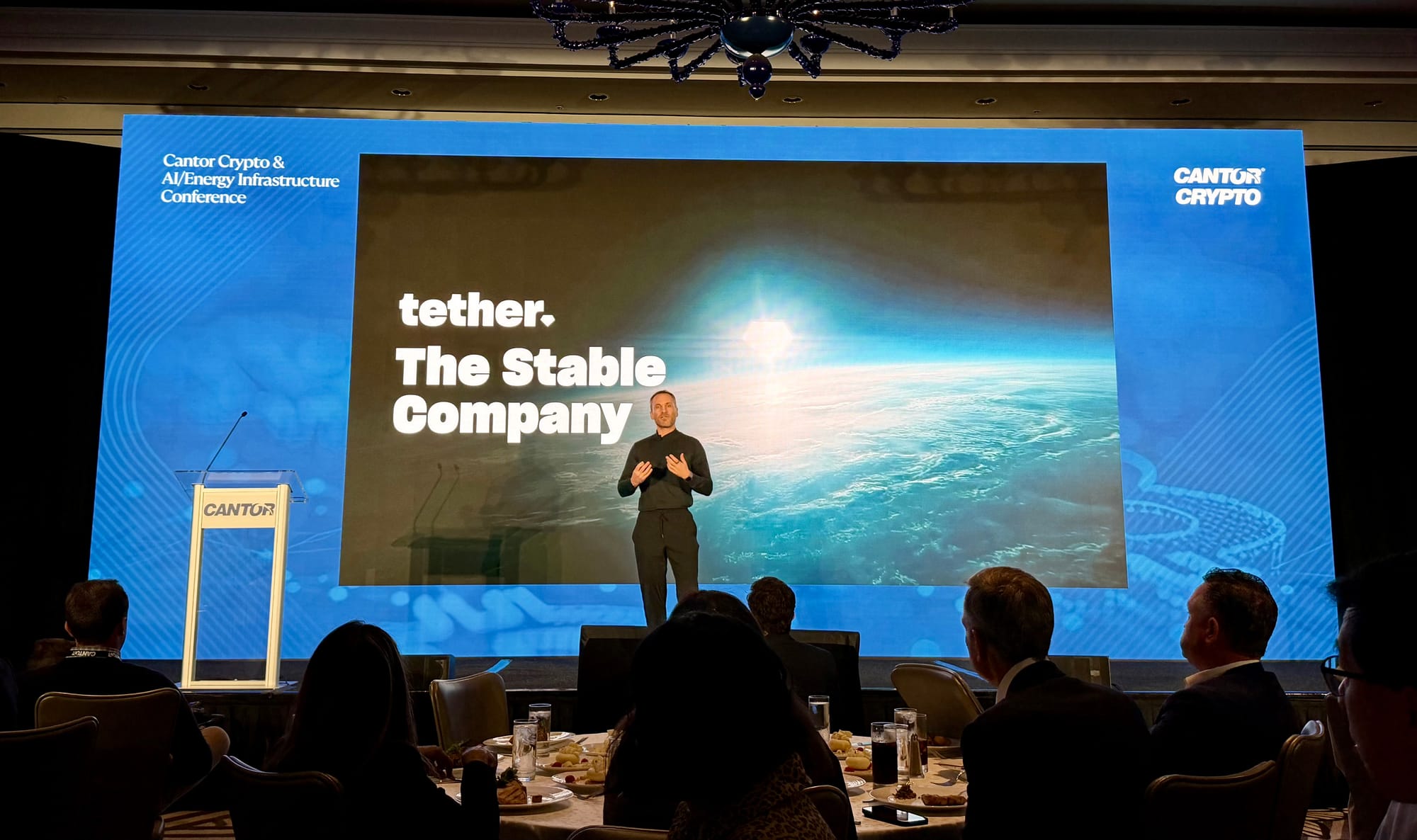
At Cantor’s Crypto & AI/Energy Infrastructure conference in Miami this week, Tether’s CEO, Paolo Ardoino, painted a picture of a company evolving far beyond its stablecoin origins. Tether is building what might become the most important digital infrastructure company of the decade, spanning finance, energy, communications, and AI for the 1.4-3B unbanked people in emerging markets:
“We’re not just exporting dollars. We’re exporting resilience. […] We are bringing forward the concept of the US for hegemony... we are protecting the USA... We are making the dollar so rooted in all the wallets in all the businesses in all these emerging markets... in a way that cannot be eradicated.”
— Paolo Ardoino, CEO, Tether
Tether is quietly becoming one of the most powerful companies in crypto and beyond. And you should pay attention.
Let’s unpack.
👉PRO Readers: Download the PDF at the bottom
What happened
In his first U.S. conference appearance, Tether CEO Paolo Ardoino unveiled a sweeping strategy to reframe the company from a crypto utility to a global infrastructure provider. He described Tether not as a fintech company, but as:
“The largest monetary distribution network in the history of money.”
Ardoino detailed Tether’s transformation from a crypto-centric company to what he termed a “stable company”.
His long-term thesis: a stable society requires stable infrastructure across four layers:
- Finance: USDT, USAT (Genius Act-compliant), XAUT (gold-backed), Rumble Wallet
- Communication: Keet (fully peer-to-peer messaging, no central servers)
- Energy: Tether kiosks — 500 live in Africa, 100k planned, powering up to 150M people; Tether is also the world’s biggest Bitcoin miner.
- Intelligence: QVAX — a peer-to-peer AI runtime that runs LLMs locally, even on low-power phones
Tether is building all of this via 140+ portfolio companies, tightly integrated into its expanding distribution rails.
“We are creating such a consolidated distribution network that not only can transport USDT or Tether Gold, but can transport values — information, education — that are outside of a simple exchange of money. This is about resilience.”
He framed Tether’s colossal growth as a direct consequence of global failure: the rapid devaluation of national currencies in emerging markets.
“The Venezuelan bolívar lost 99.8% in the last 10 years against the US dollar... That is in one simple chart the reason why Tether is successful.”
This is why 37% of USDT’s supply is held by savers in Argentina and Turkey, not traders, but everyday users turning to stablecoins as inflation hedges.
“Tether is the biggest financial inclusion success story in human history. Wherever banks fail to support local communities, Tether is present.”
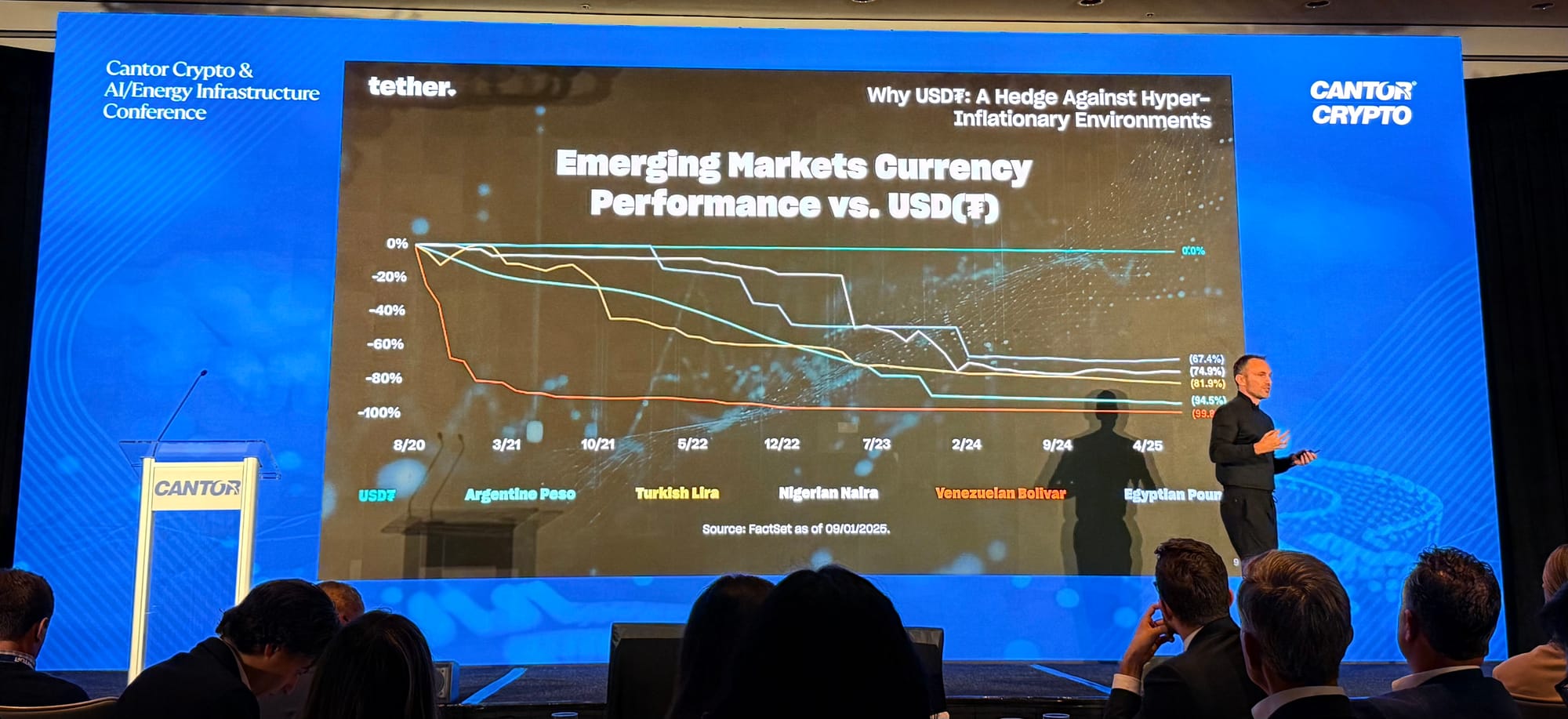
Zooming in: Ardoino lays out a powerful thesis: The traditional financial system is failing billions, exporting inflation, and leaving half the world’s population behind. What many see as a crypto asset, Tether views as the most effective monetary distribution network in history, capable of transporting the US dollar, and the values it represents to the farthest corners of the globe.
“If half of the population in the world is left behind from the traditional financial system and it’s not financially included, how the world can move forward?”
🚨 We just opened new sponsorship slots for our newsletters & podcast. Want to reach 35k+ digital asset leaders? Contact us here.
 Marc Baumann
Why it matters
Ardoino’s vision presented Tether as a force for global stability and a champion of the U.S. dollar’s hegemony. By embedding the dollar in the financial fabric of emerging markets, he argued, Tether is creating an “eradication-proof” network that will benefit the U.S. economy for the foreseeable future.
“We are making the dollar so rooted in all the wallets, in all the businesses, in all these emerging markets — in a way that cannot be eradicated.”
This narrative positions Tether not as a rogue offshore entity, but as a strategic partner to the United States. This is a significant shift in tone for a company that has historically had a contentious relationship with U.S. regulators.
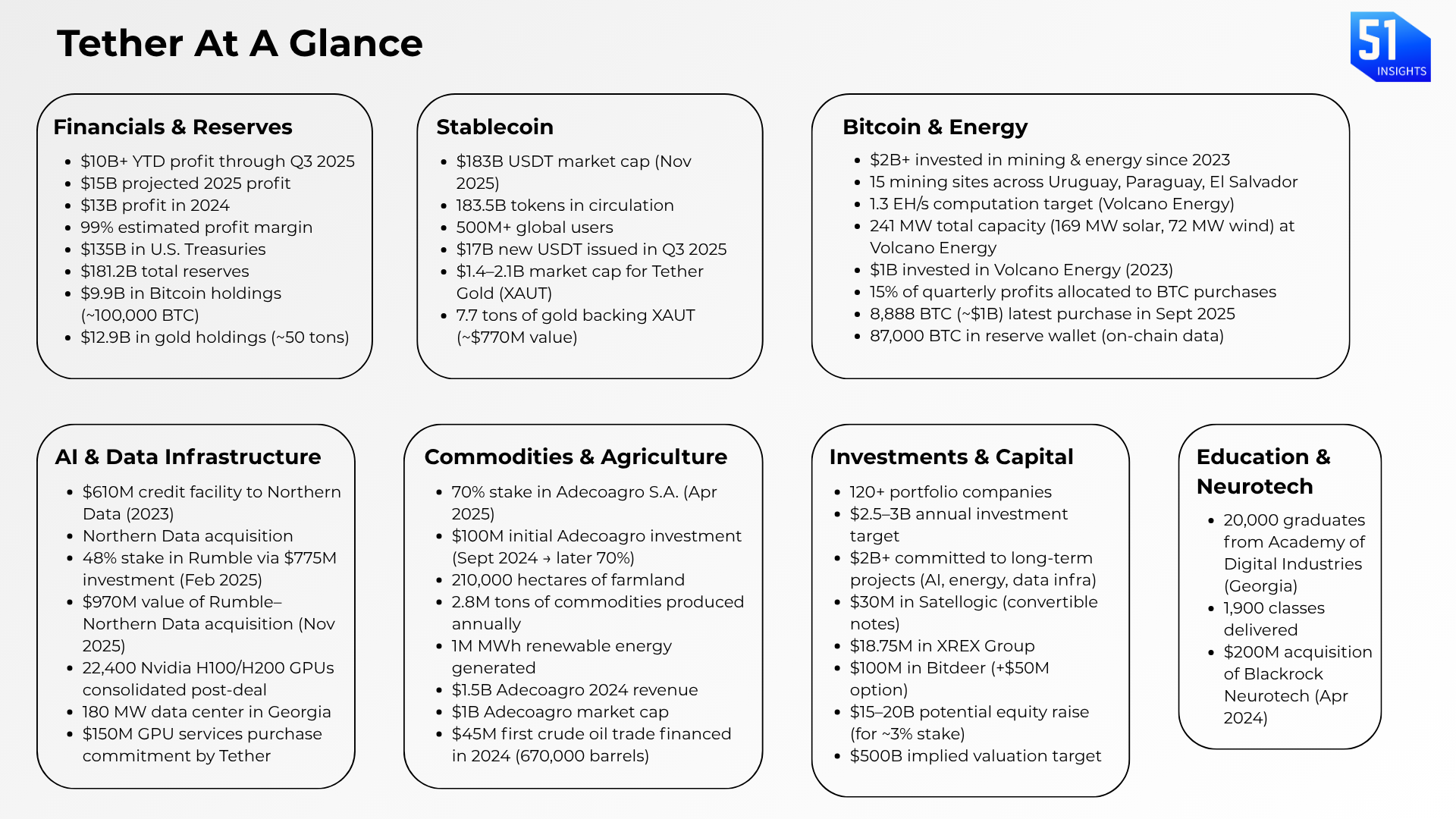
By the data: Tether became the 17th largest U.S. Treasury holder with $135B, surpassing South Korea and Germany. By Q3 2025, it reported over $10B in profit for the year (projected: $15B) with a 99% profit margin. It also plans to raise $15-20B at $500B valuation.
This massive footprint flips the narrative: Tether is now a net supporter of U.S. fiscal stability, helping to absorb the growing supply of Treasury issuance in a fragmented global market.
Unlike China, which is steadily divesting from Treasuries, or Europe, where demand is regulatory-bound, Tether is buying U.S. debt and distributing it to people who would never otherwise touch a Treasury product.
“For the first time, America has a decentralized buyer of its debt — and it’s reaching populations the U.S. financial system has never touched. […] We’re decentralizing access to U.S. Treasuries and embedding the dollar where it can’t be eradicated. That’s not just liquidity, that’s resilience.”
My biggest takeaways
- Stablecoins are becoming soft power infrastructure.
Ardoino’s most provocative claim, that Tether is “the best ally for the United States”, isn’t political marketing. It’s strategic positioning backed by distribution facts. Traditional banks can’t profitably reach 600M unbanked Africans. Tether can. This is dollar hegemony through private rails. The company isn’t competing with the Federal Reserve, it’s extending Federal Reserve Notes into markets traditional finance abandoned. As Ardoino put it:
“We should not go to the bank first. We should go to the shops, to the people that need it the most.”
“We’ve created the biggest monetary distribution network in history — and we’re using it to embed the dollar in places where it can’t be eradicated.”
- Tether is an infrastructure company
Ardoino’s core argument is that centralized platforms controlling money and communication flows create systemic fragility, not stability. His thesis:
“The centralization of money and communication over the last 30 years is a dangerous trend that will not scale for a future of AI agents and IoT devices.”
When WhatsApp goes down, 2 billion people lose communications. When AWS has an outage, half the internet breaks. Centralized platforms optimize for control and extraction, not resilience and accessibility. Tether’s bet is returning to peer-to-peer architecture at scale. Keet runs without servers that can be shut down. USDT moves without banks that can block transfers. Solar kiosks generate power without grids that can fail. QVAX executes AI without data centers that can restrict access. This is infrastructure designed to resist entropy, to remain stable when centralized systems collapse. The mission is making essential infrastructure accessible to everyone.
“We call ourselves a stable company because our goal is to reduce chaos — to bring stability to society.”
- Tether isn’t competing with Circle, it’s playing a different game entirely.
The market sees Tether vs Circle as a stablecoin rivalry. That’s wrong. Circle went public at $18B (now $33B) as a regulated stablecoin issuer targeting banks and institutions. Tether is building a decentralized infrastructure conglomerate.
The difference isn’t just regulatory strategy, it’s the total addressable market. Circle serves the existing financial system with compliant dollar tokens. Tether serves 3 billion people that system ignores, building the entire stack they need: money (USDT), energy (solar kiosks), communications (Keet), and compute (QVAX).
The valuation gap makes sense through this lens. Circle at $33B is a stablecoin company. Tether at $500B is a stablecoin company plus energy infrastructure company, plus communications platform, plus AI compute provider – all integrated into one distribution network.
- The business model is absurdly profitable.
Tether’s 99% profit margin comes from a simple arbitrage: hold customer deposits in short-term Treasuries yielding 4-5%, pay customers 0%, keep the spread. Tether will face competition, but for now, their distribution is their moat. At $180B scale with zero customer acquisition cost (users come because their local currency is failing), this prints $13-15B annually. The next decade will test whether Tether’s model, rooted in building real-world infrastructure for money, energy, and intelligence, can deliver a directed acceleration of technology that serves human resilience, not just financial returns.
Today’s Market Signals
- Coinbase and stablecoin startup BVNK call off $2B acquisition. Link
- JP Morgan rolls out the deposit token. Link
Take care,
Marc & team
👉Download the PDF