Polygon’s $250M payment pivot
Polygon spent eight years perfecting speed. Zero-knowledge rollups1. Plasma chains. Proof-of-Stake2 optimisations. Then on January 13, 2026, it abandoned that playbook entirely.
The company announced a $250M acquisition of Coinme (a compliance-first, cash-to-crypto network in 50,000 U.S. retail locations) and Sequence (a smart wallet and payments company). Together, these are a declaration: Polygon is no longer a scaling solution. It is now building a vertical payments stack that moves capital faster and cheaper than SWIFT, while operating inside U.S. regulatory guardrails. [RELEASE]
Let’s unpack.
👉PRO: Download the PDF
What happened:
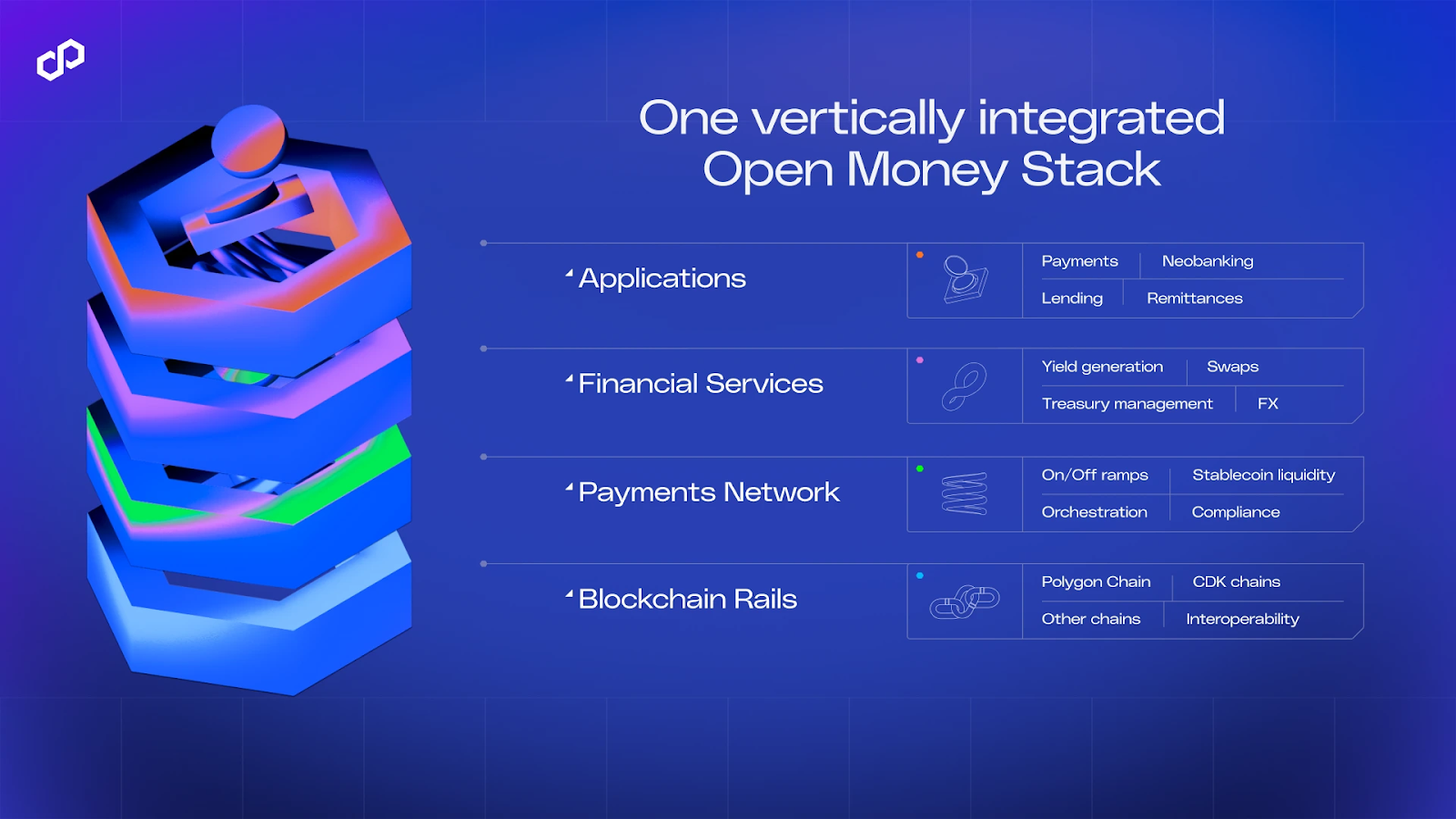
Polygon Labs announced on January 13, 2026, that it will acquire Coinme and Sequence in deals totaling over $250M, positioning itself as a regulated U.S. payments provider. The deal bundles to form the “Open Money Stack3”:
Coinme’s4 licensed fiat on-/off-ramps and retail touchpoints (48 state Money Transmitter Licenses)
Sequence’s5 wallet abstraction and cross-chain orchestration
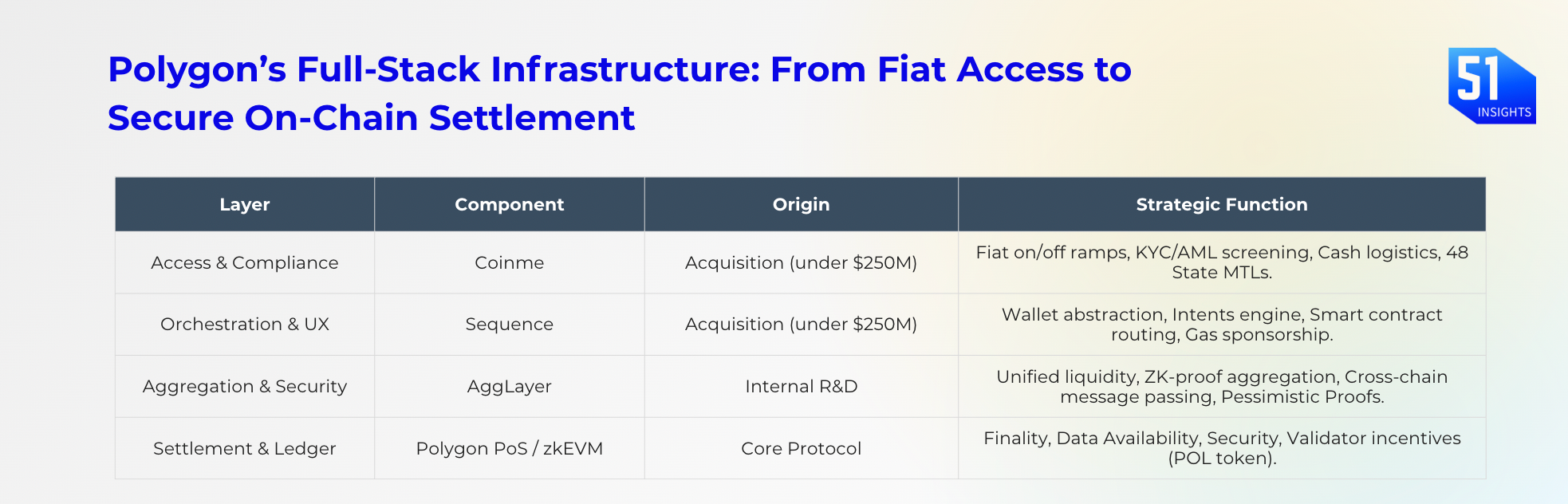
Polygon now controls the ledger, the wallet, and the fiat gateway, pivoting into a product-led fintech giant. Combined, Polygon + Coinme + Sequence have processed $1B+ in offchain sales and $2T+ in onchain value transfers.
Regulatory Context: Coinme paid $300,000 in California penalties in 2025 for violations, including exceeding state limits on individual customer transactions at kiosks. Coinme also faced a Washington cease-and-desist order (later stayed after segregating customer funds). Polygon CEO Marc Boiron told Fortune: “I think they go far beyond what is required... The way that they handle being able to limit risk to users, I think, is state of the art.”
The Strategic Play (&why Polygon won’t compete with Robinhood)
In our recent podcast with Marc Boiron (CEO at Polygon Labs), he said: Polygon isn’t going after consumer payment apps like Revolut or Robinhood, because:
- It requires insane amounts of capital
- It’s complicated to execute
- Polygon doesn’t want to compete with the companies it wants to partner with
 Marc Baumann
Instead, the strategy is B2B2C:
- 1. Corporate treasury operations: Serve enterprises directly. Treasury operations that need to move money globally. Companies that pay creators and freelancers across borders. These are high-value, repeatable transactions.
- 2. Enterprise payouts: Once you’ve made it easy for enterprises to use stablecoins on-chain, they start offering them to their end users. Now you’ve got adoption without building a consumer app.
- 3. Infrastructure-led consumer adoption: Over time, as stablecoins become more normal and integrated into commercial operations, developed markets naturally adopt them.
“I’ve told my team: developed country merchant payments are not where we spend time. I’m not going to a US store to pay in crypto; I’ll use Venmo. But if my family in Canada needs money, or a cotton farmer in Africa needs to get paid by a global corp? That’s where the blockchain wins.”
Translation: Polygon doesn’t need to build Venmo. It needs to BE the rails that Venmo uses when it goes global.
“This is actually one of the difficulties that Coinbase has, for example. Coinbase has done a phenomenal job executing—they’ve become a fintech giant. The problem is when you’re a fintech giant, none of the other fintechs want to use your products, right? Because why would they pay a competitor for this stuff?”
Be smart: Timing is strategic. With movements in the Clarity Act senate voting and validation of stablecoins as payments mode, this transition threatens the revenue models of correspondent banks.
Marc Baumann
Not B2B or retail. Polygon is targeting B2B2C volume for payments in countries like India.
Polygon is now building the plumbing for that shift.
Zooming in: Polygon solved the adoption killer: fragmentation. With Sequence’s “Trails” technology and gas sponsorship, the blockchain becomes invisible. Users log in with Google, pay in USDC, and the “AggLayer” handles the bridging, swapping, and gas fees in the background. It’s the “WeChat Pay” experience on decentralised rails.
By the data: The remittance market was projected to reach $913B in 2025, and current pathways take 2–5 days at 6.6% cost. Whereas, Treasury data models $6.6T in potential deposit flight if stablecoins offer 5% yield while bank deposits offer 0.5%.
Investor Alpha
Polygon is undergoing a radical “narrowing.” By moving away from being a general-purpose “World Computer” and focusing on being the “Global Payments Layer,” they are positioning themselves to capture a good share of the $300B+ stablecoin market.
From Token Play to Cash-Flow Business: Polygon historically relied on Foundation funding to drive POL token value. Post-acquisition, it transitions to self-sustaining transaction-fee revenue with $100M+ annual revenue target.
The infrastructure phase of crypto is over; the application phase has begun. Polygon historically relied on Foundation funding to drive POL token value. Post-acquisition, it transitions to self-sustaining revenue with $100M+ annual revenue target (through Coinme’s fiat conversion fees (basis points on $1B+ in off-chain sales)). Many investors are still pricing POL based on throughput-per-second, but the real alpha lies in Polygon’s ability to capture stablecoin velocity and generate revenue.
- Polygon ecosystem token (POL): POL trades at $0.15 (down 66% YoY) because markets price it as blockchain infrastructure. If Polygon captures stablecoin payment velocity and conversion fees, it should be valued as a cash-flow business. That’s a different valuation model entirely.
- Long DeFi Blue Chips (Aave/Uniswap on Polygon): Polygon enables users to earn 5% APY through DeFi protocols (Coinme → USDC → Aave) without being a stablecoin issuer. Same economic outcome. Different legal structure. Banking lobby calls it “shadow banking.” Polygon calls it “infrastructure neutrality.” Meanwhile, the GENIUS Act might ban stablecoin issuers from paying yield but allow third-party platforms to offer rewards. The Senate Banking Committee votes this week on whether to close this “loophole.”
Watchlist:
- Jan: USAT launch by Tether (expected)
- Jan: Clarity Act (H.R.3633) Senate vote (expected)
- Jan 13: Consumer Price Index data for December 2025; heavily influence the January 27-28 meeting
- Jan 15: Senate committee vote
- Jan 27: The Federal Reserve will convene for two days, with the rate decision
- Jan: SEC Crypto Innovation Exemption
- Jan: Spot crypto ETF approvals for altcoin
- Q1’26: Kraken IPO
- Q1’26: Hong Kong Stablecoin licensing
- Q1’26: Singapore Stablecoin framework
Market signals
- BitPanda eyes Frankfurt IPO in 1H26. Link
- The U.S. Senate Committee released the market structure bill. Link
- StanChart plans crypto prime brokerage. Link
That’s it for now.
Marc & Team
Zero-knowledge (ZK) rollups are Layer 2 scaling solutions that process transactions off-chain and use cryptographic validity proofs to verify them on a main blockchain (Layer 1), such as Ethereum. By bundling thousands of transactions into a single batch, they significantly increase throughput and reduce gas fees while maintaining the security of the underlying network. ↩
Proof-of-Stake (PoS) is the dominant consensus mechanism for the majority of top-tier blockchain networks, including Ethereum, Solana, and Cardano. Unlike the energy-intensive Proof-of-Work (PoW) used by Bitcoin, PoS selects network “validators” based on the quantity of native tokens they hold and are willing to “stake” as collateral. ↩
The “Open Money Stack” is a strategic vision and integrated technological framework being developed by Polygon Labs, not a single application that a user can “open” in the traditional sense. It is a comprehensive set of services designed to move all money on-chain instantly and reliably. ↩
Coinme’s tech stack includes a proprietary “Compliance Engine” that performs real-time sanction screening (OFAC) and transaction monitoring. This engine is integrated directly into the OMS APIs. When a transaction is initiated via Sequence, it is simultaneously screened by Coinme’s infrastructure before being broadcast to the AggLayer, ensuring that all value transfer within the compliant zone of the stack meets U.S. regulatory standards. ↩
Sequence provides the interface layer using advanced implementation of ERC-4337 (Account Abstraction).
Session Keys: Allows users to grant limited permissions to a dApp for a specific duration, enabling “1-click” gaming or payment interactions without signing every single transaction.
Gas Abstraction: The “Relayer” infrastructure in Sequence allows fees to be paid in any token (e.g., USDC, EURC) or sponsored by the application. This is critical for payments; a user buying coffee doesn’t want to hold a volatile gas token like POL or ETH, they just want to spend their stablecoin. ↩
The AggLayer (Aggregation Layer) is the linchpin of Polygon’s technical strategy. It solves the fragmentation problem of modular blockchains.
The Fragmentation Problem: In a typical modular ecosystem (like the OP Stack or Cosmos), each chain has its own state and liquidity. Moving assets requires asynchronous bridging, which is slow and introduces security risks (e.g., the “weakest link” problem where a compromised bridge affects all connected chains).
The AggLayer Solution: The AggLayer uses Zero-Knowledge (ZK) Proofs to aggregate the state of all connected chains into a single proof that settles to Ethereum.
Pessimistic Proofs: A pessimistic proof guarantees that a chain cannot withdraw more tokens from the unified bridge than it has deposited. It treats every connected chain as untrusted. This allows for shared liquidity without shared risk, if one chain is compromised, the damage is contained to that chain and cannot drain the shared pool.
Atomic Transactions: The AggLayer enables atomic cross-chain transactions. A user can execute a swap on Chain A and a lending action on Chain B in the same transaction bundle, with the AggLayer ensuring both happen or neither happens. ↩
"ZK-powered" refers to systems or protocols that utilize Zero-Knowledge (ZK) technology—a cryptographic method where one party (the "prover") can prove a statement is true to another party (the "verifier") without revealing any of the underlying data. ↩