

JP Morgan: Stripe of Private Markets?
J.P. Morgan made private equity history on-chain by launching Kinexys Fund Flow.
It offered high-net-worth clients served by JPM Private Bank direct digital ownership of fund shares, with a broader Kinexys rollout planned for 2026 into real estate, infrastructure and private credit. [NEWS]
This is the world’s largest bank turning LP stakes into tokens.
Let’s unpack.
PRO: Download the PDF
What Happened
JPM tokenised a private equity fund on its own blockchain, Kinexys. It is turning private-market infrastructure into a profit engine, opening access to a $400B high-net-worth investor pool while capturing fees across issuance, custody, and settlement in a single, integrated loop.
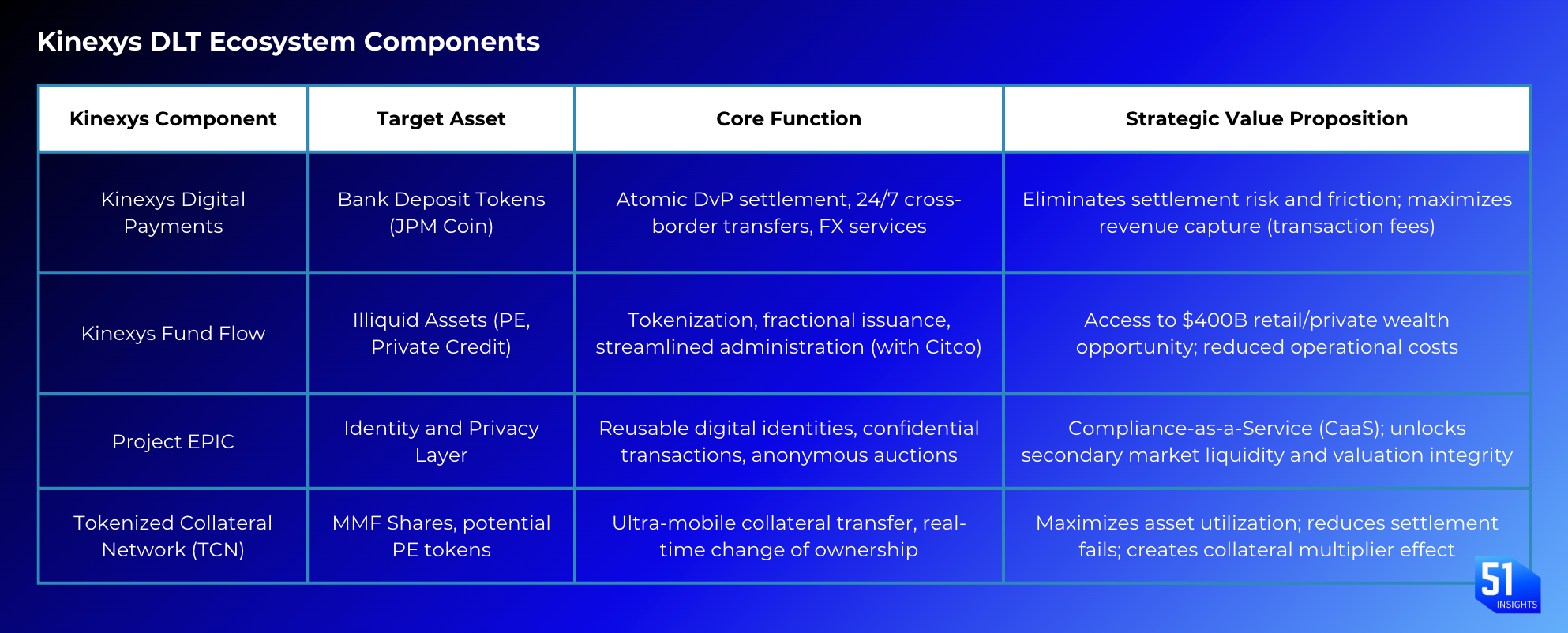
Zooming in: The debut PE tokenisation transaction was conducted in collaboration with fund administrator Citco, a critical operational partnership.
The immediate upside is practical: faster settlement, cleaner records, simpler transfers between owners and a smoother onboarding experience for wealthy clients who want alternatives without paper-heavy ops.
The numbers tell the story:
- Private markets: $23T today → $32T by 2030
- JPM’s Kinexys: $1.5T processed since 2020
- Processing $2B+ per day
Zooming out: While its peers (Goldman Sachs and BNY Mellon) are rolling out tokenised money-market products, and regulators have handed clearer rules, JP Morgan is building the Stripe of private markets by tokenising the illiquid asset class, private equity, rather than liquid cash equivalents.
 Marc Baumann
Why it matters
1. Infrastructural efficiency
Tokenisation redraws three lines that have long defined private markets: access, liquidity and cost. Managers who embrace digital shares get easier distribution and faster NAV updates; custodians that adapt keep relevance; banks that stitch issuance, custody and settlement can capture new, recurring fees.
2. Targeting the structural friction points
Competitors have focused on tokenising liquid assets, such as Money Market Funds. JPM, conversely, is tokenising “what never moves.” Tokenising private equity, a complex, high-fee asset class, signals JPM’s move to its blockchain shift from internal cost savings to a profit-making business line, while securing the banking mandate.
3. The payment engine
Kinexys’s real advantage is its built-in digital cash system, Kinexys Digital Payments (formerly JPM Coin), which enables instant, atomic settlement, assets and cash to move together, eliminating counterparty and settlement risk. By integrating tokenised funds and digital USD deposits on the same ledger, JPMorgan creates a closed commercial loop that locks in fees across issuance, custody, settlement, and FX.
Our take
JPMorgan’s move is the recognition that the highest-margin opportunity resides not in the commoditised asset custody, but in controlling the transactional layer. It plans to own both the client experience and the settlement economics. By 2026, private equity, private credit, real estate, and infrastructure funds can trade on Kinexys. Its existing transaction volume ($2B+ / day) gives it a built-in network advantage; every new tokenised asset plugs into a trusted, liquid ecosystem, helping it with scale and plumbing: interoperability, secondary market depth, and client behaviour.
Not just that. JPM is standardising the data layer and processes across the complex fund lifecycle. By unifying fragmented fund data, JPM gains a rich stream of transactional intelligence, positioning it to monetise insights through premium “smart data” services built atop its core infrastructure.
We will see other banks pivot toward building or partnering on digital asset infrastructure, covering private credit, structured notes, and alternatives. The strategic priority is clear: develop or acquire the infrastructure that meets institutional-grade standards.
More analysis from 51:
Marc Baumann Marc Baumann
Today’s Market Signals
- Mastercard acquires Zerohash for $2B. Link
- Securitize and BNY Mellon launch a tokenized fund backed by AAA-rated collateralized loan. Link
- Consensys plans for IPO. Link
Take care,
Marc
🙌 Work with us: We create pioneering thought leadership that helps digital asset and technology companies lead the conversation, earn trust and win business.
