
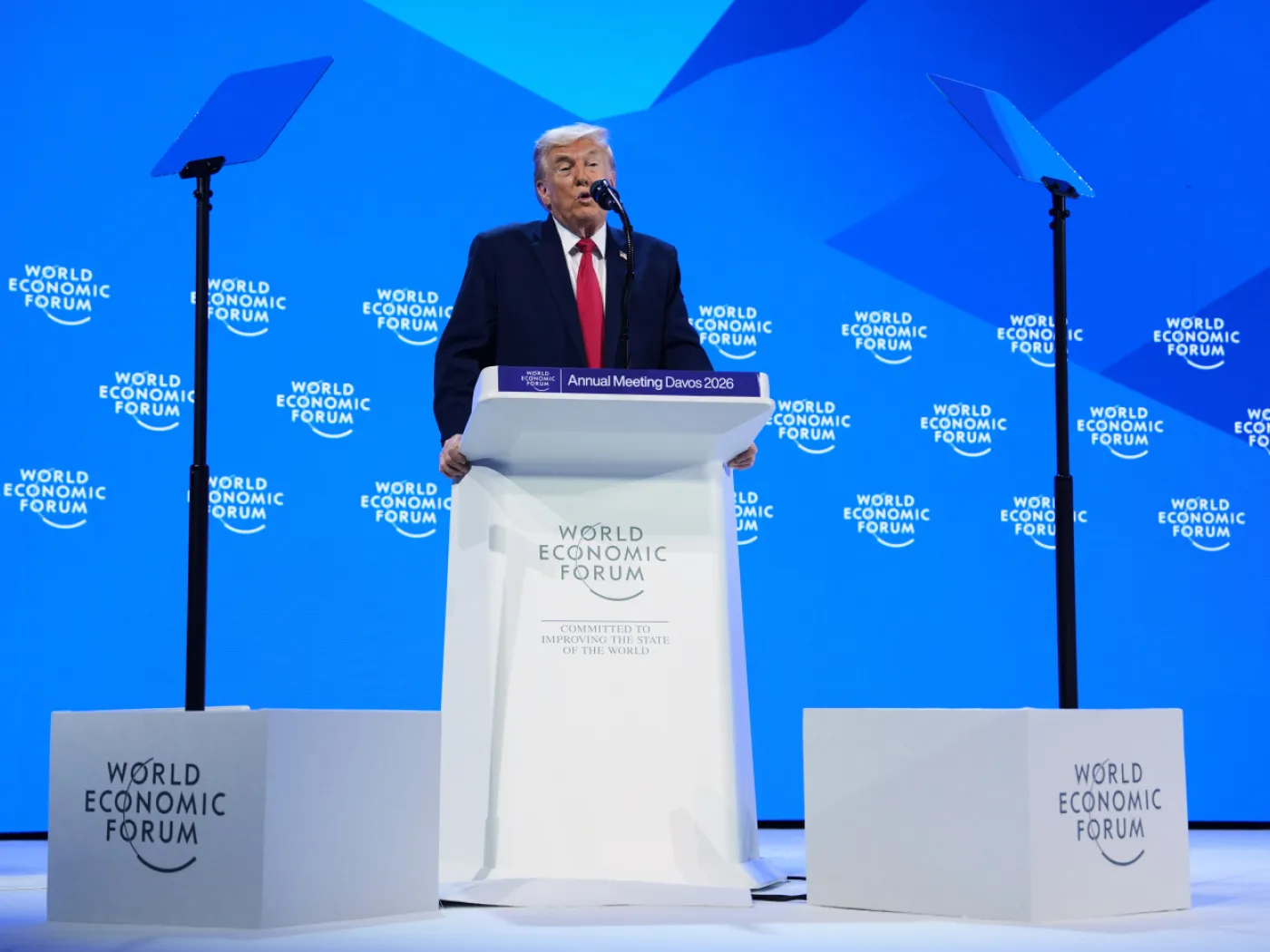
What Davos really said about crypto
Dear PRO reader,
Every January, the world’s most powerful people gather in the Swiss Alps to tell us what they actually think. This year, we listened.
We tracked every panel, keynote, and CNBC hit from the 2026 Davos event. Trump. Fink. Dimon. Ermotti. Allaire. Armstrong. Musk.
The question: where do the people controlling $50+ trillion in capital actually stand on Bitcoin, blockchain, and digital assets?
The answer surprised us. The debate has shifted. Nobody argued whether blockchain would transform finance. They argued over who controls the rails.
Here’s what the most powerful voices in global finance said, and what it means for investors and operators.
👉PRO: Download the PDF
What happened
The 56th Annual Meeting of the World Economic Forum (WEF) in Davos, convened in January 2026, revealed a global financial order in a state of aggressive fragmentation and reconstruction. Davos 2026 became a clear turning point: a more protectionist U.S. government, a defensive traditional banking sector, and a crypto industry shifting from rebellion to acceptance all collided in one place.
Binance former CEO Changpeng Zhao(CZ) sees three waves emerging:
- Tokenization: Governments will tokenize their own asset holdings
- Stablecoin payments: The bridge between crypto and commerce
- AI native currency: Crypto as the settlement layer for AI agents
The quotes that matter:
We compiled the most significant statements from Davos 2026 and what they signal for investors.
1. Stablecoins: Digital Mercantilism vs. Open Finance
By 2026, stablecoins have evolved from a niche trading tool into a critical component of global payments. The total stablecoin transaction volumes surged to $33T in 2025. Now, it is being recognised on global platforms including the WEF annual meeting with leaders who view stablecoins not just as crypto-trading rails, but as a solution for cross-border payments, remittances, and a hedge against inflation in emerging markets.
“We saw transaction volume in USDC grow 580% year-on-year… and stablecoins act as the general purpose money for the internet.” – Jeremy Allaire, CEO, Circle
“Remittances are more important to Africa than aid... stablecoins take minutes and it costs a dollar.” – Vera Songwe, Chair, Liquidity and Sustainability Facility
Our take: Songwe’s perspective from the Global South reframes the stablecoin narrative. This isn’t about trading infrastructure; it’s about financial survival. Cross-border remittance fees average 6-7% through traditional channels. Stablecoins collapse to near-zero. When African adoption is driven by humanitarian necessity, not speculation, the use case is structural. High optimism on utility and adoption.
2. Regulation and Geopolitics
The growth in stablecoin volume and institutional adoption were mainly accelerated by the passage of the GENIUS Act. The US GENIUS Act was about extending American hegemony through frictionless dollar distribution.
But the geopolitical angle is sharper. The Act includes extraterritorial provisions that force foreign jurisdictions to align their crypto regulations with Washington’s or lose access to the U.S. market. The EU passed MiCA. Now they negotiate with Treasury over what counts as “comparable” regulation.
Meanwhile, the CLARITY Act – the grand bargain on market structure – imploded during Davos week. The sticking point: whether stablecoin issuers can pay yield. Banks say it threatens deposits. Coinbase CEO Brian Armstrong called the lobbying effort “un-American.”
Bill Winters (CEO, Standard Chartered) took a pragmatic view, noting that while stablecoins are currently used for payments, “as a store of value they’re much less interesting if they don’t... carry a yield“. However, some bank CEOs argue this creates a “deposit flight risk.“
U.S. dominance was visible throughout Davos.
Why China is “spooked”: USDC running on smartphones anywhere in the world is functionally a dollar bank account without KYC friction. For a Chinese citizen wanting to move capital out of the mainland, it’s a porous border the People’s Bank of China can’t seal. The e-CNY, their digital yuan, is surveillance infrastructure. The USDC alternative is perceived freedom plus monetary stability. Beijing sees their capital controls eroding in real time.
Trump was explicit at Davos: Any nation building a BRICS currency or backing one gets 100% tariffs. That’s not a threat. That’s a binary choice encoded in trade policy.
“I’m also working to ensure America remains the crypto capital of the world... China wanted that market too. It’s just like they want AI and we’ve got that market I think pretty well locked up.” – Donald Trump, President of USA
On geopolitical stakes, he added: “We have to make it so that China doesn’t get the hold of it. And once they have that hold we’re not going to be able to get it back.”
“Come grow with the US.” – Scott Bessent, US Treasury Secretary
Our take: Bessent frames the US environment as “regulatory certainty” and “deregulation.” He contrasts this with Europe, citing business leaders who find it “easier doing business in China than the EU” due to red tape. The message to global capital: America is open, Europe is not.
3. On Blockchain Adoption
“Blockchain is the future for traditional banking. You will see a convergence.” – Sergio Ermotti, CEO, UBS ($6.9T AUM)
Our take: This is the quote of Davos. UBS went from “blockchain yes, crypto no” in 2018 to offering Bitcoin trading in 2026. When the world’s largest wealth manager declares convergence inevitable, the institutional conversion thesis is no longer speculative. It’s operational. Days after this statement, UBS announced BTC trading for wealth clients. Follow what they do, not just what they say—and now they’re doing both.
“The potential effect of quantum computing on the safety of cryptocurrencies still needs to be proved.” – Sergio Ermotti, CEO, UBS
Our take: Ermotti joins Ray Dalio, BlackRock, and Jefferies’ Christopher Wood in flagging quantum risk. This isn’t FUD, it’s institutional risk management. Expect quantum-resistant narratives to gain traction in 2026. Bitcoin developers face mounting pressure to demonstrate urgency. Nic Carter warns that if they don’t, allocators will “quietly downgrade and re-weight Bitcoin in their portfolios.”
“We would be reducing fees, we would do more democratization. If we have one common blockchain, we could reduce corruption.” – Larry Fink, CEO, BlackRock ($11.5T AUM)
Our take: Fink wants a single settlement layer for global finance. BlackRock’s BUIDL fund already tokenises Treasuries on Ethereum. If the world’s largest asset manager is building on public rails, the private blockchain vs. public blockchain debate might be over soon.
4. On Tokenization
“Eventually all things will settle in digitized form.” – Bill Winters, CEO, Standard Chartered
Our take: Standard Chartered warned $1T could flee emerging market banks by 2028 due to stablecoin adoption. Winters isn’t cheerleading; he’s acknowledging an existential threat to his own business model. When bank CEOs predict total digital settlement, they’re telling you their strategic planning assumptions. Tokenised RWAs crossed $40B. The trajectory is set.
“A cross-asset trade that needs two accounts and two days of waiting? On-chain it’s one signature in 10 seconds.” – Gracie Chen, CEO, BitGet
Our take: The NYSE moving to 24/7 tokenized trading is competitive necessity. Settlement compression is the killer app. Two days to ten seconds isn’t an improvement, it’s a category change. Infrastructure providers enabling instant settlement capture the spread.
“There’s about 4 billion adults right now who are unbrokered—they don’t have any way to invest in high-quality assets. Apollo wants to tokenize every single fund they have.” – Brian Armstrong, CEO, Coinbase
Our take: Armstrong frames tokenization as financial inclusion, and talks his own book. The unbrokered population is the TAM that keeps institutional strategists awake – and always makes for a good narrative at places like the WEF.
5. On AI and Crypto Convergence
“The native currency for AI agents is going to be crypto. Blockchain is the most native interface for AI agents.” – Changpeng Zhao, Former CEO, Binance
Our take: AI agents can’t open bank accounts. They need programmable money. CZ’s thesis: as autonomous AI proliferates, crypto becomes the default payment layer for machine-to-machine transactions. The “Machine Economy” is speculative today. It may be the dominant volume driver by 2030.
“AI agents making high-velocity transactions at very low cost—taking out your Visa card or firing up a bank wire is completely absurd.” – Jeremy Allaire, CEO, Circle
Our take: Allaire predicts “billions of AI agents conducting economic activity continuously.” If accurate, stablecoin velocity explodes. USDC isn’t competing with Visa for human transactions, it’s positioning for machine transactions that don’t exist yet. First-mover advantage in AI payment rails could define the next decade.
“The limiting factor for AI deployment is fundamentally electrical power.” – Elon Musk, CEO, Tesla/SpaceX
Our take: Musk predicts AI surpasses collective human intelligence by 2030. His bottleneck analysis matters: energy, not chips. Ripple CEO Brad Garlinghouse noted most tokenization runs on low-energy Proof-of-Stake chains. The intersection of AI compute demands and blockchain energy efficiency is underexplored. Watch for infrastructure plays bridging both.
6. On Banking’s Future
“Now we have Stripe and PayPal coming at you. If you put your head in the sand, you will lose.” – Jamie Dimon, CEO, JPMorgan
Our take: Dimon acknowledges the threat but defends banks’ role in large-scale capital movement. The subtext: JPMorgan is playing defense on payments, offense on custody and prime brokerage. Their acceptance of BTC/ETH as loan collateral signals where they see defensible moats. Payments are commoditizing. Balance sheet services aren’t
“Brick and mortar banks will decrease significantly over the next 10 years.” – Changpeng Zhao, Former CEO, Binance
Our take: The most bearish take on traditional banking at Davos. CZ’s prediction is aggressive but directionally consistent with branch closure data. The counterargument: regulatory trust and compliance infrastructure remain bank advantages. Winters called banks “the policeman” for financial crime. Governments won’t outsource AML to protocols. Hybrid models win near-term.
“The bank lobbying groups are out there trying to ban their competition. I have zero tolerance for that. I think it’s un-American.” – Brian Armstrong, CEO, Coinbase
Our take: The CLARITY Act collapsed over yield restrictions. Armstrong frames it as incumbent protection. The yield debate determines whether stablecoins compete with deposits or stay in payments lanes. If yield passes, the deposit flight accelerates. If it doesn’t, stablecoin issuers pivot to transaction volume. Either way, the competitive dynamics intensify.
So What?
The technology argument is over. Blockchain won.
The remaining fights are political: who controls the rails (sovereign vs. private), who captures the value (banks vs. fintechs), and which nations set the rules.
Ermotti’s (and UBS’s) conversion tells you where the puck is going. Fink wants one global blockchain. Dimon admits fintechs are “coming at you.”
For investors, the alpha isn’t in token prices. It’s in the firms providing custody, settlement, and collateral infrastructure. The Davos consensus: blockchain infrastructure is inevitable. The Davos debate: who builds it, who regulates it, and who profits.
Position accordingly.
🙌 Work with us: We arm financial institutions and digital asset leaders with bespoke research, thought leadership to shape the most important conversations, scale trust, and win business.

Investor Alpha
Many investors are betting on token prices. The real alpha is in the firms providing custody, settlement, and collateral infrastructure.
- Coinbase (COIN): Generates $332M annually from stablecoin yield sharing. A yield ban destroys this revenue stream. But their custody and institutional infrastructure becomes more valuable if banking continues to consolidate around tokenized assets. 👉 Trade on Robinhood
- BlackRock (BLK): Manages Treasuries backing USDC. The GENIUS Act mandates reserves stay in T-bills. More USDC circulation = more Treasury demand = more BlackRock AUM. The boring bet that actually compounds. 👉 Trade on Robinhood
- Payment Processors (PYPL, Stripe): Also brooks’ compromise (yield on transactions only) specifically favors closed-loop payment networks. Velocity plays over savings plays. 👉 Trade on Robinhood
Watchlist:
- Jan 27: Federal Reserve two-day meeting, rate decision
- Jan: SEC Crypto Innovation Exemption window
- Jan: Spot crypto ETF decisions for altcoins
- Feb 2: Bank of Japan (BoJ) Summary of Opinions (Jan meeting)
- Feb 4–5: ECB Governing Council monetary policy meeting
- Feb 5–6: Digital Assets Forum 2026, London
- Feb 9: Liquidity Summit 2026, Hong Kong
- Feb 10–12: Consensus Hong Kong (CoinDesk)
- Feb 11: US CPI (Jan) release
- Feb 12: US PPI release
- Feb 17–21: ETHDenver 2026
- Feb 18: FOMC minutes for Jan 27–28 meeting
- Q1’26: Kraken IPO window
- Q1’26: Hong Kong stablecoin licensing regime
- Q1’26: Singapore stablecoin framework launch
Today’s Market signals
- Revolut scraps US merger plans in favour of push for standalone licence. Link
- Ethereum treasury firm ETHZilla purchased two jet engines for $12.2M. Link
- Binance and OKX will introduce tokenised U.S. stock products. Link
- Ondo launches tokenized stocks on SOL. Link
- BitGo raises $213m in IPO, $2b+ valuation. Link
- US M2 supply hits $22.3T. Link
That’s it for now.
Marc & Team
Appendix
- Special Address by Donald J. Trump, President of the United States of America | WEF 2026
- New Era for Finance | World Economic Forum Annual Meeting 2026
- Conversation with Scott Bessent, US Secretary of the Treasury | WEF Annual Meeting 2026
- Is Tokenization the Future? | World Economic Forum Annual Meeting 2026
- Conversation with Elon Musk | World Economic Forum Annual Meeting 2026
- Conversation with Ken Griffin, President and CEO of Citadel | WEF Annual Meeting 2026
- Dedollarization or Redollarization? | World Economic Forum Annual Meeting 2026
- He Lifeng, Vice-Premier of the People’s Republic of China | World Economic Forum Annual Meeting 2026
- Rebalancing the New World Order | World Economic Forum Annual Meeting 2026
- Where Are We on Stablecoins? | World Economic Forum Annual Meeting 2026