
Wall Street's weekend just died
Hey, it’s Marc,
On May 29, CME opens crypto derivatives trading 24 hours a day, 7 days a week. One problem: if Bitcoin crashes at 3am on a Saturday, CME has to manage that margin call instantly, and every bank in America is asleep.
The world’s largest derivatives exchange just dragged traditional finance into a stress test it doesn’t have the plumbing for. [RELEASE]
Let’s unpack.
👉PRO: Download the PDF below
What happened
In February, CME Group said what traders have been begging for: 24/7 crypto futures and options, live on Globex starting May 29. Continuous trading, one two-hour maintenance window per week, done.
Why now: The trigger is volume. Bitcoin and Ether ETFs brought in billions of dollars and a big problem: traders needed to hedge over the weekend, but CME was closed. They sat exposed to price swings with zero cover. That problem dies on May 29.”
The numbers tell the story: In 2025, CME processed a record $3T in notional crypto volume. This year, Average Daily Volume (ADV) surged 46% year-over-year to 407,200 contracts. Large open interest holders hit a record 1,039.
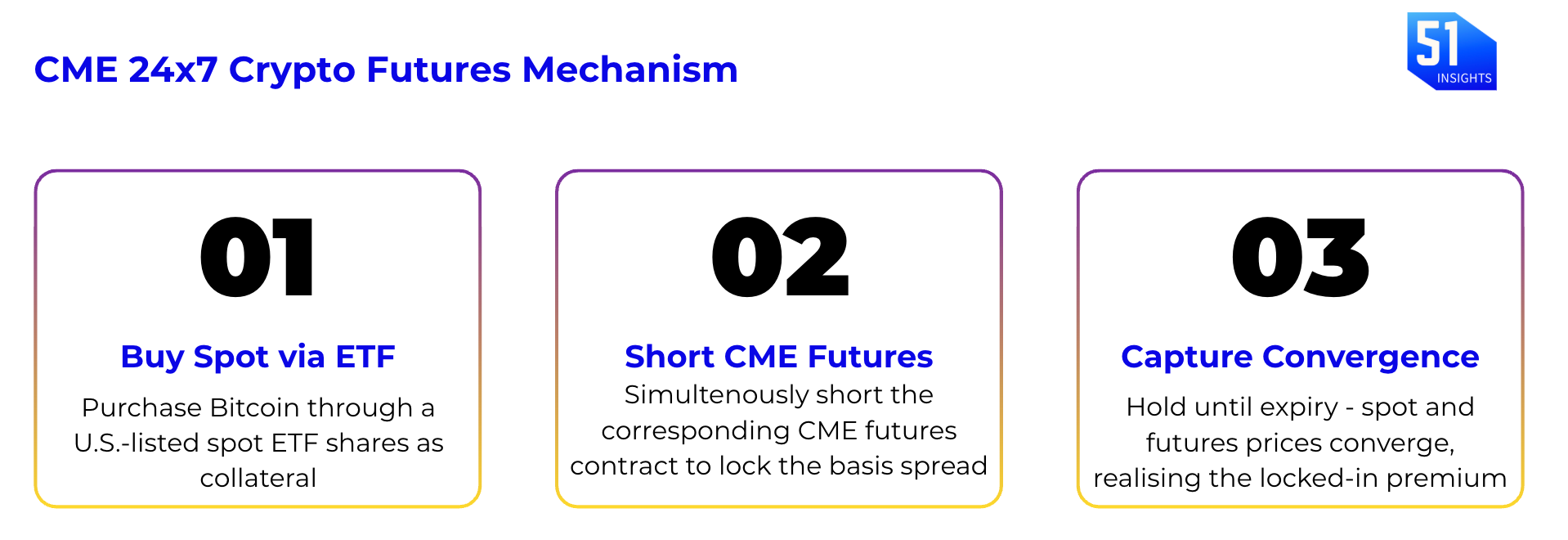
Zooming in: Here’s how the smart money actually uses this: the basis trade. Buy Bitcoin spot (through the ETF), short CME futures at a higher price, and pocket the difference. You’re market-neutral, meaning you don’t care which direction Bitcoin moves. You just collect the spread. In a contango market (where futures trade above spot), this is essentially a risk-free yield on crypto exposure.”
The mechanics:
How 24/7 trading change the game:
- Price discovery: Removing the Friday close barrier enables continuous feedback loops that dictate basis behavior, institutions can deploy capital to capture basis spikes the exact moment they occur, any day of the week.
- Embedded models: Institutional desks integrate real-time Fear & Greed analytics directly into basis models, using 90-day Z-scores of MACD and 30-day rolling returns to convert market psychology into actionable entry signals.
- Capital efficiency: ETF shares serve as collateral with standard haircuts, enabling leveraged deployment of borrowed capital. 24/7 access maximizes return on equity by eliminating weekend opportunity gaps.
- Basis volatility: Continuous trading reduces artificial basis volatility spikes concentrated around weekly settlement windows, improving the risk-adjusted return profile of the overall carry strategy.
Zooming out: As institutional footprints expand through ETFs, corporate treasuries, and CME derivatives, Bitcoin’s correlation with global risk sentiment and traditional equities will surge dramatically.
Why it matters
- The Death of the CME Gap & The Basis Trade: Historically, there was a price gap every weekend, Bitcoin’s Friday closing price often differed from where it opened on Sunday. Traders would exploit this gap. Now, with continuous trading, that gap disappears. The weekend gap is gone, but it’s not completely dead, it’s just shrunk to two hours. And traders are already preparing for it. The strategy is simple: watch for unusual activity right before the pause, track how crypto prices move on other exchanges during those two hours, then trade the moment Globex comes back online. Same game. Two-hour window.
- What happens when Bitcoin crashes and banks are asleep: If Bitcoin crashes at 3am on a Saturday, CME has to manage that risk instantly, but the traditional banking system is offline. Their current fix requires members to set aside cash upfront before the weekend. It works, until a crash is big enough to overwhelm it. The only real solution is stablecoins and digital versions of government bonds that can move instantly, any time, without banks. Stablecoin supply has already doubled to $300B in 18 months. Traditional payment systems can’t handle billion-dollar emergency transfers. The problem is that CME is bringing traditional finance into a 24/7 world without the plumbing to support it.
Investor Alpha
This transition to a 24/7 market is the live beta test for T+0 settlement across all global equities. The legacy banking model relied on the multi-day float to manage balance sheets. That buffer is dead. The real winners here aren’t the funds betting on Bitcoin’s price, but the infrastructure providers supplying the programmable collateral and real-time AI liquidity routing that makes a Saturday night margin call survivable. Capital efficiency is the new alpha.
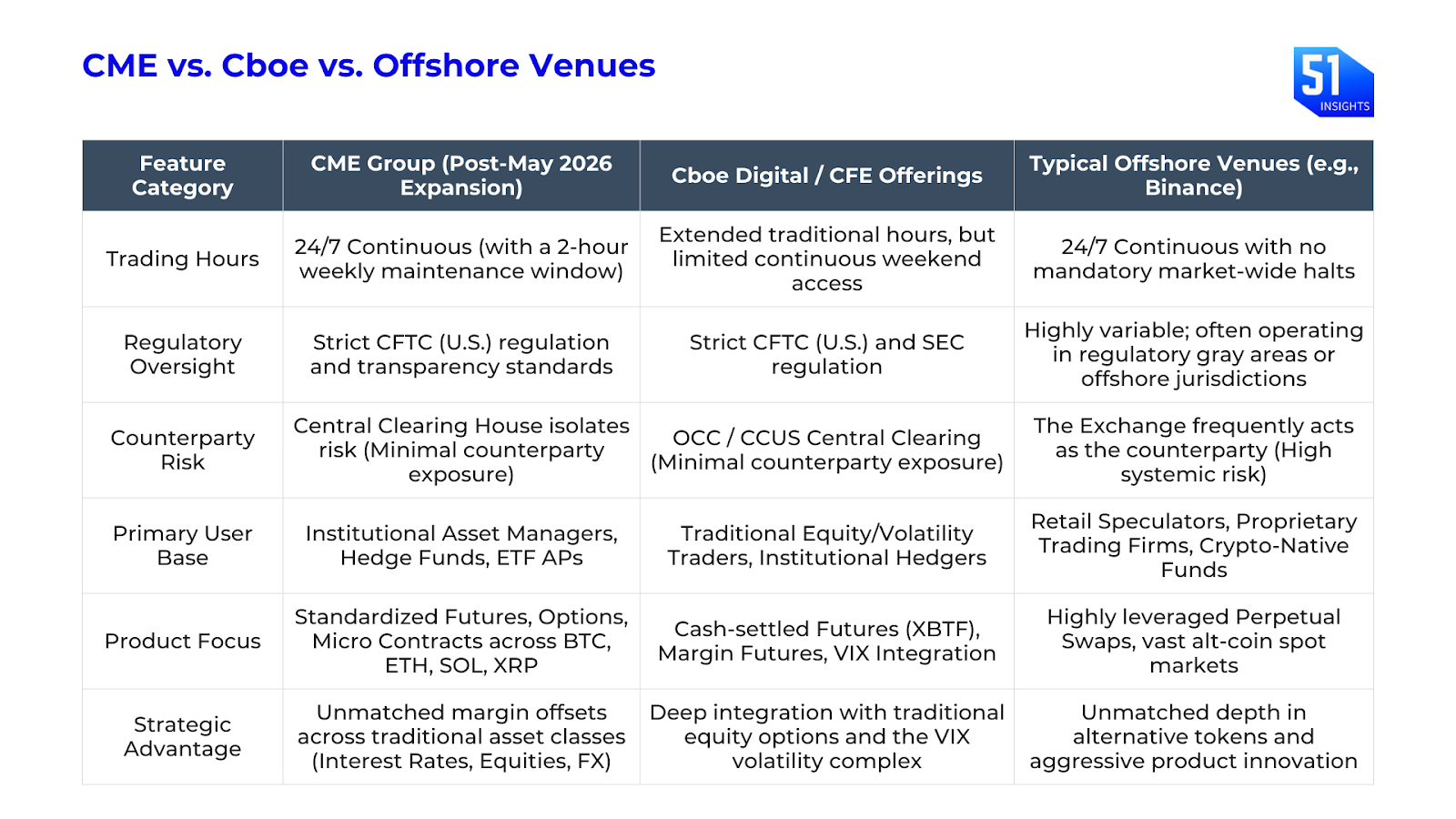
- Long CME Group (CME): They are building a structural monopoly. By offering 24/7 crypto trading with the ability to cross-margin against traditional assets (interest rates, FX, equities), CME saved clients $80B in daily margin last year. Offshore exchanges simply cannot replicate this level of capital efficiency. 👉 Trade on Robinhood
- Long the Stablecoin Plumbing (BLK / COIN): A 24/7 derivatives market requires 24/7 collateral. With the GENIUS Act legitimizing stablecoins for wholesale settlement, USDC and tokenized Treasuries become the default weekend margin. BlackRock (BLK) manages the underlying Treasuries; Coinbase (COIN) captures the ecosystem flow. More weekend margin equals more stablecoin demand, driving higher AUM and velocity revenues. 👉 Trade on Robinhood
- Short MicroStrategy (MSTR) Premium: With CME offering non-stop, regulated, highly liquid leverage that precisely tracks the asset without weekend gaps, the institutional need to use MSTR as a proxy for leveraged Bitcoin exposure continues to evaporate. It compresses the Microstrategy’s premium. 👉 Trade on Robinhood
Watchlist:
- Mar 11: US CPI (Feb) release – critical for Fed rate cut expectations
- Mar 17–18: DC Blockchain Summit (Chamber of Digital Commerce)
- Mar 18: FOMC Interest Rate Decision & Summary of Economic Projections
- Mar 24–25: Next Block Expo (Warsaw)
- Mar 24–26: Digital Asset Summit (DAS) (New York City)
- Mar 25: Crypto Assets Conference (#CAC26 Frankfurt)
That’s it for now.
Missed last week? Access all our CEO notes here.
Marc & Team