

Visa’s new card: It’s called a stablecoin
Visa has just gone all-in on stablecoins, adding support for four tokens (USDC, PYUSD, USDG, EURC) across four different blockchains, representing two currencies, all of which are convertible into 25 fiat currencies. [NEWS]
Since 2020, Visa has processed more than $140B in crypto and stablecoin flows, with over 130 card programs now live in 40+ countries. It is transforming from a card network into a full-stack infrastructure company, becoming the connective tissue of the digital economy. Let’s unpack.
What’s happening?
The company now connects 12 billion endpoints, including cards, bank accounts, and digital wallets, and is betting big on stablecoins as the next growth engine. It enables banks to mint and burn their own stablecoins using the Visa tokenised asset platform.
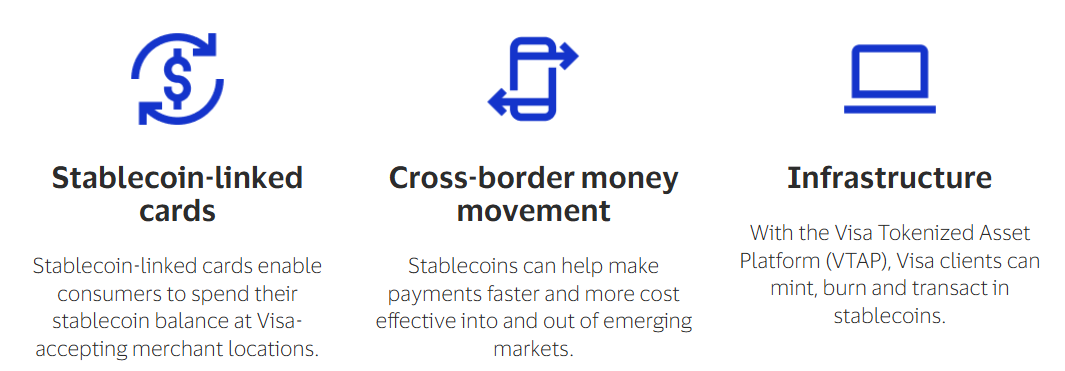
Zooming in: Visa is targeting a significant portion of its product roadmap to capture the stablecoin opportunity:
- It has issued 16B tokens toward its goal of fully tokenising all eCommerce transactions.
- 79% of in-person payments globally are now tap-to-pay, and Visa Direct transactions surged 23% to 3.4B.
- It signed a Pismo deal to launch a stablecoin-linked card with Gnosis Pay in Europe, marking progress on issuance.
- Stablecoin projects were also part of 4,500 consulting engagements that helped clients generate $6.5B in new revenue this year.
Context: In September 2025, Visa’s new pilot allowed businesses to use stablecoins to pre-fund their payouts through the Visa Direct platform.
Zooming out: Visa is future-proofing itself as payments shift from plastic cards to programmable money. Its new cloud-based, AI-assisted VisaNet system reflects that evolution: faster deployments, open infrastructure, and generative AI baked into the code.
What they’re saying: CEO Ryan McInerney said,
“Visa has become a hyperscaler, enabling anyone that wants to be in the money movement or payments business to build on top of the Visa-as-a-service stack.”
Why does it matter?
- Proof of concept: Stablecoin card spend has quadrupled year-over-year, with Visa now facilitating more than $2.5B in annualised blockchain settlements. Visa users have purchased more than 100B of crypto and stablecoin assets and spent more than 35B of these assets using their Visa credentials.
- Weaponising trust: By partnering with regulated stablecoin issuers like Circle and Paxos, it is managing its legal and financial risks. This focus on compliance and security is crucial for building trust and encouraging mainstream adoption.
Our take
As money gets faster, smarter, and more software-driven, Visa is aiming to make sure every new transaction, whether it’s a tap, token, or transfer, still runs through its network. It is executing a brilliant and aggressive plan to make itself the indispensable, non-negotiable plumbing for the entire digital economy, effectively turning a mortal threat into its most powerful moat.
Visa plans to turn issuance into a SaaS product, while owning the settlement spread, capturing a predictable margin instead of just routing flows. They plan on selling mint/retire tooling + liability management + reconciliation as a package. Visa is ensuring that even its direct competitors must build their future on top of Visa’s rails. It’s a classic platform strategy.
 Marc Baumann
 Marc Baumann
Take care,
Marc & team
🙌 Work with us: We create pioneering thought leadership that helps digital asset and technology companies lead the conversation, earn trust and win business.