
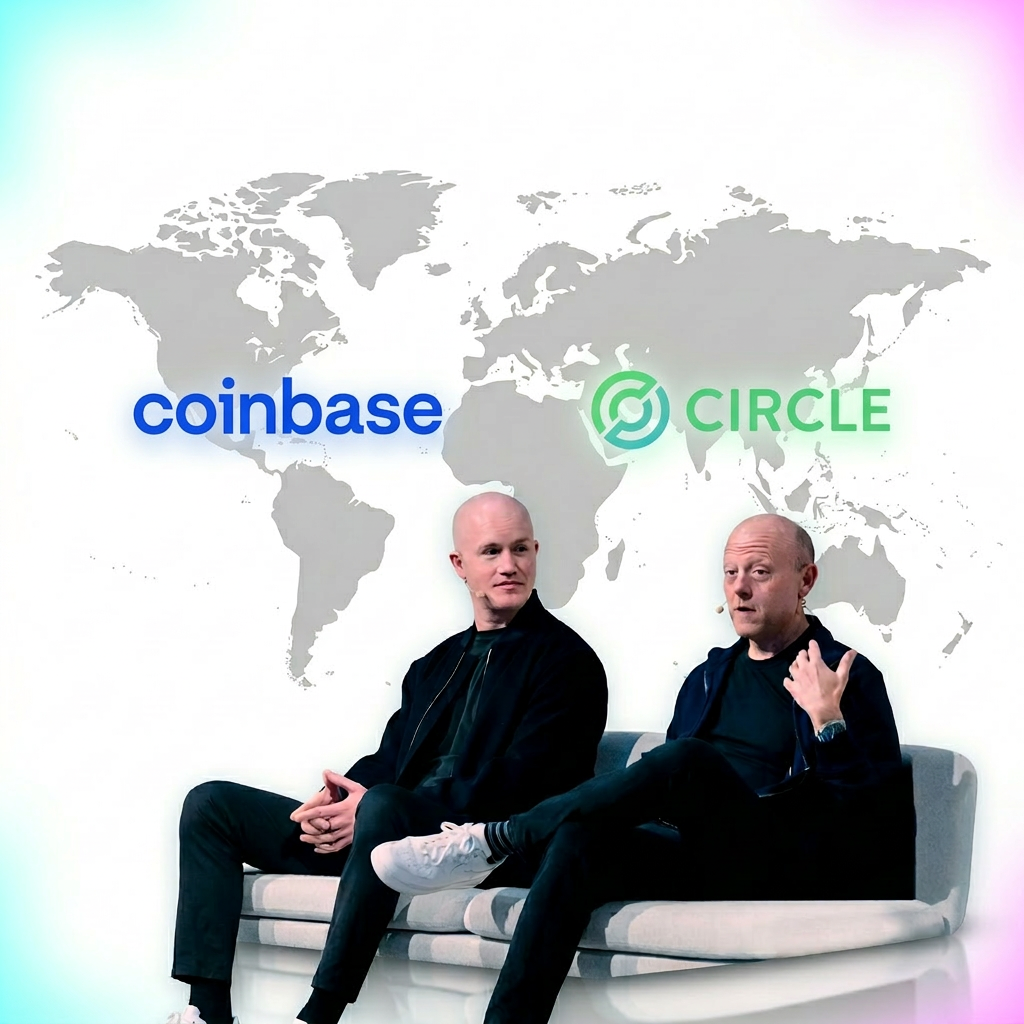
USDC prints $2.7B. Coinbase keeps 60%
Circle (NYSE: CRCL) reported Q4 2025 results that beat estimates across the board.
It's one thing to build a $75B stablecoin network. But it's another to keep the economics.
Circle Internet Group (NYSE: CRCL) is the issuer of USDC, the world's second-largest stablecoin at $75.3B. The company generated $2.75B in revenue in FY 2025, up 64% year-over-year, with Q4 net income of $133M and its stock surging 30% post-earnings. [RELEASE]
But here's the number nobody's talking about: Circle paid $1.6B, 60% of its reserve income to distribution partners. Mostly Coinbase.
👉PRO: Download the PDF
What happened
On February 25, Circle reported strong Q4 2025 numbers: USDC circulation rose 72% YoY to $75.3B, quarterly on-chain volume surged 247% to $11.9T, and full-year revenue grew 64% to $2.7B. Circle generated $582M in adjusted EBITDA but reported a $70M net loss after booking $424M in IPO-relaed stock-based compensation.
Circle paid $1.6B to distribution partners in FY 2025 — more than its entire $1.18B operating expense base. The vast majority went to Coinbase. Under their August 2023 agreement, Coinbase keeps 100% of reserve income on USDC held on its platform and splits 50/50 on everything else. Simply put, Circle keeps ~40 cents of every dollar it generates.
How the machine works: Circle‘s revenue is overwhelmingly driven by one mechanism: interest income on USDC reserves. When users mint USDC by depositing fiat, Circle invests those reserves, roughly 90% in short-duration U.S. Treasuries via BlackRock‘s Circle Reserve Fund, ~10% in bank deposits at BNY Mellon. In FY 2025, reserve income totaled $2.6B (up from $1.6B in FY 2024), driven by $64.9B average USDC in circulation (+95% YoY) and a 4.1% annualized reserve yield.
The Q4 numbers: USDC circulation hit $75.3B (+72% YoY), on-chain volume surged to $11.9T (+247% YoY), and full-year revenue grew 64% to $2.7B. Circle generated $582M in adjusted EBITDA but reported a $70M net loss after booking $424M in IPO-related stock compensation. EURC circulation grew 284% YoY to €310M, positioning Circle for MiCA-compliant European expansion.
Why Coinbase has leverage: Coinbase is Circle‘s primary distribution channel. Without Coinbase, USDC doesn’t reach retail. Without retail, USDC doesn’t grow. Circle needs Coinbase more than Coinbase needs Circle — and the economics reflect it.
The way out: Other Revenues from CPN, subscription & services, transaction fees — hit $110M in FY 2025, up from $15M in FY 2024. It’s 7x growth off a low base, but it’s the first proof Circle can build revenue streams that bypass Coinbase entirely.
Why it matters
- USDC is winning. USDC now accounts for ~47% of stablecoin transaction volume despite holding only ~25% of circulation. USDC has far higher velocity than Tether, meaning it’s being used for economic activity, not just passively held. Meanwhile, USDC‘s market share grew ~3 pts to ~25% while Tether fell ~6 pts to ~62% — the first meaningful shift in the stablecoin duopoly in years. USDC is also becoming the default pairing token on Morpho and UniswapX for RWA markets. AMMs and publishers increasingly launch pools where USDC is the sole fiat leg, signaling institutions expect it to be the on-ramp of choice for tokenized bonds, bills, and private credit.
- The diversification play. Circle knows its single-revenue-stream, single-partner dependency is existential risk. The counter-strategy shows in the numbers: Other Revenue hit $110M in FY 2025 (vs. $15M in FY 2024) — a 7.3x jump. In Q4 alone, Subscription & services: $24.7M (platform APIs, wallet-as-a-service, developer tools) and Transaction revenue: $12.2M (CPN payments, CCTP cross-chain transfers). The management is guiding $150–170M for FY2026 — a ~40–55% step-up from the $110M in FY2025. Arc, Circle‘s blockchain for stablecoin finance and AI agent payments, is set to launch in 2026 to aid the diversification efforts.
- The rate risk is the bear case nobody's pricing. Circle's $2.6B in reserve income depends on Treasury yields staying elevated. Every 100bps rate cut costs Circle ~$650M in annual revenue. Mizuho recently raised its price target partly because Middle East tensions are reducing rate-cut odds, but that's a geopolitical tailwind, not a structural one. Meanwhile, the CLARITY Act amendments could extend the GENIUS Act's yield prohibition to third-party platforms like Coinbase, potentially killing the rewards model that drives USDC retail adoption.
Investor Alpha
The bottom line is that Circle operates a structurally unique business — a quasi-money market fund that shares most of its yield with distribution partners to grow faster, while ensuring its core product, USDC, meets regulatory and partner requirements.
- Long Coinbase (COIN). Coinbase is the direct beneficiary of Circle‘s growth earning reserve income on-platform and building products on top of USDC for its global users, with zero regulatory overhead of being a stablecoin issuer. As USDC circulation grows, Coinbase‘s passive yield income scales automatically. On top of that, every enterprise onboarding to USDC drives more trading volume, custody revenue, and user activity for Coinbase. In short, Coinbase gets paid whether Circle wins or loses — making it the lower-risk, higher-certainty expression of the same USDC growth thesis. 👉 Trade on Robinhood
- Long Circle (CRCL). Circle‘s business resembles Coca-Cola‘s: it owns the core product —USDC, the “syrup” — and lets a global network of distributors handle last-mile delivery. Coinbase, Binance, and banks are the bottlers, embedding USDC into their products via reserve-sharing economics. Coca-Cola survived a century because the brand compounds with every new market. Circle‘s equivalent isUSDC‘s network effects — 30 blockchain integrations, RWA pools on Morpho and UniswapX, and Arc positioning USDC as the AI agent settlement layer. The moat deepens with every new channel. 👉 Trade on Robinhood
What to watch going forward
- Arc mainnet launch: The single biggest binary event of 2026. Smooth launch with strong enterprise adoption validates the infrastructure thesis; delay or thin participation resets the diversification narrative.
- Coinbase revenue-share renegotiation: Circle‘s margin ceiling won’t improve until the 50/50 split is revisited; any signal of renegotiation is a major catalyst.
Watchlist:
- Mar 11: US CPI (Feb) release – critical for Fed rate cut expectations
- Mar 17–18: DC Blockchain Summit (Chamber of Digital Commerce)
- Mar 18: FOMC Interest Rate Decision & Summary of Economic Projections
- Mar 24–25: Next Block Expo (Warsaw)
- Mar 24–26: Digital Asset Summit (DAS) (New York City)
- Mar 25: Crypto Assets Conference (#CAC26 Frankfurt)
That’s it for now.
Missed last week? Access all our CEO notes here.
Marc & Team