
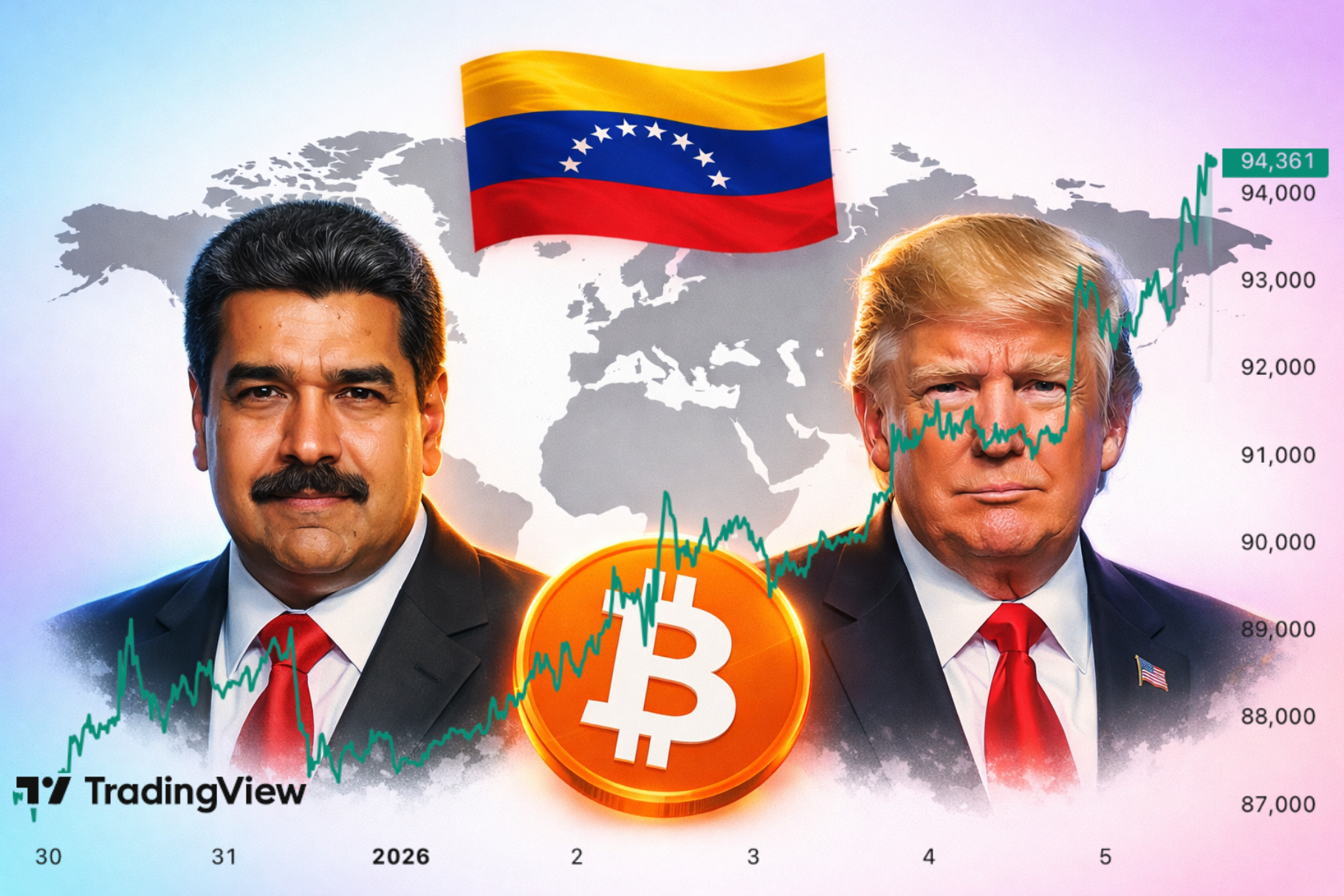
The United States just seized 3% of Bitcoin
The U.S. government just became the world’s largest Bitcoin holder without spending a dollar.
It has executed the largest digital asset seizure in history. Not just that, the United States just secured control over the world’s largest crude oil reserves: 303 billion barrels. [NEWS]
The detention of Venezuelan President Nicolás Maduro triggered the seizure of an estimated 600,000 BTC (~$55–67B), a shadow reserve accumulated through illicit gold trafficking, oil-for-crypto trades, and state mining operations.
But here’s what matters: this doesn’t get auctioned. Under the March 2025 Strategic Bitcoin Reserve executive order, these coins are locked into the U.S. Treasury permanently.
Here’s what this means for investors.
🔺PRO: Download the full PDF at the bottom
Today’s Market signals
- Morgan Stanley files for bitcoin, solana ETFs, became the first US bank. Link
- BoA started advising crypto ETPs to clients. Link
- Polymarket launched real estate prediction markets. Link
- Maduro Polymarket win triggers bill to bar government officials from insider trading. Link
🚨 Get your brand in front of 100k+ decision makers in digital assets.
What happened
U.S. military operations in early January 2026 detained Nicolás Maduro on narco-terrorism and corruption charges. This creates a clear legal path: by labeling the regime a criminal enterprise under the International Emergency Economic Powers Act (IEEPA), it allows the Treasury to seize all illicit proceeds, including cryptocurrency holdings.
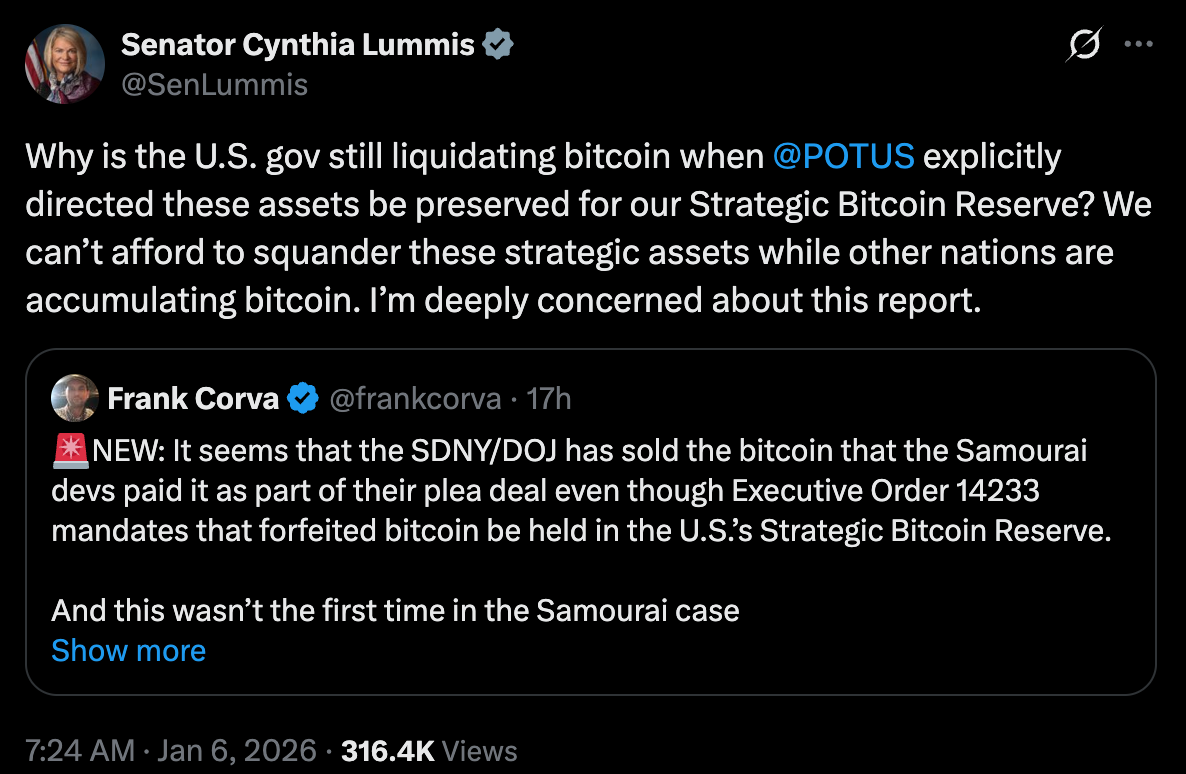
Unlike previous seizures (Silk Road, Bitfinex), these assets will not be auctioned. Under President Trump’s Executive Order 14233 and the BITCOIN Act of 2025, these funds are legally classified as “proceeds of crime” and are earmarked for the newly established US Strategic Bitcoin Reserve.
This reverses a decade of policy where the U.S. Marshals Service liquidated seized crypto at pennies on the dollar.
Backdrop: The Venezuelan government accumulated these Bitcoin holdings across three mechanisms over eight years:
👉Read below with PRO:
4 key implications for investors you shouldn’t miss
What allocators are doing now
Impact on global oil markets (spoiler: it’s not what you think)
Catalysts of the next 3 weeks
$2B in gold proceeds swapped for Bitcoin at ~$5,000 per coin during 2018–2020;
$3–5B in oil revenue converted through PDVSA1 into Bitcoin during 2023–2025; and
tens of thousands of mining rigs nationalised and redeployed in state-controlled facilities from 2023–2025.
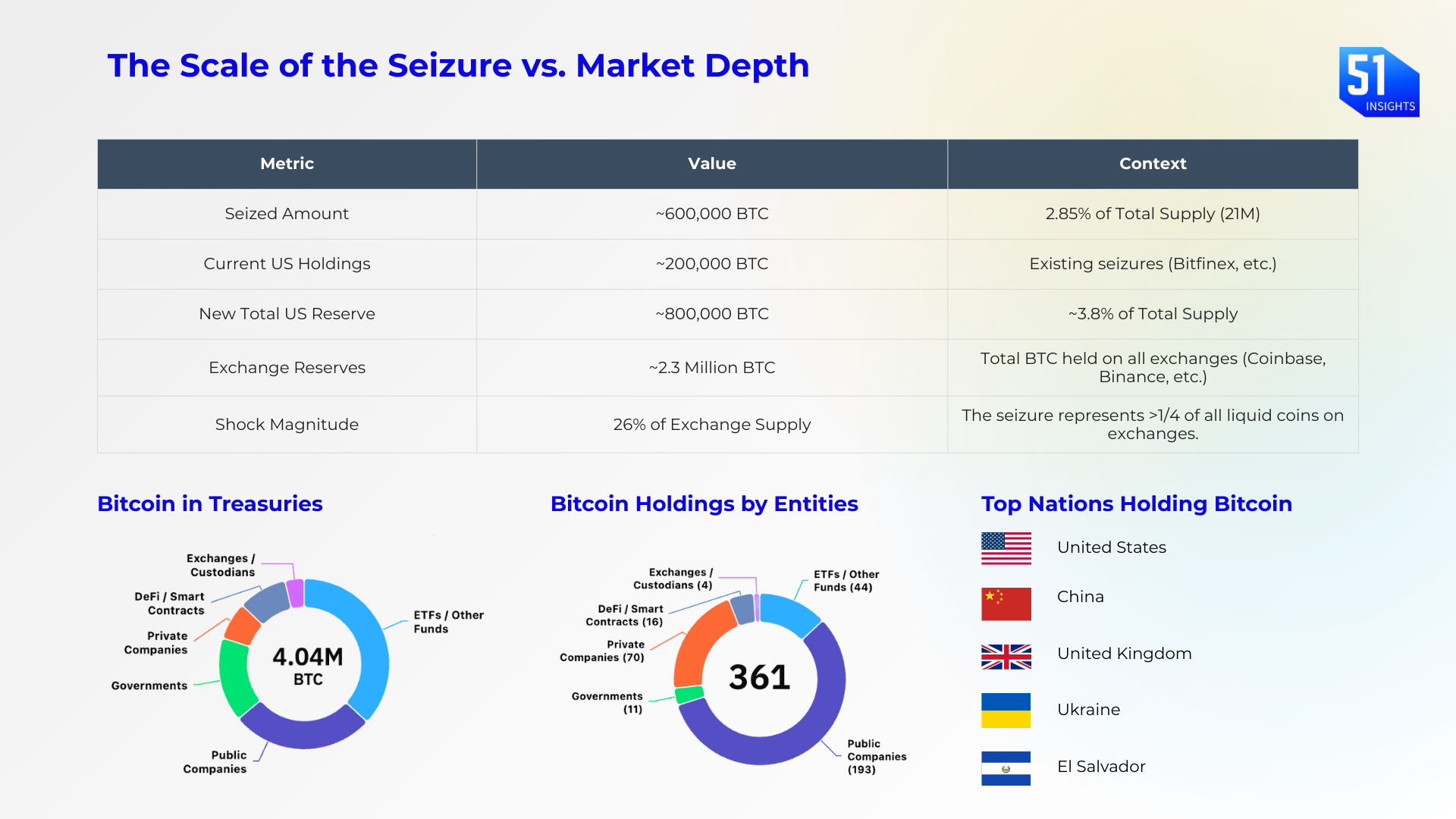
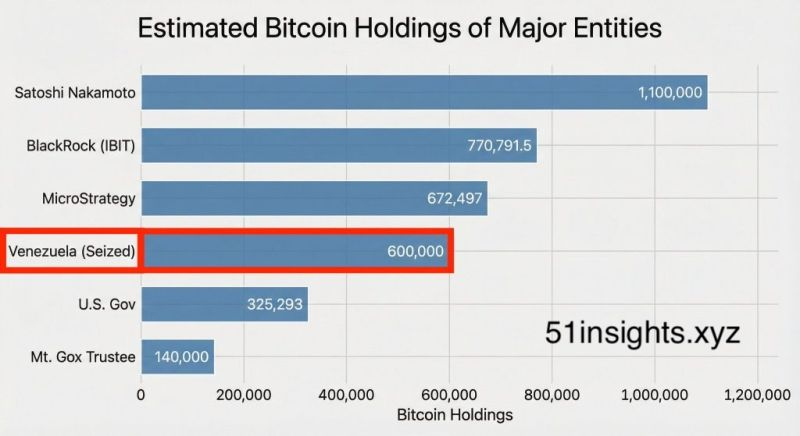
Total estimated holding: 600,000 BTC, representing 2.85% of all Bitcoin in circulation.
U.S. acquisition of Bitcoin is important as it effectively fulfils 60% of its Bitcoin treasury target of 1M without costing the taxpayer a single dollar.
Be smart: Bitcoin jumped above $94,000 on Monday, returning to early-December levels, as markets reacted to the news.
Stepping back: In 2018, Venezuela launched the Petro, a state-backed cryptocurrency meant to bypass U.S. sanctions. It failed from the start: a centralized, opaque token run by an untrusted regime and quickly banned under U.S. Executive Order 13827.
Why Bitcoin: By 2020, Venezuela’s regime admitted the Petro was unusable, no one abroad would accept it. Instead of creating a token the world rejected, they pivoted to accumulating Bitcoin and USDT, using existing state crypto infrastructure to move value through assets that were liquid, censorship-resistant, and globally accepted.
As of January 2026, it is estimated that as much as 80% of Venezuela’s oil revenue is received in USDT.
Zooming in: The U.S. is taking Bitcoin because it is treating Maduro’s holdings as criminal proceeds, not state assets.
Maduro was charged with narco-terrorism and corruption, allowing the U.S. to label the regime a criminal enterprise. Under U.S. law, that means the Bitcoin is forfeitable “proceeds of crime,” not Venezuela’s sovereign property. This lets the DOJ seize the assets and the Treasury take ownership without handing them to an unstable successor government.
The play: Arresting Maduro does not mean the U.S. automatically controls Bitcoin. Bitcoin can only be moved with private keys, not by freezing accounts.
That is why the U.S. is pursuing the people, not just the assets. Investigators believe the keys were split among trusted insiders using a multi-key setup. Alex Saab, Maduro’s financial fixer, is seen as the weak link and likely controls part of the access needed to unlock the funds.
By detaining these individuals and recovering wallets or key fragments, the U.S. can reconstruct the private keys. Once obtained, the Bitcoin can be legally seized as criminal proceeds and transferred to U.S. custody.
Tether as the US’s ally: Tether cooperated with US authorities by freezing wallets tied to Venezuela’s state oil company. Venezuela relied on USDT for liquidity, but that centralisation made transactions visible and controllable.
The result: USDT now functions as a de facto U.S. sanctions tool. Future sanctions evaders will be forced away from Tether toward less liquid stablecoins or direct Bitcoin use. Both are riskier, harder to scale, and more volatile.
Why it matters
- The Supply vacuum: This is a market structure event equivalent to twelve German sovereign sales occurring in reverse. The seizure represents approximately 26% of all Bitcoin currently held on exchanges globally. By absorbing this into the Treasury’s “Digital Fort Knox,” the US effectively deletes the liquidity cushion of the market. Models suggest a “Multiplier Effect” where this lock-up triggers a repricing event far beyond linear demand, the supply needed to settle trades simply does not exist at current prices.
- Geopolitical impact: The U.S. now controls approximately 4–5% of total Bitcoin supply when combining existing holdings (~200,000 BTC from prior seizures) with the Venezuelan acquisition. This concentration of the world’s most powerful entity into digital assets triggers a geopolitical game theory problem: rival nations cannot afford to leave the U.S. as the sole hegemon of the crypto ecosystem. China’s Ministry of Foreign Affairs immediately condemned the seizure as a violation of international law. Russia (holding >50K BTC) views it as an escalation of “hybrid warfare.” Both nations hold cryptocurrency from their own seizures (China: ~190,000 BTC from PlusToken). The policy forces them to either (a) accelerate their own Bitcoin accumulation or (b) accept strategic vulnerability.
- Sovereign validation: The U.S. government holding 800,000 BTC as a strategic reserve validates the “Digital Gold” thesis through the actions of the issuer of the world’s reserve currency itself. This provides fiduciary and regulatory cover for pension funds, endowments, and insurance companies to allocate. If it’s good enough for the Treasury, it’s defensible for the California Teachers’ Pension Fund or Harvard’s endowment or for any private allocators.
- The death of the Petrodollar: For decades, the US dollar’s dominance was anchored in the oil trade. Venezuela tried to break this with the “Petro” crypto and failed. However, their use of USDT and Bitcoin to sell oil was a successful proof-of-concept for “Petro-Bitcoin.” Venezuela proved that a state can sell oil for crypto at scale ($21B volume).
Alpha
The market is currently mispricing the “seizure risk.” Historically, government seizures meant forced selling and market overhang. That assumption no longer holds.
The Venezuela operation is a “budget-neutral” acquisition for the US Treasury, meaning no new dollars are printed to acquire the asset, yet the float is decimated. We are facing a supply shock that the order books cannot absorb without price action.
Long Spot & Calls (Dec ‘26): Some investors buy the uncertainty dip. Once the transfer to the Strategic Reserve is confirmed, the supply squeeze will likely trigger a price increase. 👉 Trade on Robinhood
Long US Miners (MARA, CORZ, RIOT): With the US government as the largest holder, political risk for domestic miners vanishes. They are effectively “defense contractors” securing the national reserve. 👉 Trade on Robinhood
Avoid privacy-coin exposure: The regulatory perimeter is tightening. Tether’s cooperation with U.S. authorities in freezing PDVSA-linked wallets signals that OFAC2 compliance has become the de facto classification mechanism for “approved” crypto. Allocators should overweight “compliant” chains (Bitcoin, Ethereum, USDC) and underweight tokens that might become regulatory targets.
What this means for oil and energy: For the first time, the United States has effective influence over the largest oil reserve on the planet. Venezuela’s reserves big, and they are systemic.
At current market prices of ~$57/barrel, that is $17.3 TRILLION in underground wealth. That’s 4x the size of Japan’s total economy. And5x larger than the total reserves of the US (55B barrels). This is worth nearly 16% of all world debt.
This means:
- Supply security: U.S. refining is built for heavy crude. Domestic shale is too light, Canadian supply is constrained by distance and infrastructure, and Mexican output is declining. Venezuelan crude fits U.S. refineries naturally. If production is restored, it reduces long-term dependence on distant or unstable suppliers.
- Pricing power: Markets have never priced a scenario where U.S. policy indirectly influences nearly a fifth of global proven reserves. Even partial restoration of Venezuelan output changes expectations around future supply, spare capacity, and long-term oil prices.
- Energy becomes an industrial advantage: Cheap, reliable energy is now a strategic input for everything from manufacturing to AI data centers. Control over regional energy supply removes a key constraint on scaling power-hungry infrastructure inside the U.S.
The market still sees this as law enforcement. When it is repriced as a strategic reserve building, the supply impact becomes clear.
Watchlist
- Dec 10: U.S. Federal Reserve: 0.25% interest rate cut (expected)
- Dec 15: SEC roundtable (crypto task force)
- Dec 15: Cboe Global Markets will launch the first U.S.-regulated perpetual-style futures contracts (PBT and PET)
- Jan: USAT launch by Tether (expected)
- Jan: Clarity Act (H.R.3633) Senate vote (expected)
- Dec 31: Europe’s MiCA full enforcement (Austria, Germany, and Spain) ends
- Jan 1: Basel Committee crypto capital standards implementation in Hong Kong
- Jan’26: SEC Crypto Innovation Exemption
- Jan’26: Spot crypto ETF approvals for altcoin
- Q1’26: Kraken IPO
- Q1’26: Hong Kong Stablecoin licensing
- Q1’26: Singapore Stablecoin framework
That’s it for now.
Marc & Team
🔺 Download the PDF
This note reflects strategic analysis and market interpretation, not investment advice. All views are based on publicly available information and are subject to change without notice.
Petróleos de Venezuela, S.A. (PDVSA), Venezuela’s state-owned oil company, has increasingly integrated digital wallets and cryptocurrencies into its operations to circumvent international sanctions and maintain global trade.By the end of the first quarter of 2024, PDVSA began requiring all new customers conducting spot oil deals to hold digital wallets and settle at least 50% of each cargo’s value in Tether (USDT). This requirement has been enforced even on existing contracts that did not originally specify digital currency use. ↩
OFAC compliance in the crypto industry requires adherence to the same sanctions obligations as traditional finance, including a strict liability standard for violations. Firms must implement a risk-based compliance program to prevent transactions with sanctioned individuals, entities, and jurisdictions. ↩