The house model is dying
For decades, the barrier was maintained by gaming compacts and the assumption that a wager is legally distinct from a trade. But that distinction evaporated.
In December 2025, DraftKings, FanDuel, Coinbase, and Robinhood didn’t launch betting apps. They launched financial derivatives, dressed up as betting apps.
- DraftKings (market cap of ~$17.8B) is a CFTC-registered Introducing Broker. [RELEASE]
- Coinbase acquired The Clearing Company. [RELEASE]
- Robinhood turned its prediction markets into a full sports betting business by letting users place parlay-style and player bets on NFL games. [NEWS]
- CME Group partnered with FanDuel to launch prediction markets. [RELEASE]
- In January, Polymarket brought real-estate to prediction markets. [RELEASE]
This is bigger than sports betting: Every liquid market creates derivative markets. Once you can trade “Will Microsoft beat earnings?” you can create options on that binary outcome. The prediction market isn’t the endpoint, it’s the primitive that unlocks a derivatives ecosystem for every measurable event.
Let’s unpack.
For an intro into Polymarket, read our primer below:
 Marc Baumann
👉Download the PDF
What happened
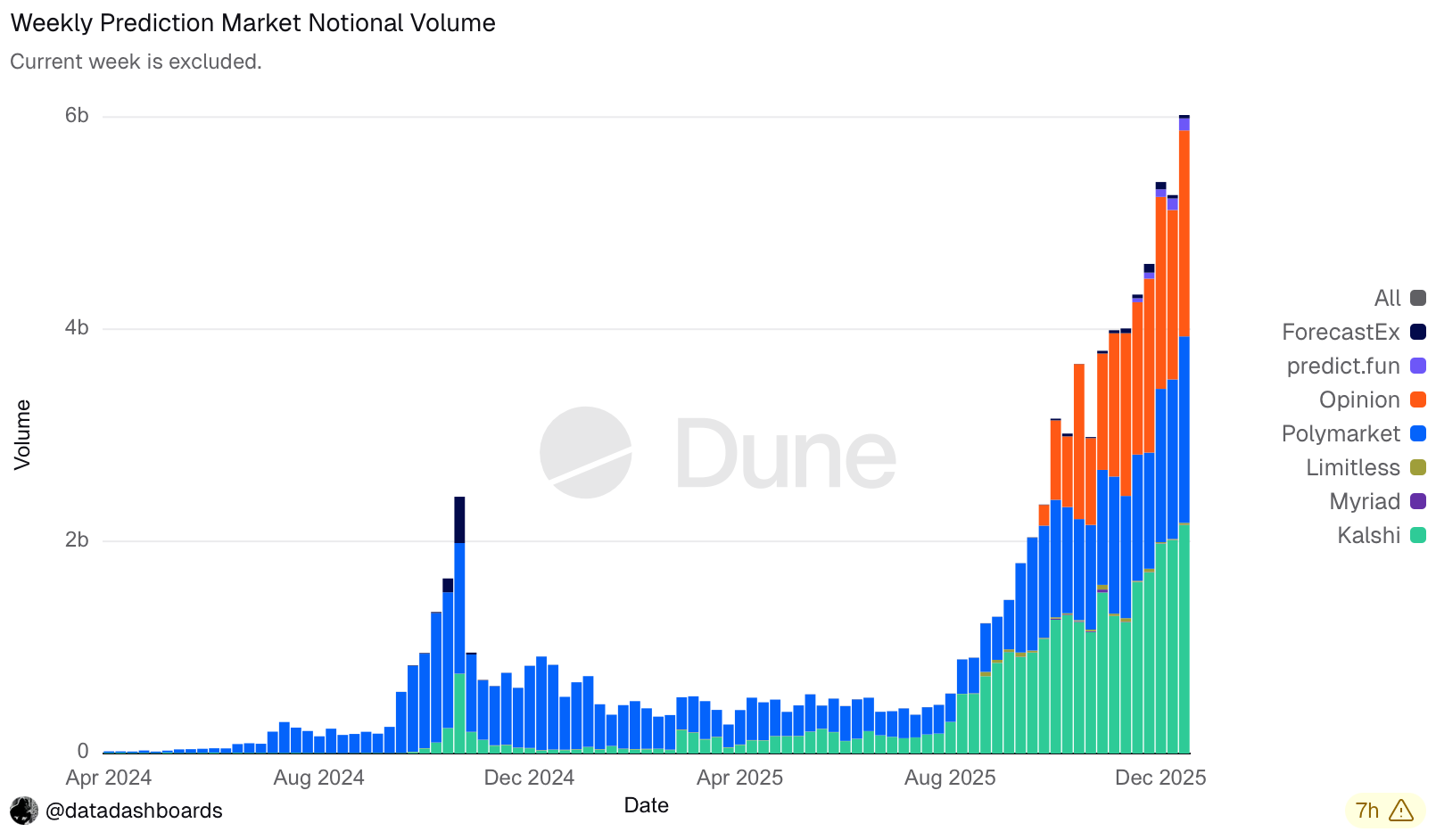
By mid-December, the prediction market industry crossed a structural threshold. Trading volume on regulated platforms like Kalshi hit $1.8B weekly, a 180x increase from $100M in early 2024. More significantly, sports contracts now represent 90% of that volume, a complete inversion from 2024’s politics-heavy narrative.
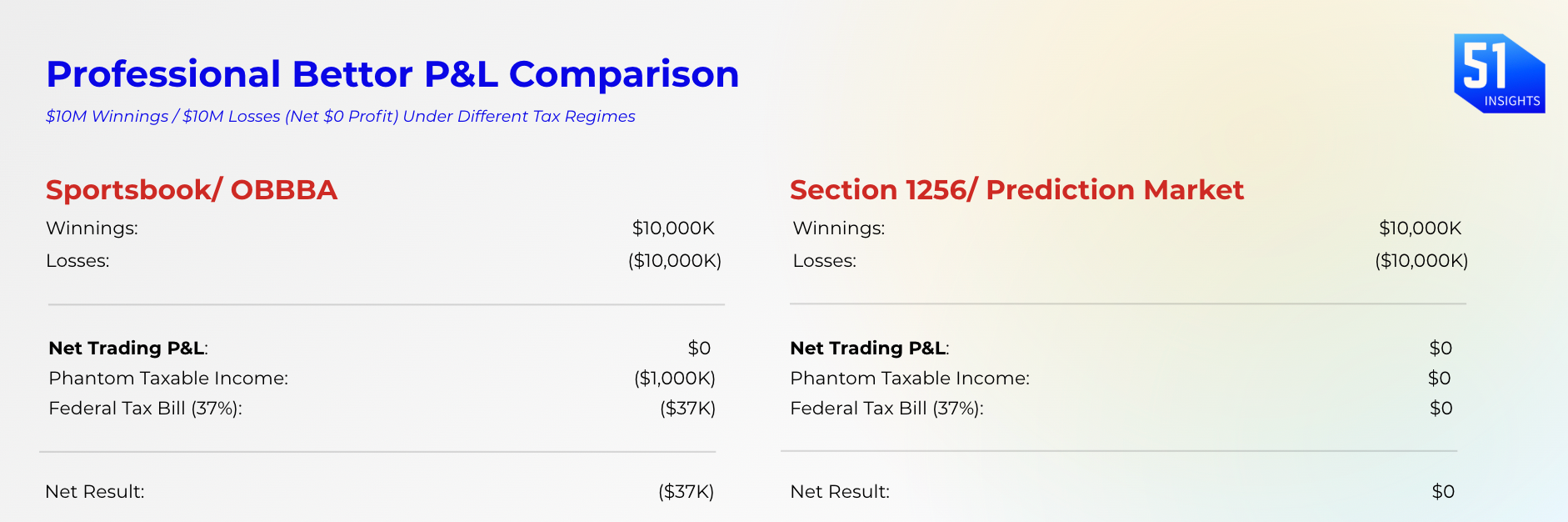
Under standard sportsbook tax treatment (OBBBA)1, effective 2026, gambling loss deductions are limited to 90% of losses, capped at winnings, creating phantom income for break-even bettors. For a professional bettor with $1M wins and $1M losses, taxable income is $100K (10% of winnings). At top federal rates (~37%), this results in ~$37K in taxes on unrealized gains.
Section 1256 contracts on regulated prediction markets like Kalshi could theoretically allow break-even tax results (via 60/40 long-term/short-term treatment on net-zero P&L), offering potential savings of ~$37K+ annually for high-volume traders versus sportsbooks. However, tax treatment remains contested and unresolved: IRS guidance and user-reported 1099s treat Kalshi event contract earnings as ordinary income, not automatically qualifying as “regulated futures contracts” or “nonequity options” under Section 1256, despite CFTC oversight, pending definitive ruling. [Read Report]
The catalyst was coordinated: DraftKings launched “DraftKings Predictions“ as a CFTC Introducing Broker (not a gaming licensee), making it instantly available in 38 states, including California, Texas, and Florida, markets that have explicitly rejected traditional sports betting. FanDuel followed days later with a CME partnership. Coinbase integrated Kalshi’s markets directly into its app and also acquired The Clearing Company.
Each move exploited the same regulatory arbitrage: binary options on sports outcomes traded as commodity derivatives under federal jurisdiction, not gambling under state jurisdiction.
They have rebranded sports wagering as event contracts and are using federal commodities law to preempt state gaming sovereignty.
Zooming in: On December 19, 2025, Coinbase filed federal lawsuits against Illinois, Michigan, and Connecticut, seeking a declaratory judgment that establishes federal preemption. [Complaint]
The legal theory: Congress defined “commodities” broadly in the Commodity Exchange Act, deliberately excluding specific items (onions, motion picture box office receipts). Since sports outcomes aren’t on that exclusion list, they’re commodities. State gambling law doesn’t apply. This case is headed to the Supreme Court and will define whether the U.S. prediction market industry stays domestic or fragments along state lines.
The shift: Kalshi controls 38% of the regulated prediction market volume. Polymarket, the offshore crypto-native competitor, has collapsed to 22%. Why? Regulatory clarity beats decentralised ideology. Kalshi integrated with U.S. banking, ACH, wire transfers, Robinhood, and accessed a capital base where people trust.
In October 2025, Opinion witnessed an explosive growth triggered by its exclusive launch on the BNB Chain and strategic backing from YZi Labs (formerly Binance Labs). In late 2025, Opinion’s trading volume surged to $1.5B weekly, temporarily outpacing Polymarket and Kalshi.
Prediction markets have commoditized sports betting. Operators have found the ultimate growth hack: wrap wagers in the flag of federal commodity regulation.
Marc Baumann
Why it matters
The tax engine: The overlooked catalyst is a new U.S. law taking effect in 2026 that makes traditional sports betting far less tax-efficient, especially for frequent bettors, while prediction markets sit under a different regulatory regime and avoid this penalty.
The Loophole: Trades on these platforms are classified as Section 12562 contracts.
The Impact: Losses are fully deductible, and gains receive the favorable 60/40 tax treatment (60% long-term / 40% short-term capital gains).
The Consequence: We are witnessing a mass migration of “whale” capital from traditional sportsbooks to regulated exchanges to avoid the OBBBA cap.
The house model is dying: DraftKings and FanDuel are pivoting to a pass-through model where they earn commissions on trading volume rather than net gaming revenue. This aligns operator incentives with winning traders, eliminating the adversarial relationship inherent in traditional bookmaking. With Google integrating real-time probability widgets directly into Search, market consensus is replacing the “odds maker” as the source of truth.
This is bigger than sports betting: Every liquid market creates derivative markets. Once you can trade “Will Microsoft beat earnings?” you can create options on that binary outcome. Then swaps. Then structured products. The prediction market isn’t the endpoint—it’s the primitive that unlocks a derivatives ecosystem for every measurable event. We’re moving from markets for things to markets for everything. Sports outcomes, election results, Fed decisions, product launches, M&A approvals, clinical trial outcomes, weather events, geopolitical developments. If it’s uncertain and verifiable, it’s tradeable.
🙌 Work with us: We arm financial institutions and digital asset leaders with bespoke research, thought leadership to shape the most important conversations, scale trust, and win business.

Investor Alpha
The convergence of sports betting and capital markets re-rates the entire sector. We are moving from a “gaming” valuation multiple (constrained by state-by-state legalization) to a “financial exchange” multiple (driven by national preemption and high-velocity trading).
- CME Group (CME): The quiet beneficiary. As sportsbooks push prediction-style trades through regulated exchanges, CME gains a massive new high-frequency volume stream without the customer acquisition costs with Fanduel partnership.
- DraftKings (DKNG): By launching as an Introducing Broker in California and Texas, they have effectively expanded their TAM by 30% overnight without spending a dime on lobbying. If the Coinbase preemption lawsuit holds, DKNG is undervalued.
Watchlist:
- Jan 27: Federal Reserve two-day meeting, rate decision
- Jan: SEC Crypto Innovation Exemption window
- Jan: Spot crypto ETF decisions for altcoins
- Feb 2: Bank of Japan (BoJ) Summary of Opinions (Jan meeting)
- Feb 4–5: ECB Governing Council monetary policy meeting
- Feb 5–6: Digital Assets Forum 2026, London
- Feb 9: Liquidity Summit 2026, Hong Kong
- Feb 10–12: Consensus Hong Kong (CoinDesk)
- Feb 11: US CPI (Jan) release
- Feb 12: US PPI release
- Feb 17–21: ETHDenver 2026
- Feb 18: FOMC minutes for Jan 27–28 meeting
- Q1’26: Kraken IPO window
- Q1’26: Hong Kong stablecoin licensing regime
- Q1’26: Singapore stablecoin framework launch
Today’s Market signals
- Coinbase established independent advisory board on Quantum computing. Link
- BitGo announces IPO. Link
- WEF on stablecoins. Link
- HK to issue stablecoin licenses in Q1. Link
- Strategy buys $2.1b BTC, largest buy in 1+ year. Link
- Central Bank of Iran has acquired US dollar stablecoins worth $0.5B. Link
That’s it for now.
Marc & Team
One Big Beautiful Bill Act (OBBBA): It is a comprehensive U.S. federal budget reconciliation law signed by President Donald Trump on July 4, 2025. Starting in 2026, bettors can only deduct 90% of their documented gambling losses against their winnings, a decrease from the previous 100% allowance. Because only 90% of losses are deductible, bettors can owe federal taxes even if they break even or lose money overall for the year. Example: If you win $10,000 but lose $10,000, you can now only deduct $9,000. You will be taxed on the remaining $1,000 as if it were pure profit. ↩
Section 1256: In contract markets, each contract held at the end of the tax year is treated as if it were sold for its fair market value on the last business day, and gains/losses are reported annually on IRS Form 6781. Any gain or loss is classified as 60% long-term capital gain or loss and 40% short-term capital gain or loss, regardless of the actual holding period. This often results in a lower overall tax rate compared to ordinary income tax rates. ↩