
The Big Shift to AI
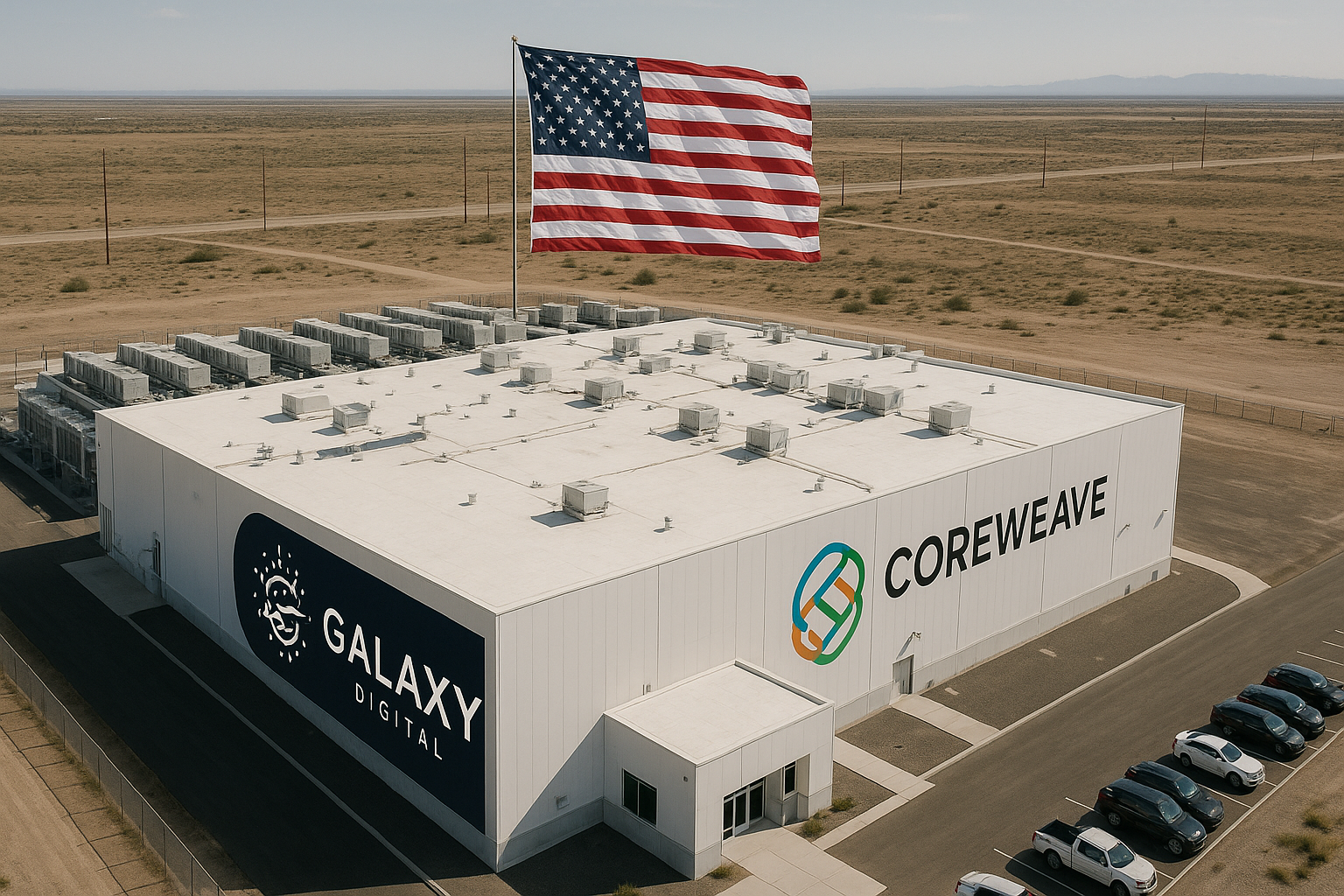
Galaxy just walked away from Bitcoin mining and signed a $4.5B, 15-year deal with CoreWeave to use its flagship datacenter "Helios" for AI infrastructure 🤯.
Why? CoreWeave is better money than mining:
- $300M per year in revenue
- 90% EBITDA margins
- Near-zero Opex for Galaxy
- $2.26M revenue per MW
Galaxy isn't alone:
and others — all traditional crypto miners — are pivoting into AI data centers.
They can generate an order of magnitude more income per MW of power than Bitcoin mining operations.
But this isn’t just about chasing better returns. It’s a signal of a deeper shift:
The global race for AI dominance.
As Maja Vujinovic, frontier-tech operator & investor, puts it:
"We’re entering an AI-Dollar era: The world will earn and spend USD through U.S.-owned AI infrastructure. If true, this would extend America’s dominance over the global value chain — not only through coins, but through compute. Owning AI compute is the next big infrastructure play."
And smart capital wants to be part it:
- Global data center investment jumped 51% YoY to $455B
- Blackstone provided $2.3B debt financing to CoreWeave
- KKR’s did a $50B partnership with ECP (Energy Capital Partners) for AI infra
- Crypto VCs invested $350M+ in decentralized compute
- Top 14 crypto miners added $4B in market cap since June 2024
This cycle, the biggest upside isn’t in coins.
It’s in kilowatts, GPUs — and geopolitical leverage.
– Marc
51: We help companies like Avalanche, Near, or MoonPay with industry-leading thought leadership campaigns. Interested? Start dominating your vertical.
The largest U.S. Bitcoin miner (by hash rate) entered Chapter 11 bankruptcy in 2022, but emerged in 2023 with a new focus on AI hosting. It reallocated 100 MW of power from Bitcoin mining to AI/HPC services and expanded total capacity to 800 MW, with 700 MW now contracted to CoreWeave – a fast-growing AI cloud provider. In a landmark deal, CoreWeave agreed to utilize Core Scientific’s sites for AI GPUs, even covering ~80% of retrofit CapEx. This $8.7 billion, 12-year partnership (for up to 800 MW of AI workloads) is expected to deliver tremendous stable cash flow. Core Scientific noted the expanded CoreWeave contract will “maintain high contribution margins of ~80%” and could contribute over $600 million in EBITDA annually once fully ramped . This is a dramatic pivot for a company that, as of late 2024, was still mining ~369 BTC a month. Executives have made clear that while Bitcoin mining remains important, the future growth is in being an AI data center operator. The company’s market cap rebounded to over $2 billion on the back of this AI pivot , reflecting investor enthusiasm for the new strategy. ↩
Europe’s biggest mining firm (originating from Northern Bitcoin AG) has arguably gone all-in on AI. Northern Data pivoted to HPC as early as 2020, and by 2023 it split its divisions into Peak Mining (crypto) and Taiga Cloud/Ardent (HPC cloud and data centers). In October 2024, NDG announced it is considering selling off its entire crypto mining business to “solidify our focus on powering AI innovation through best-in-class infrastructure”, according to CEO Aroosh Thillainathan. The company highlighted that proceeds from any sale would be plowed into more GPUs, data center acquisitions, and AI product growth. NDG’s AI/HPC segment was already seeing strong revenue growth by Q3 2024. This marks a full circle for a firm that began as a Bitcoin miner in 2014 – now embracing AI as its core business and treating crypto mining as a legacy unit. (Notably, Northern Data’s contemplated HPC spinoffs were rumored to target a combined $10–16 billion valuation, underscoring how the market values its AI endeavors.) ↩
In July 2023 it rebranded from “Hive Blockchain” to “Hive Digital” to reflect a focus on hosting AI and other GPU-intensive applications. HIVE then repurposed its vast fleet of Nvidia GPUs for cloud computing – and even began renting out GPU servers to AI clients. By Q2 2024, HIVE’s new HPC cloud division had scaled to $2.6 million in quarterly revenue. While still modest, that was pure incremental income alongside its $29M from crypto mining, and HIVE noted it expects this to grow rapidly. In late 2024, HIVE announced a $30 million investment to deploy cutting-edge Nvidia H100 and H200 GPU clusters in Quebec, powered by renewable energy . The deployment (756 total new GPUs) is expected to bring HIVE’s AI/HPC annual revenue run-rate to over $20 million by mid-2025. ↩
This Canadian Bitcoin miner (with sites across North America) made a bold move into AI in mid-2024. Hut 8 secured a $150 million investment from Coatue Management – a fund known for tech and AI bets – specifically to expand Hut 8’s capacity for hosting AI customers. According to Hut 8’s CEO, “traditional data center operators are failing to meet surging demand for AI compute… Hut 8 can leverage its expertise in energy infrastructure to address this unmet demand”. The Coatue funds will go into high-end GPU hardware (the firm reportedly ordered 1,000 Nvidia H100 GPUs, a ~$25M investment) and facility upgrades for AI computing . Hut 8 has even restructured its organization – carving out its Bitcoin mining into a separate subsidiary – to jointly develop Bitcoin + AI hybrid facilities going forward . This dual approach reflects their belief that “managing complex energy infrastructure” can serve both crypto and AI needs. Hut 8’s pivot underscores that even long-time Bitcoin miners are now branding themselves as high-performance compute providers. ↩
This Australian-listed Bitcoin miner has likewise begun diversifying into AI data center services. In its FY2024 results, Iris reported a small but notable $3.1 million in revenue from “AI cloud services” contracts – essentially renting out a portion of its capacity to HPC customers. The company is now exploring a much larger move: it engaged Morgan Stanley to evaluate AI data center opportunities for a massive 1.4 GW site in Texas. Iris expanded its operating hash rate 5× in 2023 but is indicating that future expansion may tilt toward AI workloadsalongside Bitcoin, especially at such a large-scale site. ↩