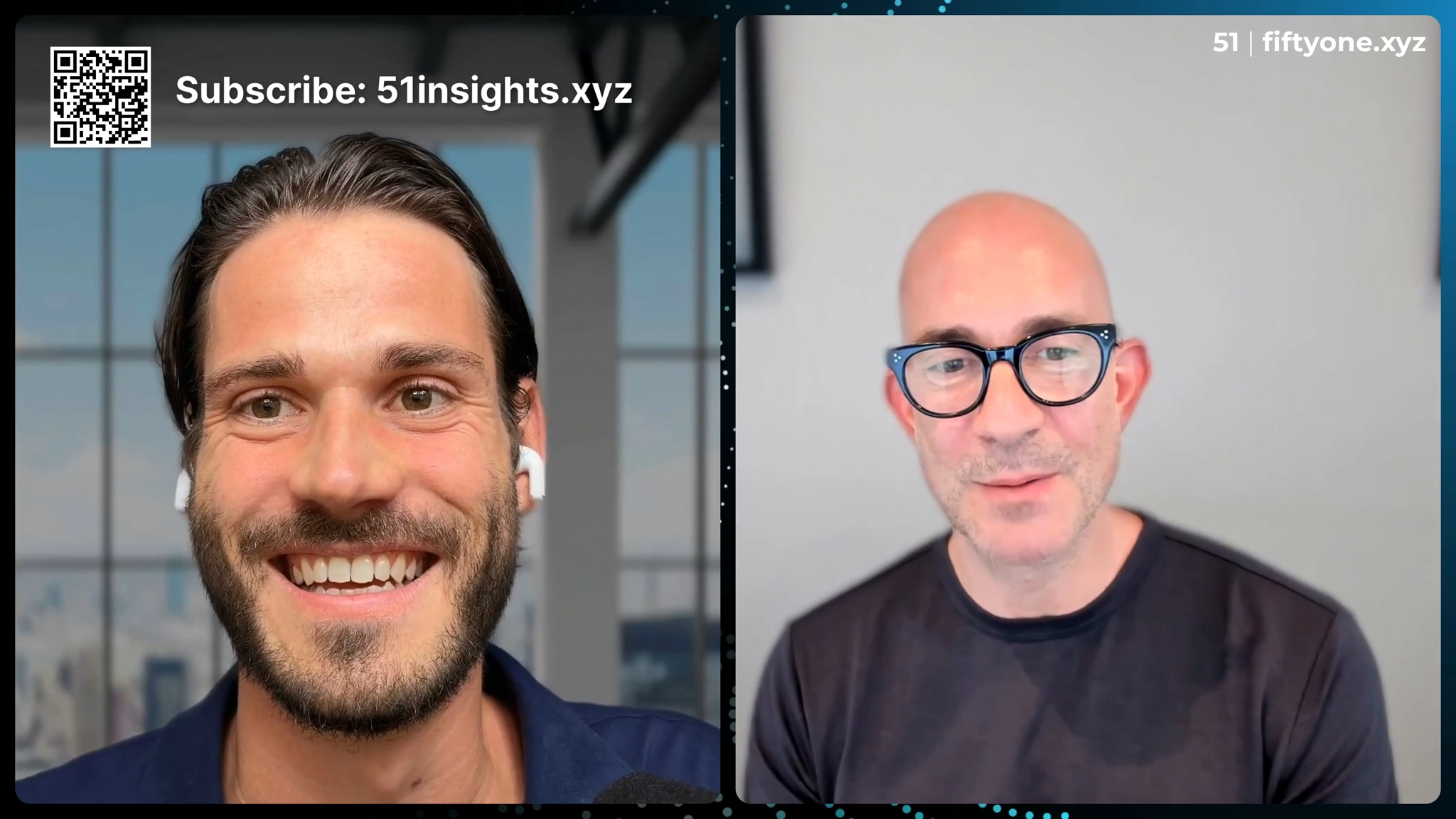
The $400 trillion tokenization migration, with Carlos Domingo, CEO Securitize
Hi, it’s Marc. ✌️
“The $400 trillion market is any asset that is recorded on an antiquated ledger... If we go to $2 trillion in the next five or 10 years, that would be a very good outcome for everybody.”
That’s Carlos Domingo, CEO and co-founder of tokenization pioneer Securitize.
And he clears up a big myth:
“Tokenization makes the asset easier to trade... But that doesn’t necessarily make it liquid unless the asset is liquid itself because the liquidity is intrinsic to the asset.”
In this episode, we sit down with Carlos to understand how tokenisation moves from a buzzword to reality.
Carlos explains why 2025 is an inflection point for tokenization. He breaks down why Securitize is going public via a SPAC at a ~$2B valuation , and why the “liquidity myth” of tokenizing real estate is a trap.
We also cover the critical shift from stablecoins to tokenized treasuries, the entry of BlackRock, and the inevitable future where your Tesla shares aren’t just entries in a DTCC database, but liquid collateral in your digital wallet
About Carlos: Carlos Domingo is the Co-founder and CEO of Securitize, one of the leading tokenization platforms. He founded the company in 2017 when the space was pure speculation. He has led Securitize to become the transfer agent of choice for giants like BlackRock and KKR. Before Securitize, he worked at Fortune 500 companies and was co-founder and managing partner at SPiCE Fund.
🚨 We just opened new sponsorship slots for our podcast. Want to reach 35k+ digital asset leaders? Contact us here.
🎧 Jump to the best parts
- (00:25) → The $400T opportunity: Why tokenization isn’t a threat to traditional finance, it’s an upgrade to it. And why $2-10T in real tokenized assets over the next 10 years is the realistic target.
- (04:39) → Why Carlos started Securitize in 2017: The founding story, watching shares take weeks to transfer, getting inspired by ICOs, and realizing institutions needed the same efficiency.
- (08:57) → The BlackRock moment: Why the largest asset manager in the world launching a tokenized product wasn’t just a win for Securitize, it was the moment the entire industry’s eyes opened.
- (18:39) → The public vs. private blockchain war: Why private blockchains (like JP Morgan’s) will lose to open ecosystems, using the same logic that killed AOL and won the internet for everyone.
- (23:36) → Tokenizing public equities: Why shares trapped in DTCC databases need to be freed onto blockchains, and why the first big marquee company to do it unlocks everything.
- (31:15) → How to profit from tokenisation: Three buckets - infrastructure tokens, service providers like Securitize, and enterprise exposure. Why betting on all three matters, and why buying the asset is better than buying the company.
Important Links
- LinkedIn: https://www.linkedin.com/in/carlosdomingo/
- X: https://x.com/carlosdomingo
- Instagram: https://www.instagram.com/carlosdomingo/
- Medium: https://medium.com/@carlosdomingo
- Securitize: https://securitize.io/
- BlackRock BUIDL Fund: https://securitize.io/buidl
🎙️ In our conversation, we discussed:
- The “big bang” moment for tokenized assets: Why 2025 might be the tipping point as BlackRock, JPMorgan, and Citi scale tokenized funds and treasuries.
- Why Stablecoins were the Trojan Horse: How the $300B stablecoin market proved the tech works, paving the way for yield-bearing instruments like Treasuries.
- The “infrastructure war”: Why banks are building private chains due to regulation, not utility, and why open innovation always wins.
- Tokenized equities: The roadmap to taking shares of companies like Tesla or Apple out of the centralized depository and into your digital wallet.
- The “service provider” alpha: Why investing in the picks and shovels (transfer agents, compliance layers) is the safest bet on the tokenization megatrend.
Watch or listen now:
YouTube • Apple Podcasts
Recommended podcasts:
 Marc Baumann
Recommended reports:
Marc Baumann

My biggest takeaways from this conversation & who to bet on:
1. Private blockchains are the “Intranets” of finance (and they will die)
For years, banks like JP Morgan have poured resources into building private, permissioned blockchains. Carlos offers a brutal reality check: these are dead ends.
He draws a parallel to the 1990s internet. You had the open internet (TCP/IP), and you had closed “intranets” like AOL or MSN. The argument for closed systems was always “safety” and “curation.” But open ecosystems allow for permissionless innovation, thousands of developers building tools the platform owner never thought of.
“I don’t know any industry where the private ecosystem has actually won... There is no way to compete with a closed ecosystem against an open ecosystem.”
The only reason banks are building private chains today is regulatory handcuffs. Once regulators (like the OCC) give the green light for public chains, the cost benefits of Ethereum or Solana (where you don’t pay to maintain data centers) will decimate the private chain model. The future is public, not private.
2. Stop tokenizing illiquid assets. Upgrade the liquid ones
For years, the narrative was: “Let’s tokenize real estate to make it liquid!”
Carlos flips this on its head.
“Tokenization makes the asset easier to trade... But that doesn’t necessarily make it liquid unless the asset is liquid itself.”
Real estate? Intrinsically illiquid. Tokenizing it doesn’t fix that. You still need a market.
Treasuries? Liquid asset, getting tokenized anyway. Why? Because BlackRock realized:
- You can move treasuries 24/7 instead of during market hours
- You can reach emerging markets that don’t have easy access to US treasuries
- You can use them as collateral in DeFi protocols
- You can plug them into automated market makers
The mental model: Tokenization = removing friction from already-liquid assets.
This is why stablecoins (tokenized dollars) exploded first. They were already liquid, tokenization just made them useful on blockchains. And suddenly, you’ve got $300B of tokenized dollar supply in 2025 vs. almost zero in 2017.
The cascade is simple:
- Dollars got tokenized → Stable coins exploded
- Next came treasuries → $8B in 12 months
- Next will be bonds → Carlos just launched a AAA CLO product
- Next will be equities → “12 to 18 months” for scale, he says
Each one doesn’t become liquid because of tokenization. It becomes more useful because of it. And in financial markets, usefulness = demand.
3. What’s next? Tokenization of equities
Right now, if you “own” stock via Robinhood or Schwab, you don’t actually hold the asset. It sits in a centralized database (the DTCC). You have a claim, but you can’t move it, you can’t lend it peer-to-peer, and you can’t use it as collateral on a Saturday night.
Carlos believes the next massive wave (12-18 months) is the tokenization of public equities.
“The possibilities are endless in terms of the things that we can do once we free the shares from these centralized closed ecosystems.”
Imagine holding tokenized Tesla shares in your wallet. You could deposit them into a DeFi protocol like Aave, borrow stablecoins against them to buy a coffee, all without selling the asset or waiting for a broker to open on Monday morning. This is the “consumer app” moment for finance, where DeFi protocols become the backend for everyday wealth management.
To profit, own the haystack - not the hero token
Three buckets of exposure:
Infrastructure tokens: Ethereum, Solana, and Avalanche are the leaders in total RWA value locked. Ethereum, Solana, and Algorand lead in tokenized stocks. These benefit from whatever gets built on them.
Service providers: This is where the fees accrue. Securitize (issuance/transfer agent), Ondo Finance (product structuring), Backed Finance, and Superstate (tokenized public equities) are the leaders. These capture fees from tokenization happening, regardless of which blockchain wins.
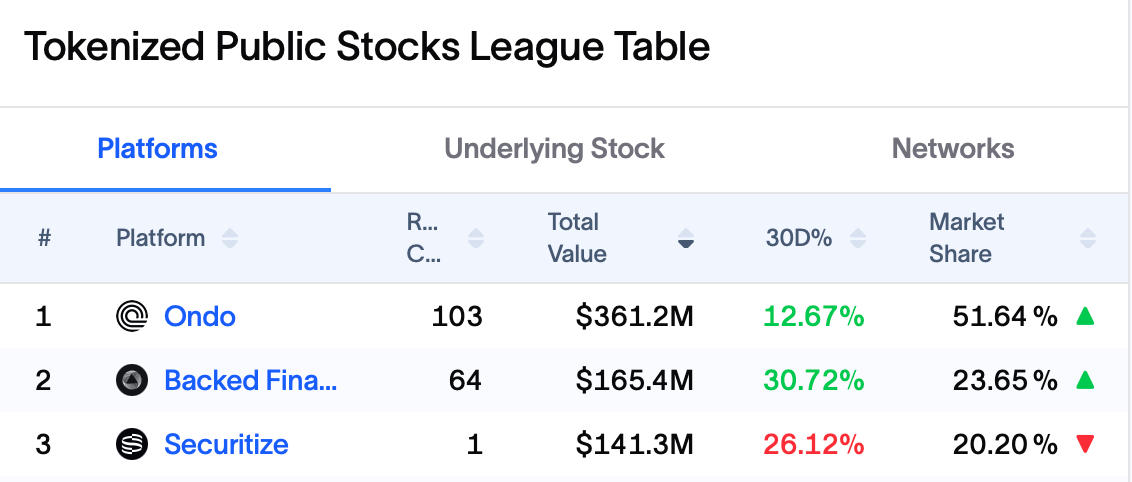
Source: RWA.xyz The Distribution Layer (The Consumer Interface): While shares are currently “trapped” in legacy brokers, the battleground for untrapping them is heating up. Robinhood, Kraken, and Coinbase are racing to become the interface where users not only trade but utilize tokenized equities. They own the customer relationship, which is the ultimate leverage point.
The Utility Layer (DeFi Rails): The value of a tokenized asset is defined by what you can do with it. Aave is the leader here, allowing users to borrow against tokenized assets like BUIDL or future Tesla shares. Uniswap provides the trading venue. These protocols capture value from usage velocity, not just issuance.
Carlos’s Bottom Line: Tokenization will become normal for treasuries, bonds, equities, and credit by 2027. The 2025-2026 story will be written by companies that went public (like Securitize), institutions that built products (like BlackRock), and the infrastructure layer that connects them all.
Take care,
Marc
- Check out our Crypto Treasury Alpha newsletter here.
- Check out our AI newsletter, AI Operator, here.