Tether’s Quiet U.S. Power Play
On December 9, 2025, Twenty One Capital began trading on the NYSE under the ticker “XXI” as the third largest Bitcoin holder (~$4B). [RELEASE]
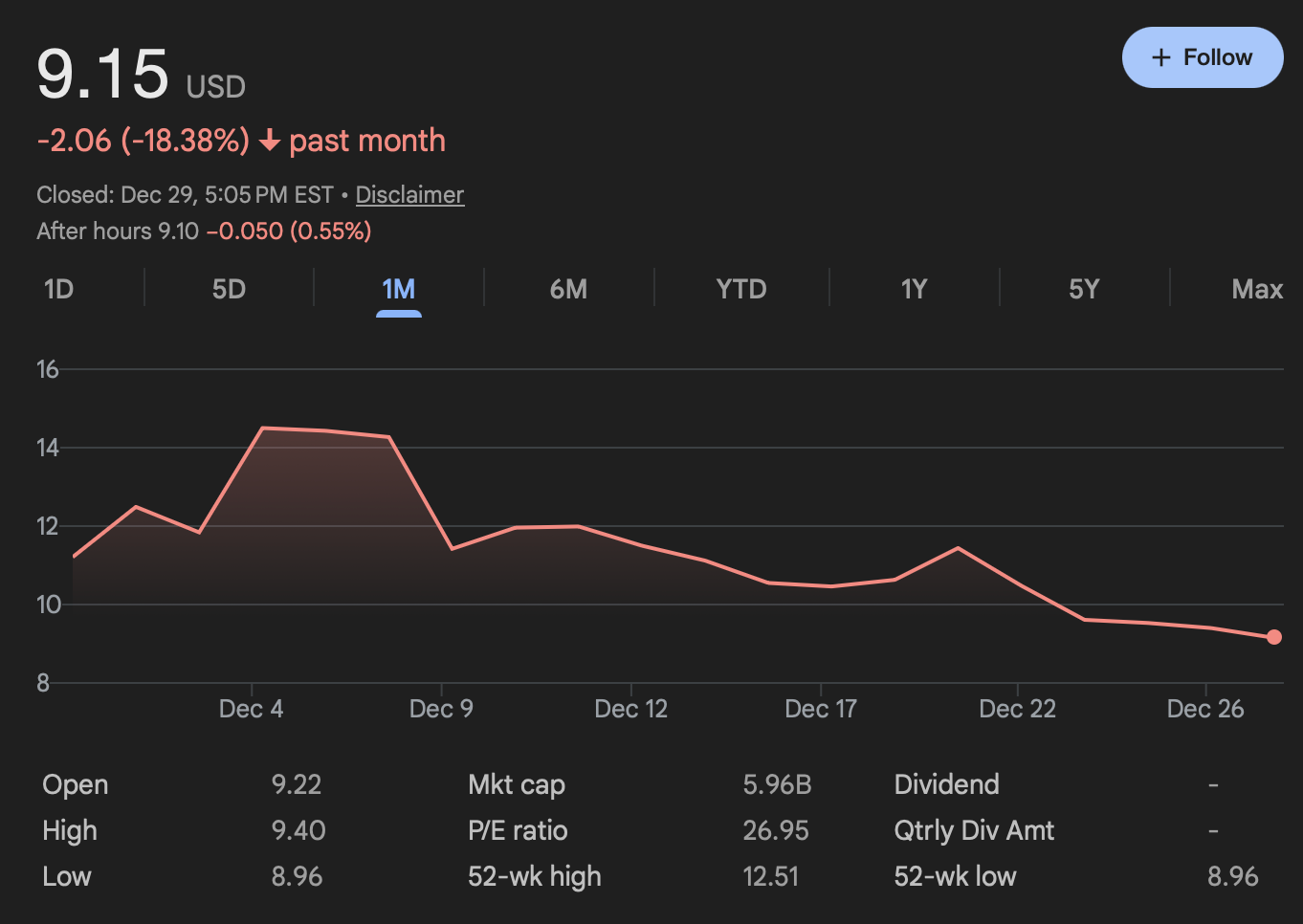
Everyone sees Twenty One Capital as another MicroStrategy clone. The market saw it too: XXI dropped 25% on its NYSE debut to $11, trading at 0.80x NAV.
But while investors fixate on the Bitcoin treasury playbook, they're missing what Tether, Cantor Fitzgerald, and SoftBank actually built: a closed-loop monetary infrastructure disguised as a public company.
This isn't about holding Bitcoin. It's about controlling the rails.
Let’s unpack.
Download the PDF
Today’s Market signals
- JPMorgan Chase reportedly froze accounts used by stablecoin startups BlindPay and Kontigo. Link
🚨 Get your brand in front of 100k+ decision makers in digital assets.
What happened
Shares opened and immediately fell 20-24% below their underlying value. Investors were willing to pay $3.2B for a $4B asset. And XXI traded below its NAV (0.80x to 0.90x mNAV) because the market saw it as a costly way to hold Bitcoin at a time when cheap spot ETFs already exist.
But the market is pricing it wrong.
Twenty One Capital (the third largest Bitcoin corporate holder) isn’t just a treasury company. It’s a closed-loop monetary system disguised as one.
The capital structure tells the deeper story. XXI secured $585M in additional closing capital, including $385M in convertible senior secured notes and a $200M common equity PIPE.
Who owns it: Led by Jack Mallers, a Bitcoin evangelist, the firm is backed by a powerful triumvirate: Tether (which issues the world’s most popular stablecoin), Cantor Fitzgerald (a major Wall Street firm), and SoftBank Group (a Japanese technology conglomerate with hundreds of billions in assets).
By the numbers: XXI's 0.80x NAV debut mirrors a sector-wide repricing. Strategy (MSTR) now trades at 1.06x NAV versus 5x premiums earlier in 2025. Only one of 195 Bitcoin treasury companies beat the S&P 500 this year. Bitcoin treasury buying collapsed 83% from July to November as the premium model broke.
Why it matters
This isn’t just about “holding” Bitcoin. It is about re-engineering the dollar through a private-public axis that traditional banks cannot touch.
The Tether liquidity loop: Tether doesn't just own XXI. It funded XXI by converting stablecoin profits directly into Bitcoin purchases that became XXI's treasury. This creates a closed circuit: USDT issuance generates profits ($80B+ in Treasury reserves managed by Cantor), which flow into Bitcoin accumulation, which capitalizes XXI, which issues equity to buy more Bitcoin. Unlike Strategy's debt-funded model, XXI recycles offshore stablecoin liquidity into a U.S.-listed vehicle, effectively laundering Tether's profit streams through public markets while hedging USDT depeg risk.
Cantor's vertical integration: Cantor Fitzgerald isn't just XXI's SPAC sponsor—it's Tether's Treasury custodian managing $80B+ in reserves. This dual role eliminates friction in converting Tether's cash into Bitcoin for XXI's balance sheet. Cantor placed the $850M+ in PIPEs and convertible notes, advised on the merger, and maintains privileged access to both Tether's liquidity engine and U.S. primary dealer status. Translation: XXI has a direct pipeline from the world's largest stablecoin issuer to Federal Reserve-adjacent capital markets infrastructure. No other Bitcoin treasury company has this institutional scaffolding.
The SoftBank-Stargate energy arbitrage: SoftBank's minority stake isn't passive capital allocation, it's strategic infrastructure play. Project Stargate (SoftBank's $500B AI data center initiative with OpenAI and Oracle) requires massive, stable power loads. Bitcoin miners control some of the most flexible energy infrastructure globally. XXI's operating business targets "Bitcoin-native financial services" and explicitly mentions energy infrastructure.
Connect the dots: SoftBank gains access to adaptable energy loads for AI compute through XXI's Bitcoin mining operations, while XXI leverages Stargate's hyperscale energy purchasing power to scale mining beyond what pure-play treasuries can achieve. XXI can theoretically borrow against its $4B BTC treasury to finance power plants or mining sites that serve both hashrate generation and AI datacenter needs.
The Lutnick conflict: Howard Lutnick was confirmed as U.S. Commerce Secretary on February 18, 2025, after divesting his Cantor positions. But his family still controls Cantor Fitzgerald, which controls XXI's structure. As Commerce Secretary, Lutnick oversees semiconductor export controls and GPU/ASIC supply chains, directly impacting both AI datacenter builds (Stargate) and Bitcoin mining equipment availability. This creates a potential competitive moat for U.S.-aligned firms like XXI/Cantor/SoftBank. Whether intentional or not, XXI now has implicit policy protection that no other Bitcoin treasury enjoys. The geopolitical angle is the quiet part no one's pricing in.
Alpha
The Bitcoin treasury model is challenged. Most companies trade at 10-90% discounts to NAV, premium-based accumulation has collapsed, and only execution quality now matters. XXI's 0.80x NAV debut looks like failure, but it's actually clearing price for a different kind of vehicle: one that doesn't need equity premiums because Tether provides the funding loop.
The market is currently pricing XXI like a "dumb" vault. When the "Liquidity Loop" starts spinning –funneling Tether’s massive profits into U.S. infrastructure acquisitions – the stock will re-rate from a discount to a massive "Sovereign Premium."
For the first six months, SPAC1 sponsors and PIPE investors can’t sell. Once that freeze ends, many may rush to exit, especially if the stock is below $10, which is why the market is already cautious. However, a discount can be a massive opportunity, and its connection with Tether, Cantor, and SoftBank might re-rate the stock. So, keep this stock in your watchlist.
- Cantor Fitzgerald (CEP): If the U.S. government decides to acquire Bitcoin or lend against its seized holdings actively, it will need a prime broker and custodian. Cantor Fitzgerald is the logical choice given its existing government securities role. 👉 Trade on Robinhood
- XXI is a "Shadow Monetary System" because it has its own Mint (Tether), its own Central Bank access (Cantor), and its own Hard Asset (Bitcoin). It is a private-sector version of the U.S. Treasury. 👉 Trade on Robinhood
Watchlist:
- Dec: USAT launch by Tether (expected)
- Dec: Clarity Act (H.R.3633) Senate vote (expected)
- Dec 31: Europe’s MiCA full enforcement (Austria, Germany, and Spain) ends
- Jan 1: Basel Committee crypto capital standards implementation in Hong Kong
- Jan’26: SEC Crypto Innovation Exemption
- Jan’26: Spot crypto ETF approvals for altcoin
- Q1’26: Kraken IPO
- Q1’26: Hong Kong Stablecoin licensing
- Q1’26: Singapore Stablecoin framework
That’s it for now.
Marc & Team
Download the PDF
De-SPAC: The process by which a private company (Twenty One) merges with a public shell (Cantor Equity Partners) to become public. ↩