

Real-estate enters prediction markets
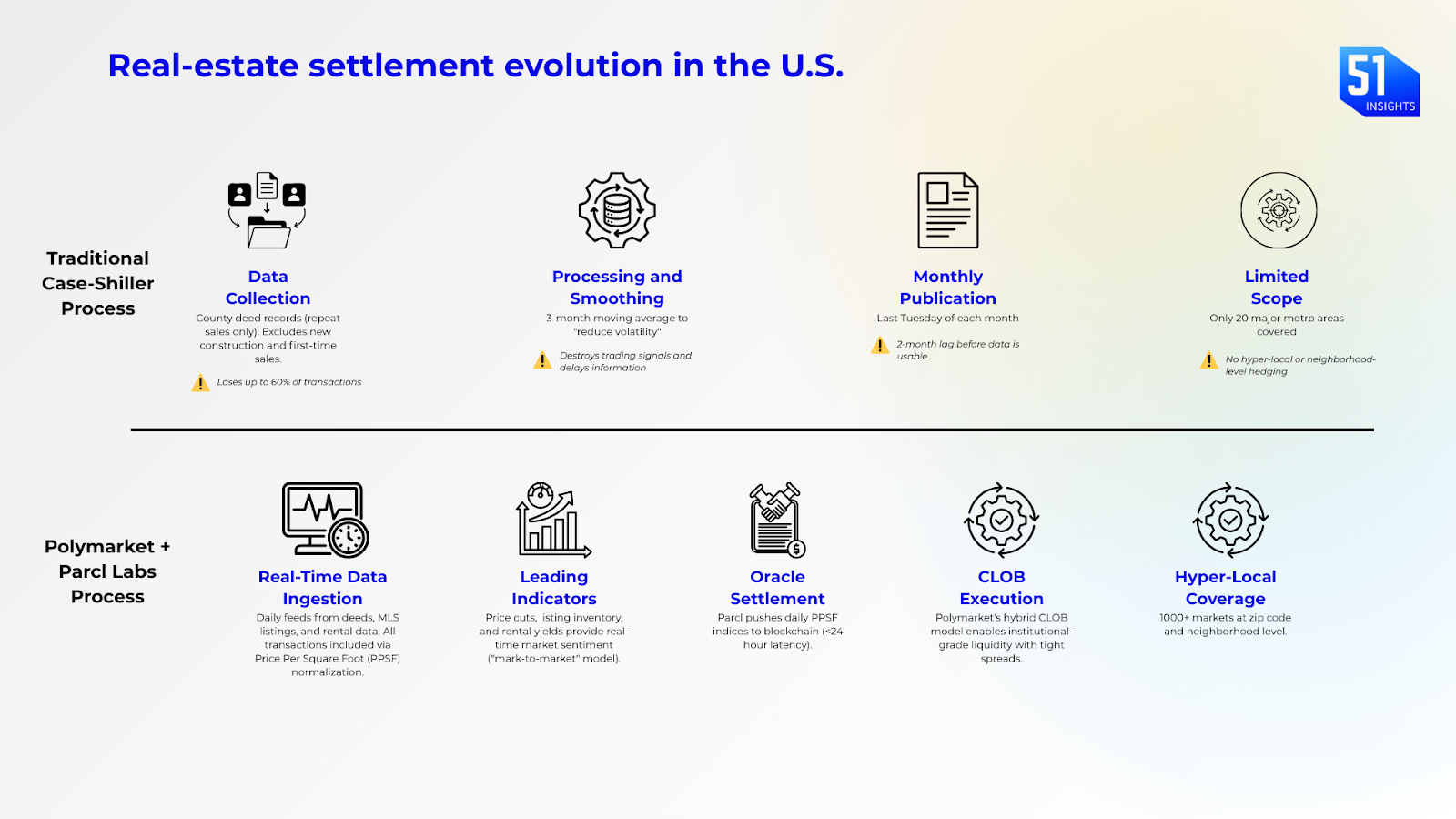
The U.S. real estate derivatives market has long been illiquid and outdated. In 2006, the Chicago Mercantile Exchange tried launching housing futures based on the S&P Case-Shiller Index, but failed. The problem wasn’t demand, it was infrastructure: the index lagged by two months, making it unusable for real-time speculation.
That changed on January 5, 2026.
Polymarket, the largest decentralized prediction market, partnered with Parcl Labs to bring real-time, settlement-grade real estate contracts to crypto. Instead of tinkering with old systems, they rebuilt the data layer entirely. And in doing so, they’ve unlocked the world’s largest asset class — real estate — as a liquid, tradeable market. [RELEASE]
Let’s unpack.
Download the PDF
🚨 Get your brand in front of 100k+ decision makers in digital assets.
What happened
New infrastructure: Polymarket integrated Parcl Labs’ daily price feeds1, based on live data from deeds, listings, and rentals, to launch contracts pegged to Price Per Square Foot (PPSF) indices in major U.S. cities.
Futures-like trading: These are scalar markets, not just yes/no bets. If Miami’s PPSF is forecasted between $350–$450 and lands at $400, traders get paid in proportion.
CLOB design: The Parcl feed powers Polymarket’s Central Limit Order Book, making home-price exposure feel like trading oil or gold futures.
Regulatory path: In late 2025, Polymarket secured an Amended Order of Designation from the CFTC, allowing operation as an intermediated execution facility. U.S. traders can now access these markets through registered Futures Commission Merchants (FCMs), not through unregulated overseas platforms.
By the data: Global real-estate value is estimated at about $4.34T in 2025, expected to grow to over $7T by 2034.
Be smart: Tokenization of real estate solves infrastructure and brings distribution to retail while this solves liquidity issues of real estate markets. The partnership addresses the “missing market” not by creating a new financial product on top of old infrastructure, but by rebuilding the data layer itself.
Why it matters
Direct exposure, no REIT baggage: REITs are outdated, correlated to the S&P 500, and full of management fees. This lets you bet on residential markets without touching the public equity markets.2
Real-time data, not stale indices: Parcl updates daily and includes cash sales, new construction, and listing changes, unlike Case-Shiller, which lags 60+ days and excludes 60% of market activity in places like Boston and Miami.
Infrastructure breakthrough: Tokenized real estate addressed accessibility; Parcl and Polymarket now solve liquidity. The entire model was rebuilt around continuous, normalized price feeds, not patching outdated indexes.
Investor Alpha
Capital efficiency is the new alpha.
Custody solutions like Coinbase custody: As notional volumes grow on Polymarket, institutions need custody solutions compliant with CFTC standards. Coinbase Custody is the infrastructure pick. Additionally, Polymarket likely uses USDC (co-founded by Coinbase) for stablecoin settlement, creating a flywheel: more trading → more USDC demand → more collateral → more Coinbase Custody revenue.
REITs with geographic concentration plays: Invitation Homes (INVH) and American Homes 4 Rent (AMH) are heavily exposed to Sun Belt markets3 (Austin, Phoenix, Miami) where Polymarket will likely launch contracts first (”high liquidity cities”). By going long the stock and shorting the specific metro indices where they hold inventory (e.g., Atlanta, Phoenix), you hedge out the macro risk of falling home prices. This strategy currently requires knowledge of upcoming market launches.
Solana (SOL): Parcl is built on Solana. High-frequency real estate derivatives require high-throughput chains. Increased data writes and settlement volume directly accrue value to the underlying L1.
Watchlist:
- Jan: USAT launch by Tether (expected)
- Jan: Clarity Act (H.R.3633) Senate vote (expected)
- Jan 13: Consumer Price Index data for December 2025; heavily influence the January 27-28 meeting
- Jan 27: The Federal Reserve will convene for two days, with the rate decision
- Jan: SEC Crypto Innovation Exemption
- Jan: Spot crypto ETF approvals for altcoin
- Q1’26: Kraken IPO
- Q1’26: Hong Kong Stablecoin licensing
- Q1’26: Singapore Stablecoin framework
Market signals
- New bill restricts officials’ use of prediction markets. Link
- Jupiter launches JupUSD Stablecoin backed by BlackRock’s tokenized treasury fund. Link
- Nike quietly sold its digital products subsidiary RTFKT in December 2025. Link
- Tether launched Scudo, a new unit of account for Tether Gold (XAU₮). Link
That’s it for now.
Marc & Team
Parcl Labs Price Feed (PLPF): This index updates daily and incorporates all transaction types, including all-cash purchases and new construction data. By capturing these transactions, Parcl found that all-cash sales in Chicago increase by an average of 5.5% annually during the winter months (December through March), which contributes significantly to market volatility. ↩
Traditional Indices (e.g., Freddie Mac House Price Index (FMHPI)): These indices primarily rely on loan data and often use a repeat-sales methodology, explicitly excluding all-cash purchases and new construction from their calculations. The omission of these significant cash transactions leads to a less volatile, and potentially distorted, view of the market’s true seasonal dynamics. ↩
Sun Belt markets refer to fast-growing metropolitan areas in the Southern and Southwestern U.S., spanning states like California, Texas, Florida, Arizona, and the Carolinas, attracting businesses and residents with lower costs, better weather, and business-friendly environments, leading to significant population and job growth, particularly in sectors like tech, and strong performance in commercial real estate. Key cities include Los Angeles, Dallas, Houston, Atlanta, Phoenix, Austin, and Orlando. ↩