
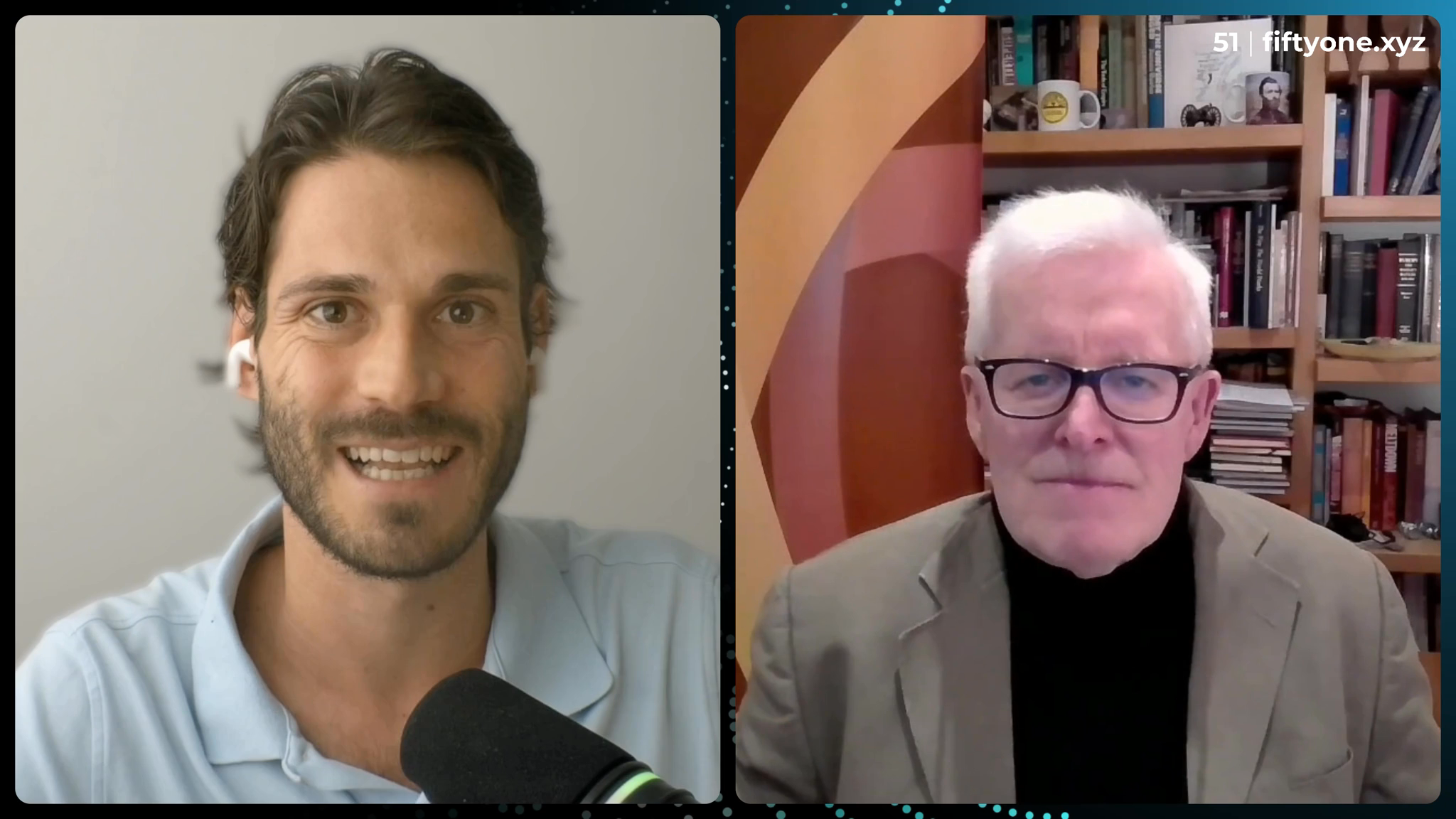
The liquidity cycle just broke bitcoin, with Michael Howell, Founder at CrossBorder Capital
Hi, it’s Marc. ✌️
There's a chart making the rounds right now. Gold at $5,400. Bitcoin at $66,000. One is at an all-time high. The other is down 47% from its October peak of ~$126,000. Same "store of value" thesis that the crypto community sold to investors over the last 5 years. Wildly different outcomes. We sat down with the man who saw it coming.
Dr. Michael Howell, one of the world’s foremost authorities on global liquidity, founder of CrossBorder Capital and creator of the Global Liquidity Index, told us why: the 65-month liquidity cycle peaked in Q3 2025. The downswing is just beginning and will likely last through 2027. Every risk asset is exposed.
“Bitcoin is the most liquidity-sensitive asset on the planet. If liquidity goes down, you’ll see it first in Bitcoin.”
About Michael: Dr Howell spent decades at Salomon Brothers and Barings. He has advised the World Bank on capital flows and pioneered the Global Liquidity Index, a framework that tracks money flowing through financial markets across nearly 90 countries. He runs Capital Wars, one of the top-ranked financial publications on Substack. His institutional service provides data to quant funds and investment managers globally.
In short: When Howell says the liquidity cycle has peaked and risk assets face a rough ride into 2027, he’s not guessing. He’s reading a framework that has called every major inflection point for decades.
Bitcoin is down over 50% from its highs. Crypto markets lost over $2 trillion in capitalisation. Every risk asset got hit at once. Michael’s model forecasts the peak, and now it’s forecasting the duration and depth of the downturn.
“Markets have trends, and those trends could be actually really quite exciting. I’m very upbeat about gold and Bitcoin in the long term. I think they’re fantastic assets. But the problem is there’s a cycle, and we can’t forget the cycle.”
 Marc Baumann
🚨We’re opening sponsorships for our next podcast series. Top guests. Serious listeners. Claim your spot →
🎧 Jump to the best parts
- 02:45 Understanding the Global Liquidity Cycle
- 05:35 The Impact of Global Debt on Liquidity
- 06:56 China and the US: A Bifurcating Monetary System
- 10:02 The Future of Bitcoin and Monetary Inflation
- 12:30 Government Debt and Monetization Strategies
- 20:16 The Impact of Stablecoins on China's Monetary System
- 21:46 The Dollar's Role in Global Trade and Devaluation
- 23:07 Understanding Asset Allocation Cycles
- 24:32 Liquidity Cycles and Market Predictions
- 29:20 Building a Resilient Investment Portfolio
- 32:05 AI Infrastructure Spending and Market Liquidity
- 33:57 Misconceptions About Gold and Market Cycles
- 37:40 China's Monetary Policy and Its Global Implications
- 42:32 The Future of US Debt and Economic Outlook
- 43:40 Investment Strategies for the Coming Year
Important Links
- LinkedIn: https://uk.linkedin.com/in/michael-howell-357b1416
- Instagram: https://www.instagram.com/michaelhowell_official/
- Google Research: https://research.google/people/michaeldhowellmdmph/
- CrossBorder Capital: https://www.crossbordercapital.com/
- Capital Wars: Substack
Watch or listen now:
YouTube • Apple Podcasts

My biggest takeaways from this conversation:
1. The 65-month liquidity cycle has turned
Michael doesn't start with opinions. He starts with data. His Global Liquidity Index tracks the flow of money through the world's financial system, encompassing central banks, private lenders, shadow banks, repo markets, and cross-border flows across nearly 90 countries.
The framework is built on a simple but powerful observation: global debt has an average maturity of five to six years. That creates a debt refinancing cycle, a 65-month wave that drives liquidity through financial markets with clockwork regularity.
"The cycle bottomed in late 2022, around September, October. It's peaking sometime around the end of the third quarter of 2025. The cycle is going down now. That down wave will likely last through this year and well into 2027 before there's an upturn."
This is not just an opinion, but a structural forecast. The upswing lasted three years. The downswing is just beginning. And every risk asset is exposed.
What makes this framework so compelling is Bitcoin's relationship to it. Michael's research shows that roughly 40–45% of Bitcoin's movement is driven by global liquidity.
“Bitcoin is a canary in the coal mine. If liquidity goes down, you’ll find that in Bitcoin first. And Bitcoin prices will lead other assets.”
The implication: the environment for strategically investing in risk assets is problematic for the next 12–18 months. You can trade tactically, but the trend is against you.
Michael's re-entry signal for Bitcoin? Around one standard deviation below trend, roughly the mid-$60,000s.
2. Bitcoin vs Gold
I pressed Michael on the "digital gold" narrative. Bitcoin and gold have decoupled sharply. Gold is at an all-time high. Bitcoin is down over 50%. What gives?
His answer: In the long term, Bitcoin and gold are highly positively correlated; they’re both monetary inflation hedges responding to the same structural force: the relentless expansion of global liquidity to refinance growing sovereign debt.
But in the short term, they’re negatively correlated. And right now, China explains the divergence.
- The US Strategy (The Genius Act): Using stablecoins as “wrappers” for US Treasuries to export dollar demand globally and provide a decentralized, digital payment rail.
- The China Strategy (Notice 42): Banning crypto to prevent capital flight while aggressively accumulating gold to back the Yuan.
China is injecting massive liquidity into its financial system, roughly $1.1–1.2T since the beginning of 2025, to dig itself out of a real estate bust and an underwater debt problem. That liquidity is flooding into gold through the Shanghai Gold Exchange. But Chinese residents are banned from buying crypto. So the monetary expansion in China pushes gold up while offering no support to Bitcoin.
“China printing paper money, the gold market goes up. Chinese residents can buy gold. They can’t export gold, but they can buy it. The monetary expansion in China is not going into crypto because they can’t buy that.”
This is the cleanest explanation I’ve heard for why the “Great Debasement Trade” is only half-working right now. The debasement is real, but it’s a China debasement, not a global one. Western liquidity is actually tightening. Gold rises because China is printing. Crypto falls because Western liquidity is rolling over.
Michael’s positioning reflects this: he’s constructive on gold near-term (supported by Chinese flows), cautious on Bitcoin (exposed to the Western liquidity downcycle), and deeply bullish on both long-term.
Related podcast:
Marc Baumann
3. A monetary cold war is unfolding, and stablecoins are the weapon
Michael paints a picture of the global monetary system bifurcating into two competing architectures.
- The US system. Decentralised, digital-first, built on dollar stablecoins that wrap treasuries and extend the reach of the dollar zone globally. The GENIUS Act is the legislative catalyst, it creates formal demand for treasuries through stablecoin issuance, effectively letting the US wrap its debt in a digital format that citizens of unstable fiat regimes worldwide will embrace.
- China’s system. Centralised, CBDC-driven, tightly controlled, backed increasingly by gold. China’s response to the GENIUS Act was Notice 42, issued in the last two weeks, which doubles down on banning crypto and digital assets. Chinese exporters can’t hold stablecoins. Chinese residents can’t buy Bitcoin. The avenue for monetary inflation protection in China is narrowed to precious metals.
“What the Chinese have done is they’ve closed off that avenue as best they can by making it illegal to hold any of these instruments. Notice 42 has been very clearly a reaction to the GENIUS Act.”
The geopolitical logic is stark. It’s in America’s interest to promote digital assets and stablecoins, as they extend dollar hegemony. It’s in China’s interest to suppress them and promote gold, which undermines the digital dollar narrative and supports the renminbi’s alternative collateral base.
Where does Bitcoin sit? Michael suggests it may “bask in the aura” of stablecoins within the US system. If the US is promoting digital value transfer, Bitcoin benefits by association. But it remains structurally excluded from the Chinese liquidity wave, which is why gold is currently outperforming.
4. A stronger economy is actually bad news for financial markets
This is the counterintuitive insight that separates Michael’s framework from conventional thinking. Most investors assume a strong economy means strong markets. Michael argues the opposite, and the data backs him up.
“All money that is anywhere must be somewhere. If it’s in the real economy, it’s not in financial markets. And if it’s in financial markets, it’s not in the real economy.”
When the economy strengthens, driven by the “Big Beautiful Bill,” AI capex, and other real-economy spending, it sucks liquidity out of financial markets. The AI infrastructure boom alone is approaching $600–700B per year, with hyperscalers issuing over $100B in debt to fund it. That capital goes into the real economy, not into risk assets.
The only offset is the central bank liquidity injection. And right now, central banks aren’t cooperating. The BOJ is tightening. The Reserve Bank of Australia is raising rates. And incoming Treasury Secretary Kevin Warsh has signalled he wants to shrink the Fed’s balance sheet.
“If they try to go down the road of cutting liquidity, which I think is far more important than interest rates, then we’ve got a problem out there.”
Michael’s assessment for the next 6–12 months: US equities are at best range-bound with downside risk. He’s gradually reducing risk asset exposure. He’d be slower to exit energy stocks and European equities, and would maintain positions in China (early cycle, technology sector). But the overall message is clear: this is not an attractive environment for risk asset investment.
“I would be taking money off the table. I’m gradually exiting. I’m not saying press the panic button and dive out tomorrow. But this is not an attractive environment for risk asset investment.”
Bottom line
Michael Howell trades the cycle. And the cycle, right now, is unambiguous: liquidity peaked in Q3 2025, the downturn will likely last into 2027, and every risk asset, Bitcoin included, is exposed.
But here's the thing that makes this conversation so valuable. Michael is one of the most bullish long-term voices on Bitcoin and gold I've spoken to. His framework doesn't say these assets are broken. It says the timing matters enormously, and most investors get destroyed by ignoring the cycle.
The structural story is still the same. Sovereign debt is growing exponentially. The only exit is monetisation. That means more liquidity long-term. That means monetary inflation hedges (gold, Bitcoin) are essential portfolio components.
The cycle will turn again. When it does, the re-entry into risk assets will be one of the best opportunities of the decade. But that’s 2027, not tomorrow.
Take care,
Marc
- Check out our Crypto Treasury Alpha newsletter here.
- Check out our AI newsletter, AI Operator, here.