

Japan's first stablecoin
The world’s third-largest economy entered the stablecoin race with the world’s first yen-pegged stablecoin. [NEWS]
JPYC is now active on Avalanche, Ethereum, and Polygon. But with 10-year JGB yields at just 1.65%, JPYC’s thin-margin seigniorage model faces heightened stability risk, making yen-backed stablecoins structurally weaker than dollar-backed ones.
Let’s unpack what this means for global FX rails, de-dollarization, and the future of sovereign stablecoins.
PRO: Download the PDF
What Happened
JPYC, a Tokyo-based startup, has launched the first-ever yen-backed stablecoin, fully convertible to Japan’s national currency and backed by savings and Japanese Government Bonds (JGBs). Live on Avalanche, Ethereum, and Polygon, JPYC plans to issue up to ¥10T ($66B) over three years, initially waiving fees and earning profit from JGB interest.
Zooming in: To scale, JPYC is partnering with MUFG’s compliant Progmat platform, transitioning to a Trust-Type structure where MUFG will custody reserves.
The adoption curve: Unlike dollar-backed tokens, yen stablecoins lack reserve currency momentum. Early traction will likely centre on Asian trade flows and multinational settlement systems, helping Japanese firms reduce dependence on USD rails.
Stepping back: In 2024, Japan’s three megabanks piloted Project Pax, a SWIFT-integrated stablecoin platform by Progmat and Datachain, to enable faster, cheaper, and compliant cross-border payments, targeting Japan’s 300,000+ corporate clients.
The warning: The Bank of Japan warns that the private stablecoin liquidity migration could erode commercial bank funding models and test the limits of Basel-era prudential frameworks.
Devil’s advocate: While JGBs offer sovereign security, they now carry high duration risk. If yields spike, JPYC could face liquidity strain during mass redemptions, as fixed-income losses erode peg stability.
Why it matters
1. Japan’s cash-heavy economy
Japan’s 2023 PSA established three stablecoin types: Deposit, Funds Transfer, and Trust, creating the world’s most conservative, bank-led framework. Only licensed institutions can issue with strict KYC and full redemption guarantees. While this builds trust, the Funds Transfer Type caps transfers and refunds, slowing innovation versus open markets like Hong Kong or Singapore.
2. The dollar dominance
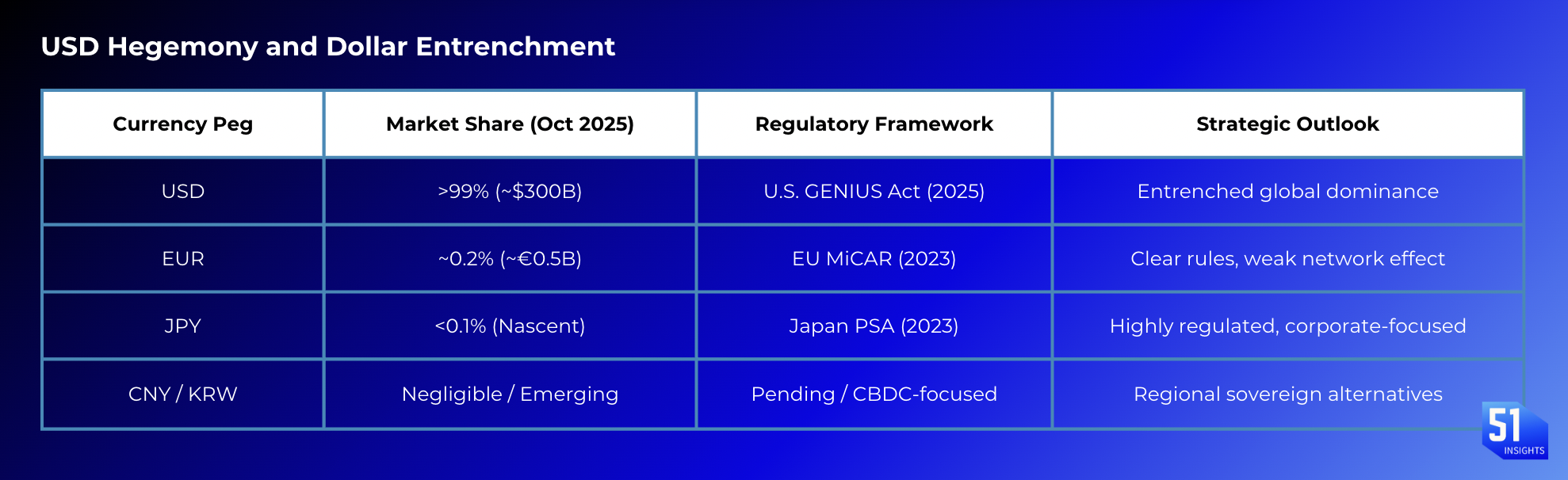
USD-pegged stablecoins command over 99% of the global market, which crossed $300B in total capitalisation as of October 2025. JPY stablecoin offers a “De-dollarisation Lite” path, creating a sovereign, regulated digital alternative to the USD for Asian trade settlement.
3. The seigniorage squeeze
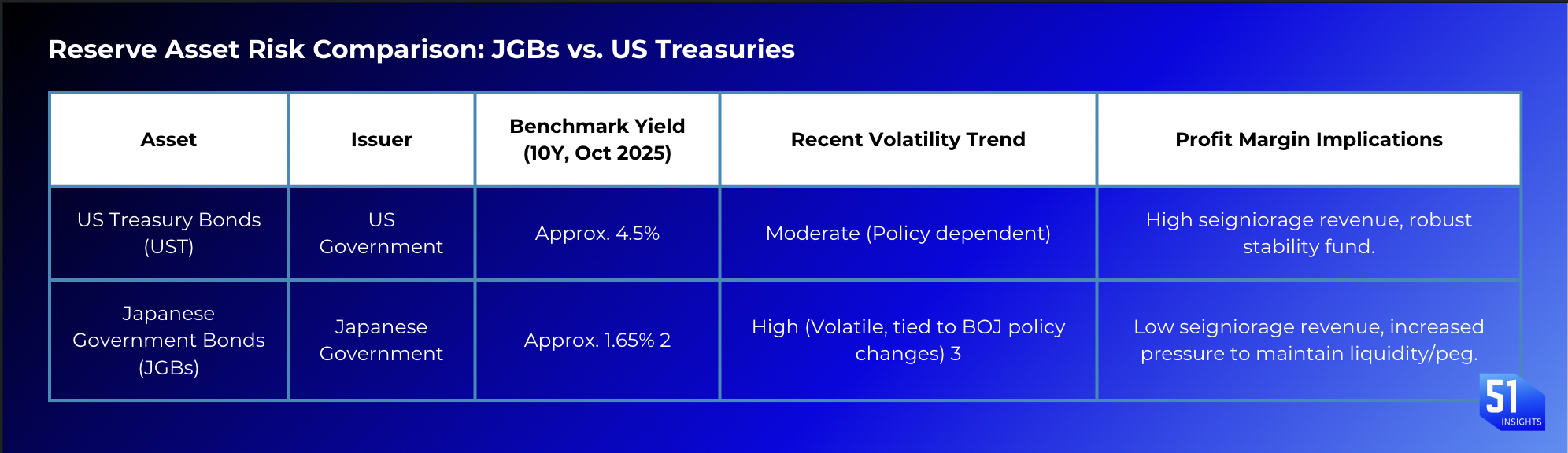
JPYC relies solely on seigniorage, the interest from JGB reserves. With 10-year yields at 1.65% (vs. 4.5% for U.S. Treasuries), margins are razor-thin. Matching dollar-stablecoin profitability requires either ¥10T issuance or higher-risk holdings, both raising systemic fragility.
Our take
Japan is building a high-trust, low-risk environment optimised for institutional capital, not DeFi experimentation. That makes it better suited for infrastructure builders, while markets like the US, Hong Kong, and Singapore retain the innovation edge.
Japan’s market is evolving into a dual structure:
- A Trust-Type corporate rail (Progmat) led by megabanks, optimised for institutional scale and efficiency.
- A multi-chain, Funds Transfer–Type rail (JPYC) serving retail and Web3 ecosystems.
Its challenge is to pair its regulatory trust with institutional utility. As seen from EU stablecoin cases, legal certainty alone can’t overcome the network effects of USD rails.
More analysis from 51:
 Marc Baumann
 Marc Baumann
Take care,
Marc
🙌 Work with us: We arm financial institutions and digital asset leaders with bespoke research, thought leadership to shape the most important conversations, scale trust, and win business.
