

Google Integrates Polymarket Data for Billions of Users
Google integrated Polymarket and Kalshi into Search and Finance. [RELEASE]
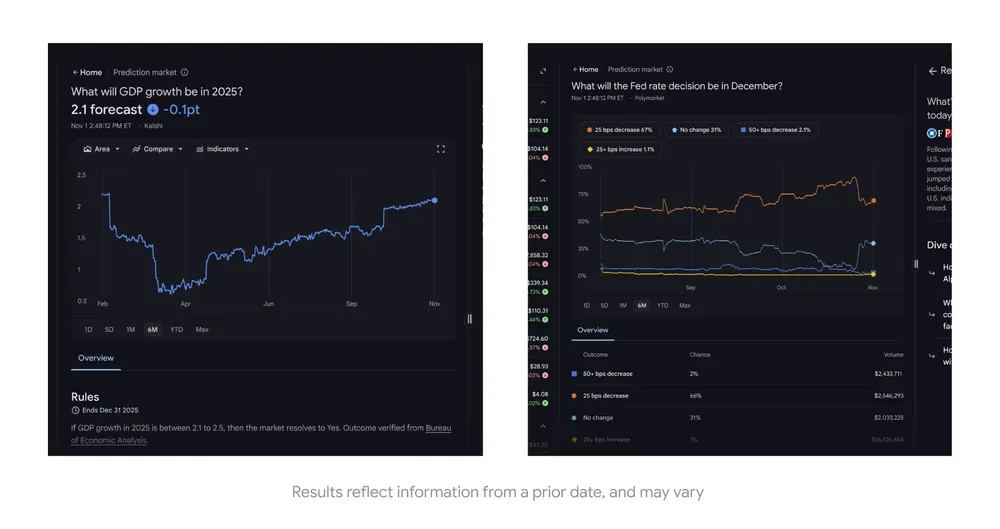
Prediction market data from Kalshi and Polymarket now allows users to see how traders are pricing real-world events, such as GDP growth or the Fed’s next move, turning crowd sentiment into a research signal. This marks a structural validation of crypto and nascent asset class: information itself.
Let’s unpack.
What happened
Google is turning Finance into an AI-powered research hub. The latest update adds “Deep Search,” prediction market data, and live earnings coverage.
Polymarket, the on-chain prediction market, is now showing up 𝗻𝗲𝘅𝘁 𝘁𝗼 𝘀𝘁𝗼𝗰𝗸 𝗽𝗿𝗶𝗰𝗲𝘀 and economic data for billions of users on Google. Users can see market-based probabilities for elections, inflation, policy moves, and more. For the first time, crypto’s pricing infrastructure just merged with the internet’s home screen.
In the last 4 years, Polymarket built crypto’s Bloomberg Terminal for sentiment:
- Lets anyone create or bet on future events
- Shows crowd-sourced odds on political and financial outcomes
- Became a go-to source for retail and institutional market sentiment
The numbers tell the story:
Polymarket grew 100x to $9B in volume 2024 and 300k+ active traders.
This is why four weeks ago, the NYSE’s parent company (ICE) invested up to $2B on Polymarket at a $9B valuation.
 Marc Baumann
 Marc Baumann
Zooming in: This marks a rare convergence of three worlds: Big Tech’s scale (Google), TradFi’s credibility (ICE), and DeFi’s transparency (Polymarket). Polymarket built the rails on-chain, earned legitimacy through ICE, and now gains global distribution through Google, completing the loop from crypto niche to mainstream finance.
Be smart: The real breakthrough here is regulatory. Polymarket’s $112M acquisition of QCEX, a CFTC-licensed exchange and clearinghouse, offers a playbook for DeFi firms seeking U.S. legitimacy: buy compliance instead of battling for it. It’s a costly move, but one that turns regulation from a roadblock into a moat.
By the data: Polymarket grew 100x to $9B in volume 2024 and 300k+ active traders.
Thesis: The market economy is transitioning from primarily pricing assets and commodities to algorithmically pricing future uncertainty. In plain English, this means: For decades, markets priced assets. Now, they’ll price information. Financial firms will soon trade and price risk based on probability markets. Citadel’s is the first big hedge fund that explores prediction markets. And, it is just the start. And prediction markets, powered by blockchain, are the infrastructure for that future. We’re going to have a market for EVERYTHING.
🙌 Work with us: We arm financial institutions and digital asset leaders with bespoke research, thought leadership to shape the most important conversations, scale trust, and win business.
Why it matters
- Bloomberg Terminal for everything. Polymarket lets anyone create or bet on future events, and shows crowd-sourced odds on political events. These platforms are effectively an algorithm for pricing information, turning dispersed knowledge into real-time probability data, far more efficient than polls that only capture sentiment.
- Google’s AI grounding strategy. More than a feature upgrade, this is Google turning prediction markets into an AI truth layer. Unlike static or delayed data, prediction markets reflect real-time, financially backed consensus, reducing AI hallucinations in forward-looking analysis. In essence, traders’ “skin in the game” becomes a validation engine for AI outputs. It shows Google building its AI systems on live, open data rather than closed, backwards-looking sources.
- Power lies in the mechanics. Each contract trades between 0 and 100%, with the price reflecting the collective probability of an event. Traders with better information move prices toward a real-time consensus, turning private insight into a public signal. Recent U.S. elections proved this in practice. Polymarket’s forecasts outperformed traditional polls, especially in swing states. The financial incentive filters noise and bias, making prediction markets a truer gauge of collective expectation.
Our take
Prediction markets infrastructure underpins the idea of a “Market for Everything.” This structural thesis is transforming uncertainty itself into a tradable asset, making platforms like Polymarket a data layer powering corporate strategy, governance, and investment decisions worldwide.
This shift opens a new lane for startups focused on data quality and indexing. As prediction markets draw interest from both retail and institutional players like Robinhood, Coinbase, and Crypto.com, the real opportunity lies in building trusted regulatory infrastructure, models like QCEX that make these markets usable and compliant for mainstream finance.
Also, with prediction markets expanding into global security and geopolitics, regulators face hard ethical limits of commodifying uncertainty. The competition now occurs along two dimensions: decentralised versus regulated. Decentralised platforms like Polymarket compete fiercely with centralised, regulated counterparts like Kalshi, which also reported massive volume ($4.4B in October) and high valuations ($5B) and has attracted similar institutional attention. Nevertheless, this is a massive step for crypto. And an incredible win for Polymarket.
Today’s Market Signals
- Ripple raised $𝟱𝟬𝟬𝗠 𝗮𝘁 𝗮 $𝟰𝟬𝗕 𝘃𝗮𝗹𝘂𝗮𝘁𝗶𝗼𝗻. Link
- Japan’s Financial Services Agency will support a pilot project on stablecoin. Link
- Fireblocks, Polygon, and Solana form an alliance for cross-border payments. Link
- Robinhood is cautious about adopting a corporate bitcoin treasury. Link
- Australia risks falling behind as others race ahead on tokenisation. Link
Take care,
Marc & team
Download the PDF