
The First RWA Unicorn IPO
Figure’s Wall Street debut isn’t just another crypto IPO.
Figure Technologies just proved that blockchain can actually fix broken parts of the financial system, and make money doing it. [RELEASE] At a $7.6B valuation and 18x revenue multiple, Figure now trades in line with Coinbase and Robinhood. That tells us two things:
- Public markets are ready to treat blockchain rails as investable financial infrastructure, not speculative tech.
- Tokenised credit markets are moving from pilot → scale, with Figure capturing 74% of tokenised private credit on-chain.
Why it matters: Figure’s $787M IPO is the first major proof that blockchain works best when it makes existing systems better, not when it tries to replace everything.
Let’s dive in.
👉 Get your ad spots now and reach 35k+ digital asset leaders
👉 Subscribe to our digital asset treasury newsletter
The State of RWAs
The current state of real-world asset tokenisation (RWAs) is dominated by Private Credit, which contributes to more than 50% of the total asset value of $30.24B.
The tokenised private credit has a total loan value of $16.98B, out of which 74% ($12.49B) of loans are being originated on Figure.
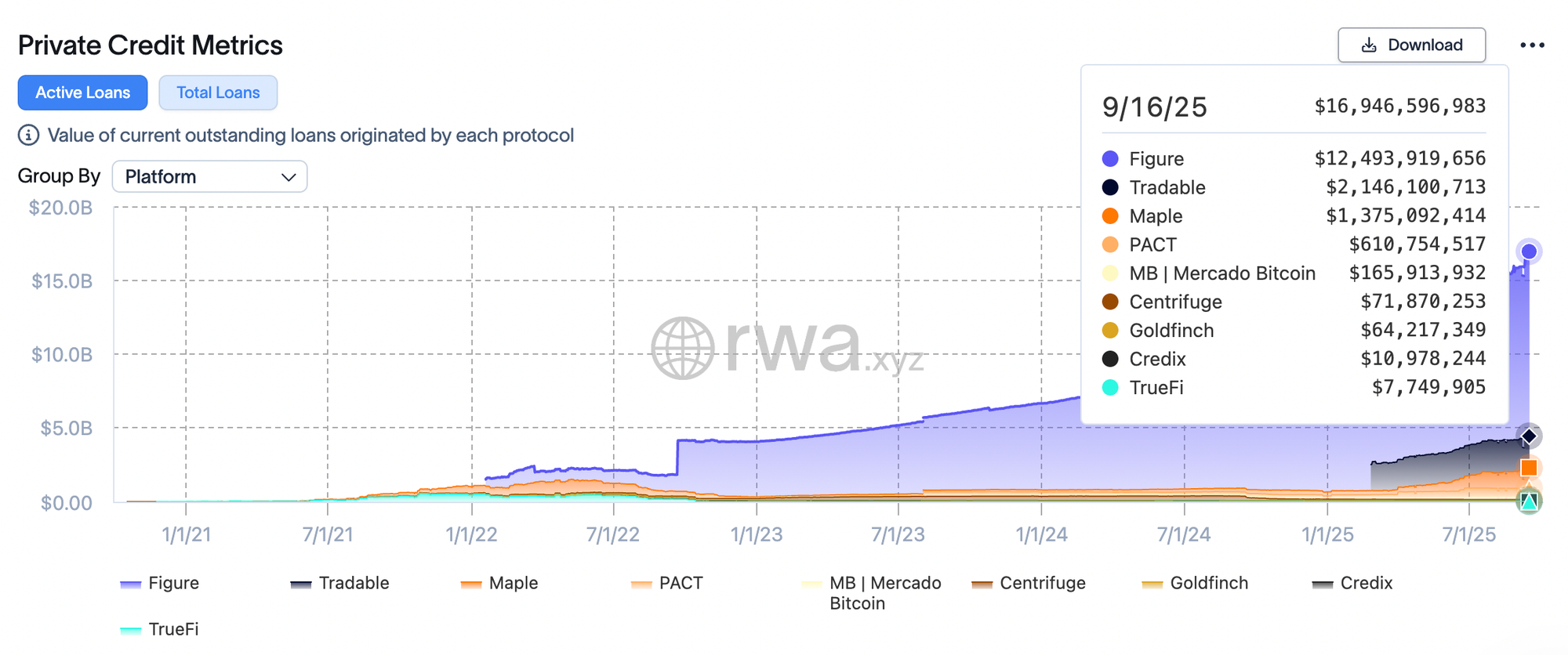
Most of Figure's activity is conducted on its own Provenance blockchain, designed for compliant asset tokenisation and financial contracts.
Case Study: Figure Technologies
IPO Highlights
- Name: Figure Technology Solutions, Inc. ()
- IPO Date: September 11, 2025 (SEC S-1)
- Valuation: $7.62B after first-day trading
- Share Performance: IPO priced at $25/share, opened at $36, surged 44% on debut
- Capital Raised: $787.5M via 31.5M shares (upsized IPO)
- Revenue Multiple: 18x — identical to Coinbase/Robinhood, ~3x above SoFi
- Timing: Biggest U.S. IPO week since 2021, fueled by strong equity markets
Business Fundamentals
Figure operates a blockchain-native capital marketplace that seamlessly connects and modernises three core components of financial activity:
- loan origination
- funding,
- and secondary market trading.
Its business model is a vertically integrated flywheel, with revenue streams derived from loan origination fees, servicing fees, gains on loan sales, and technology usage fees from its partners.
Core Business: Blockchain-powered lending platform for home equity lines of credit (HELOCs)
Scale: Facilitated $6B in home equity lending in the 12 months ending June 30, 2025 (up 29% YoY)
Technology: Runs on Provenance blockchain, built to originate, verify, and process loans
Adoption:
10 of the top 20 mortgage companies use Figure’s tech
20+ large banks are already on Provenance
A central pillar of this model is "partner-branded lending," where other financial institutions, including banks and mortgage originators, use Figure's platform under their own brands. This business-to-business (B2B) approach is highly scalable and has allowed Figure to build a robust ecosystem of over 160 partners.
Zooming in: Home equity loans are a nightmare.
- Traditional timeline: 42 days to get money
- Involves 7+ parties for settlement
- Mountains of paperwork (literally cardboard boxes in the 80s)
- Costs lenders 85 basis points in unnecessary fees
What Figure did: Built their own blockchain (Provenance) and automated the entire process.
Here's where it gets interesting. Figure didn't just become a better lender; they became the infrastructure other lenders use.
The numbers:
- 168 partners now originate loans through Figure's system
- 77% of loan volume comes from partners, not direct lending
- Partners save up to 1% by trading loans on Figure's blockchain marketplace
Not just that, unlike most blockchain companies, Figure makes actual profit:
2025 half-year numbers:
- Revenue: $191M (up 22% YoY)
- Profit: $29M
- Loan volume: $3.2B (up 27% YoY)
Valuation
At 18x revenue, Figure now trades closer to Coinbase than SoFi, meaning public markets are pricing blockchain distribution rails as financial infrastructure. For investors, that multiple creates a valuation anchor for the next tokenisation IPOs (Centrifuge, Maple). For banks, it signals equity markets will reward integrated blockchain lending platforms over fintech wrappers.
What investors are betting on:
That Figure's loan business is just the beginning of a broader blockchain finance platform. Their approach is simple: to make the existing system work better.
Zooming out: Blockchain technology is not for disruption or reinventing the wheel. Figure focused on compliance and integration to make the system better and efficient with blockchain technology, and they also got validation.
- First AAA-rated blockchain securitization
- SEC-approved yield-bearing stablecoin (YLDS)
- More tokenised private credit than any competitor
After the 2024 election and regulatory clarity on crypto, the IPO timing worked perfectly for the company.
Dan Morehead (Pantera Capital): "It was really just the SEC that was making it very scary for entrepreneurs to build things in the US... I think the election last November is a massive unlock."
Devil’s advocate: Figure’s exchange trading volume is still tiny. If blockchain trading doesn't take off, Figure is just a mortgage tech company.
The Provenance Protocol
The Provenance blockchain is a public, permissioned, proof-of-stake blockchain built using the Cosmos SDK, designed specifically to address the unique requirements of the financial services industry.
Its architecture is built on three core concepts: it is distributed (no single entity owns the ledger), immutable (information cannot be altered once recorded), and trustless (the system's integrity replaces the need for a central authority). This infrastructure allows for "atomic settlement," enabling transactions to be finalised instantly without the delays and risks associated with traditional financial intermediaries.
The Loan-as-a-Service Model: Provenance provides the core technology for Figure's loan-as-a-service model. The process of tokenising an RWA, such as a home equity loan, begins when a loan is issued by an originator's system. At this moment, a Non-Fungible Token (NFT) is minted on the Provenance blockchain, acting as a unique digital asset that represents ownership of the loan and serves as its digital certificate.
To facilitate the trading and securitization of these loans, Provenance uses a "Marker" construct to bundle individual loan NFTs into a single, more easily tradable security, or pool. This enables the creation of complex financial instruments like Mortgage-Backed Securities (MBS) directly on-chain.
Figure's standing as a leader in the RWA space is not solely due to its technology but also its formidable regulatory posture. It has an extensive portfolio of licenses and registrations. This includes over 180 lending and servicing licenses, 48 money transmitter licenses, and its status as an SEC-registered broker-dealer with the authority to operate an Alternative Trading System (ATS).
Figure vs. DeFi Protocols
Figure's approach is centralized, institution-first, and built on a proprietary, albeit public, permissioned blockchain. Its governance and control remain firmly with the company's leadership. This is fundamentally different from the models of DeFi protocols like Centrifuge and Goldfinch, which are built on decentralized, permissionless blockchains and are governed by community-led Decentralized Autonomous Organizations (DAOs).
Centrifuge, for example, specialises in tokenising a diverse range of assets, from invoices to real estate, and uses a platform that pools these assets into different risk tranches, allowing investors to choose their risk profile. Similarly, Goldfinch focuses on providing under-collateralised loans to borrowers in emerging markets, using a decentralised underwriting process that relies on human "Auditors" and "Backers" incentivised by its native token. The key difference is that Figure targets the core plumbing of traditional capital markets, while these DeFi protocols are primarily building a bridge between on-chain liquidity and off-chain assets, often for a more retail-focused audience.
Figure vs. Traditional Finance
Institutional giants like BlackRock and Fidelity are not building new blockchains to optimise a business; they are leveraging existing public blockchains to tokenise their highly-regulated, conventional products for their existing institutional client base. Meanwhile, Figure is rebuilding the financial plumbing from the ground up.
BlackRock's BUIDL (BlackRock USD Institutional Digital Liquidity Fund) is a prime example. This tokenised money market fund invests in U.S. Treasury bills and cash and operates on public blockchains like Ethereum.
The core value proposition of RWA tokenisation is its ability to unlock liquidity and vastly improve market efficiency. The Figure case study provides a compelling, at-scale demonstration of this. By tokenising home equity loans, the company has not only streamlined the origination process, but has also created a liquid market for these traditionally illiquid assets.
What’s next: Figure's real ambition isn't just loans, it's rebuilding capital markets entirely. Their vision is to tokenise $2T in consumer lending and create 24/7 trading markets for these assets.
Our Take
Figure demonstrates that blockchain’s most compelling use case isn’t replacing banks, it’s fixing structural inefficiencies in existing markets. By compressing HELOC origination timelines by 75% and enabling instant securitization, Figure has built a profitable, regulatory-compliant business at scale.
For institutions, this IPO validates blockchain rails as investable financial infrastructure, not speculative tech. The key signal: markets are rewarding Figure with infrastructure-level multiples (18x revenue), creating a benchmark for future RWA listings.
The upside case is expansion into the $2T+ consumer and corporate credit markets, where Provenance could emerge as core market plumbing. The risk is liquidity, without deep secondary trading, Figure risks being valued as a niche mortgage tech platform rather than foundational capital-markets infrastructure.
That’s all for today.
Best,
Marc
🚀 Work with us: We create pioneering thought leadership that helps digital asset and technology companies lead the conversation, earn trust and win business.