Europe's $2.3T manager went on-chain
Hey, it’s Marc!
Europe’s largest asset manager decided to skip paying the operational tax and brought its fund distribution infrastructure on blockchain. Amundi (€2.4T AUM) moved $100M onto public blockchains (Ethereum and Stellar). And, it is the firm’s second blockchain-based product in five months. [RELEASE]
Let’s unpack. [RELEASE]
👉PRO: Download the PDF below
The Signal: Europe's largest asset manager, Amundi is putting real money on the blockchain and it's already bigger than you think.
What happened
Amundi and Spiko launched SAFO on March 19, 2026, with $100 million in committed assets under management. The fund is structured as a tokenized sub-fund of SPIKO SICAV, regulated under French law, and targets treasury and collateral needs for corporates and financial institutions.
SAFO uses fully collateralized total return swaps with top-tier banks to maintain overnight liquidity. Subscriptions and redemptions are available in EUR, USD, GBP, and CHF, starting from just 1 unit of each currency.
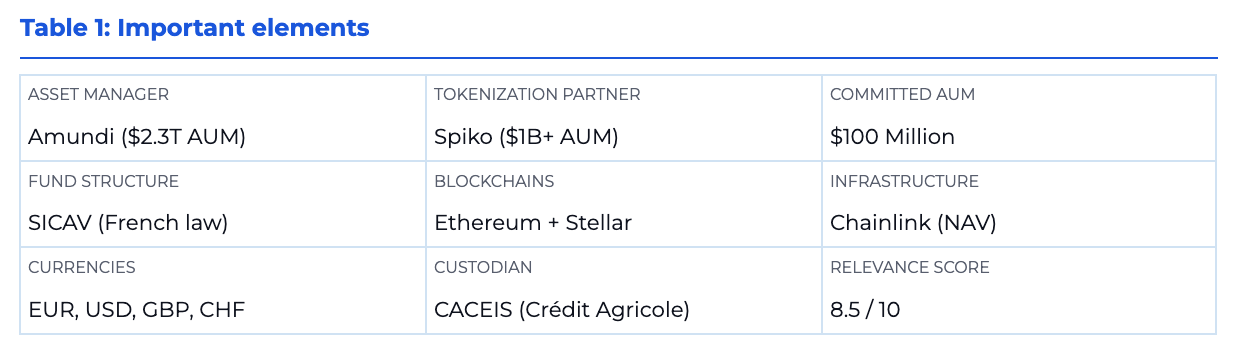
Zooming in: Amundi acts as delegated investment manager. CACEIS, Crédit Agricole’s asset servicing arm, serves as depositary bank and fund administrator. Spiko handles transfer agency, tokenization, and brokerage. The fund is currently open to eligible professional investors via Spiko, with plans to expand through an API-enabled distribution network.
Be smart: Spiko, its tokenized funds arm, already holds $1.17B in assets and ranks as the tenth-largest tokenized fund platform in the world.
Stepping back: In November 2025, Amundi launched a tokenized share class of its €5B Amundi Funds Cash EUR money market fund on Ethereum, in partnership with CACEIS. That first transaction was settled on November 4.
Also: It plans to launch Bitcoin Exchange-Traded Notes (ETNs) in early 2026, structured under the EU’s Markets in Crypto-Assets (MiCA).
State of RWAs Market
With tokenization, institutions are building B2B plumbing.
- The tokenised RWA market has grown to $48.9B (excl. Stablecoins and repurchase agreements).
- 65% of RWA holders are now institutional (family offices, pensions, treasuries).
Why it matters
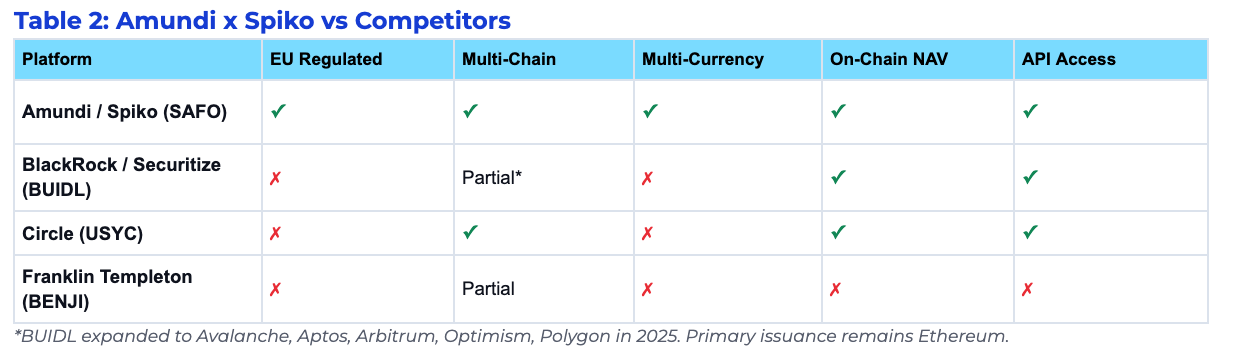
- The real story is distribution, not technology. Most tokenization coverage fixates on the chain. Ethereum vs. Solana vs. Stellar. That misses the point. Amundi chose both Ethereum and Stellar for SAFO because each serves a distinct distribution function: Ethereum for smart contract composability and DeFi integration, Stellar for fast, cheap cross-border transfers. The shareholder register lives on both chains, with planned expansion to additional networks based on investor demand. This is a distribution strategy dressed as a technology decision. Spiko’s numbers reinforce the thesis. The platform surpassed $1.03 billion in AUM by February 2026, with over 3,300 active clients and 92% of assets from business users. At the time, only BlackRock’s BUIDL and Circle’s USYC were larger. That puts Spiko in the top three globally for tokenized fund platforms. Amundi is not partnering with a startup on a whim. It is backed by the third-largest tokenized fund distributor in the world.
- Europe is building its own tokenized fund stack. U.S. headlines focus on BlackRock and Circle. But Europe is quietly assembling a competing infrastructure. Amundi ($2.3T) is the investment manager. CACEIS (Crédit Agricole) is the custodian, with a French digital asset custody license from 2023 and MiCA Digital Asset Service Provider licensing underway. Spiko is the tokenization layer. Chainlink (growing presence in Europe) is the oracle and cross-chain glue. This is a fully European stack, regulated under French law, with MiCA compliance baked in from day one. BlackRock’s BUIDL is a $2.85B product managed through Securitize on Ethereum. It dominates the U.S. market. But it is not built for European regulatory rails. Amundi-Spiko is.
- Collateral mobility: SAFO is explicitly designed for “treasury and collateral needs.” Tokenized fund shares that settle near-instantly and transfer 24/7 across chains can serve as programmable collateral for derivatives, margin calls, and repo agreements. Today, posting collateral takes T+1 or T+2, requires multiple intermediaries, and stops when markets close. SAFO shares do not stop. They settle in near real-time, with Chainlink-verified NAV ensuring counterparties can price them accurately at any hour. It is a structural change to how working capital functions. The total return swap structure means the underlying yield stays competitive with money market rates while the token layer adds velocity.
Investor Alpha
- Chainlink (LINK): CCIP is now critical financial market infrastructure, not a speculative token. Amundi, BlackRock, JPMorgan, and Swift all rely on it for tokenized asset movements.
- Coinbase (COIN): Zodia Custody (Standard Chartered) and Coinbase Custody are the dominant institutional-grade digital asset custodians. As regulated tokenized fund AUM compounds, custody revenue compounds with it.
Our Take
BlackRock dominates the narrative. BUIDL is the most recognized tokenized fund brand in the world. But BlackRock built for U.S. rails. Amundi is building for European ones. In a world where MiCA is now the most comprehensive crypto regulatory framework on the planet, covering 450M consumers across 27 countries, that home-field advantage matters.
Being the first European asset manager to tokenised assets at this level gives Amundi a competitive advantage. And, they are building infrastructure (tokenization and custody), which is not an experimentation but a pure bet.
51 Intelligence Stack: Recommended Reading
Watchlist:
- Apr 28–29: FOMC meeting. Second rate decision window
- May 5–6: Next FOMC policy meeting after April
- Mid-May: Kevin Warsh expected to take over as Fed Chair
- Jul 1: MiCA universal deadline
- Q1-Q2 2026: SEC final decision on Nasdaq tokenized trading rule change (SR-NASDAQ-2025-072)
- H2 2026: DTCC tokenization pilot launch
That’s it for now.
Missed last week? Access all our CEO notes here.
Marc & Team