Coinbase: ICO's 2.0
Crypto’s dirtiest secret is getting a rewrite and Coinbase is holding the pen. After five years of silence, U.S. token sales are back.
Coinbase just restarted the primary market with a structure built to favor real users, not insiders.
The pitch is simple: no more private rounds. No more dump-and-disappear launches. Just one token sale per month, accessible to everyone, on a platform that guarantees liquidity, compliance, and aligned incentives [ANNOUNCEMENT].
(👉PRO readers: PDF at the bottom)
What happened
Coinbase is launching an end-to-end token sales platform for global retail users (including the United States). The first sale will run from November 17 to 22. With that, Coinbase is redesigning how tokens are distributed, priced, and launched.
Key elements:
- Global retail reach: Coinbase’s 100M+ user distribution.
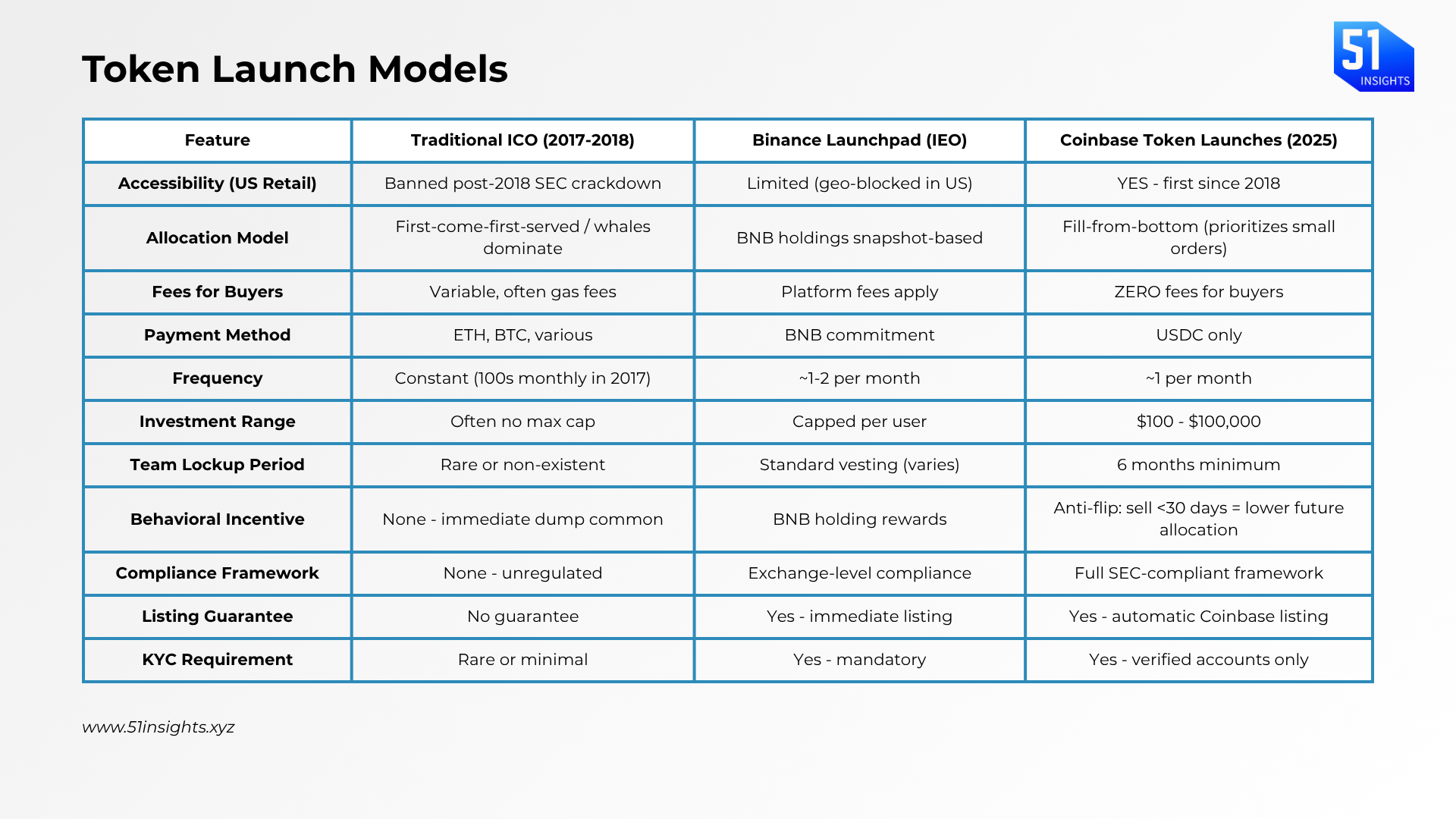
- Fair access: One token sale per month with pre-launch access for everyone, $100–$100k ticket sizes, paid in USDC, and zero fees for buyers.
- Sale window mechanics: One-week request periods instead of FCFS scrambles.
- Liquidity: Tokens move directly from sale → listing → deep order books.
- Aligned incentives: Early dumpers automatically receive smaller allocations.
- Regulatory compliance: Disclosures, lockups, and restrictions on insider sales.
The thesis: Projects struggle to reach actual users through launches. Retail buyers get boxed out or dumped on. Early insiders dominate supply. Market depth is thin. And demand is distorted by a handful of buyers who move early and sell fast. This is Coinbase’s attempt to re-onshore the token sale model, previously dominated by unregulated offshore exchanges and opaque venture capital structures known as Simple Agreements for Future Tokens (SAFTs).
Coinbase’s bet: A healthier token economy requires (1) broad distribution, (2) transparent rules, and (3) incentives that reward long-term participants instead of short-term flippers.
PRO readers: Join us live with Tony McLaughlin, CEO of Ubxy, on Dec 3rd, 11am EST. Save the date!
The first real test is the launch of Monad (MON), a high-performance Layer 1 aiming to raise $187.5M at a $2.5B valuation. How this sale performs: before, during, and after listing, will show whether a regulated, U.S.-accessible token sale can compete with the offshore models that have dominated since 2018.
Zooming in: For the Monad sale, the entity designated as the seller of the tokens is MF Services (BVI) Ltd., a subsidiary of the Monad Foundation, which is legally registered in the Cayman Islands. Utilising an offshore jurisdiction, such as the British Virgin Islands (BVI), to conduct the actual token sale is a standard practice for managing global regulatory exposure related to asset issuance.
Coinbase isn’t issuing or selling the tokens, it’s just providing the platform. This helps limit its legal risk, since it’s acting more like a regulated access point than a promoter of a potential unregistered security. Instead of taking a cut from users, Coinbase earns a percentage-based fee from the token issuer, based on how much they raise in USDC.
🙌 Work with us: We arm financial institutions and digital asset leaders with bespoke research, thought leadership to shape the most important conversations, scale trust, and win business.
Why it matters
Loyalty, trust and distribution in a package. For projects, this solves global distribution, liquidity, and trust. For users, it opens access to early-stage tokens in a way that’s transparent and fair. For the industry, it’s the clearest sign yet that crypto is maturing into a proper capital market with real underwriting, real disclosures, and real accountability.
Compliance as a moat. The new Token Launches model rests on three simple ideas: build it to be compliant from day one, shape user behavior with smart incentives, and offer something no one else can — guaranteed listing and liquidity. Coinbase treats compliance as a core product feature, not a regulatory afterthought. And the design directly tackles the two biggest problems of past token launches:
Insider dumping is eliminated by skipping private rounds entirely — no VCs, no offshore deals, no early allocations. Tokens go straight to verified U.S. users at the same price.
Short-term speculation is curbed with a reputation system: users who hold get bigger allocations in future launches, while early sellers are penalized with reduced access.
Together, these mechanics create a launch framework where aligned behavior is rewarded, and pump-and-dump dynamics are structurally disincentivized.
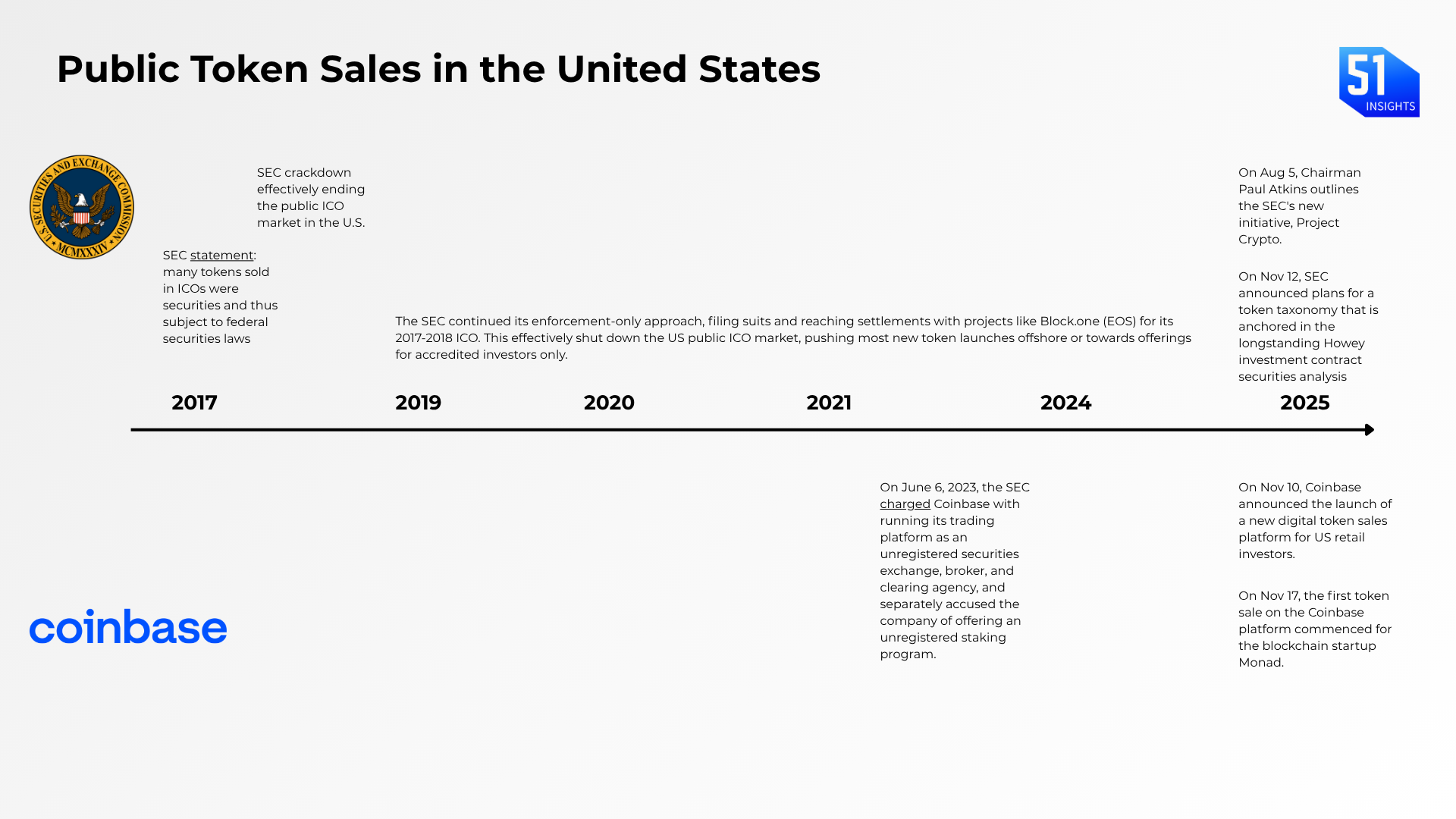
Wild west of crypto fundraising. In 2017-18 ICO boom, projects raised more than $5.6B but operated with almost no rules, no disclosures, and no safeguards. Result: more than 80% of ICO tokens collapsed within 90 days. The SEC’s crackdown effectively shut down public token sales in the U.S. by arguing that most ICOs were unregistered securities. Now, the SEC is officially introducing a new framework on how tokens fit within existing securities laws. And, Coinbase is trying to fix the primary market while fighting over the secondary one with a more transparent, fair, and compliant launch process that can finally bring token fundraising back onshore.
Our take
Coinbase just opened the door for a compliant U.S. version of on-chain capital formation. It doesn’t solve everything, but it’s a meaningful step toward fixing one of crypto’s dirtiest secrets:
Most token launches have been pump-and-dump schemes. No product. No traction. Just insiders cashing out while retail gets dumped on.
If this works, it flips the model: Access for real users, not just VC exit liquidity.
To do it, Coinbase must have built a tightly controlled compliance framework, while knowingly taking on some regulatory risk in the absence of full SEC clarity. Most likely, they weighed that risk against the upside of being first to market with a compliant U.S. token launch platform. The bet: first-mover advantage is worth the legal gray zone. If Coinbase can maintain trust, regulatory cover, and quality control, it won’t just be the place where crypto trades. It’ll be the place where crypto begins.
The challenge: The reputation system only works if future allocations are worth something. If Coinbase keeps launching strong, high-performing tokens, losing access becomes a real financial penalty.
Today’s Market Signals
- FDIC considers guidance over tokenised deposit insurance. Link
- BNY launches stablecoin reserves fund. Link
- Singapore to trial tokenised bills, bring in stablecoin laws. Link
Take care,
Marc & team
Download the PDF