
Citi just picked Solana over Ethereum
Wall Street spent a decade and billions of dollars building private blockchains. Then it figured out they were just slow databases. JPMorgan built one. So did dozens of others. The logic seemed sound: public networks are too risky, too open. We need our own.
That story is over. JPMorgan put its digital dollar on Base. BlackRock went straight to Ethereum. And last week, Citi — the bank that moves money across 160 countries — took a centuries-old paper document and ran the entire thing on Solana [RELEASE]
Here’s what happened and why it changes the math for a $9.7 trillion market.
👉PRO: Download the PDF
What happened
On February 13, 2026, Citi Group completed a proof of concept (PoC)1 tokenizing a bill of exchange2 on the Solana blockchain through its Trade and Working Capital Solutions division, working with PwC and the Solana Foundation. This kind of paper takes days to process and requires people to manually verify, approve, and settle, and ran the entire thing automatically.
The pilot simulated the full lifecycle of the instrument using synthetic data: issuance, financing, distribution, and settlement. By converting the bill into a digital token, the bank embedded payment amounts, counterparties, and maturity dates directly into the asset’s code. [FULL REPORT]
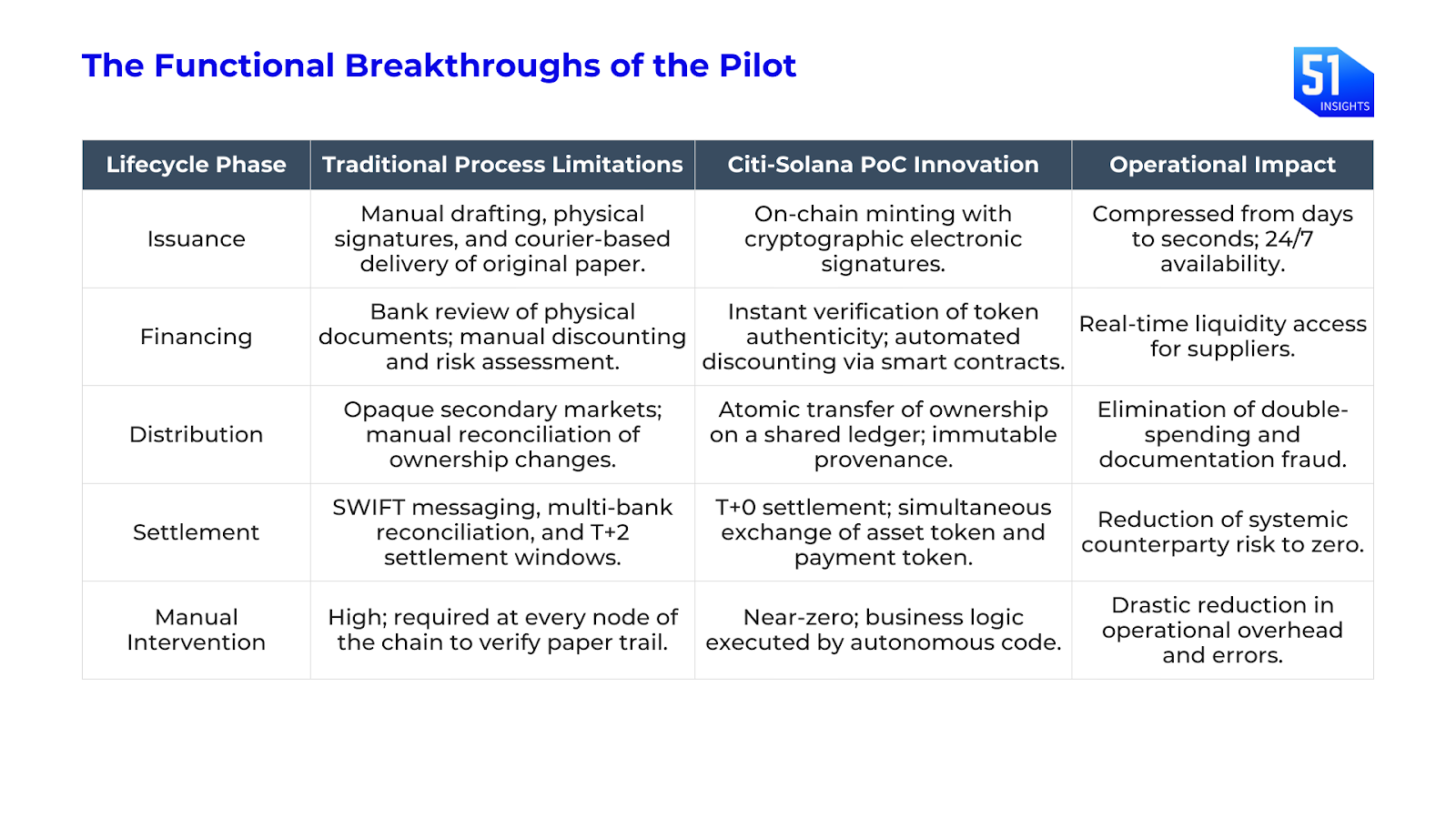
The result: a process that traditionally takes days compressed to minutes. Ownership transferred automatically with the token. Repayment at maturity went to the current holder without manual tracking. Everything that required courier services, physical signatures, and multi-bank reconciliation became autonomous code on a public blockchain processing 1,000-3,000+ transactions per second.
The goal of this project was to transform this paper document into a digital token on the blockchain that retains the legal enforceability of the physical version.
Zooming in: The PoC did not simply store a PDF on a blockchain; it executed the entire lifecycle of the trade finance transaction in a digital, simulated environment.
It involves tokenization: The bill of exchange acts as a unique digital asset (similar to an NFT). The supplier inputs transaction details, and the platform “mints” a token containing the amount, counterparties, and maturity date.
Workflow:
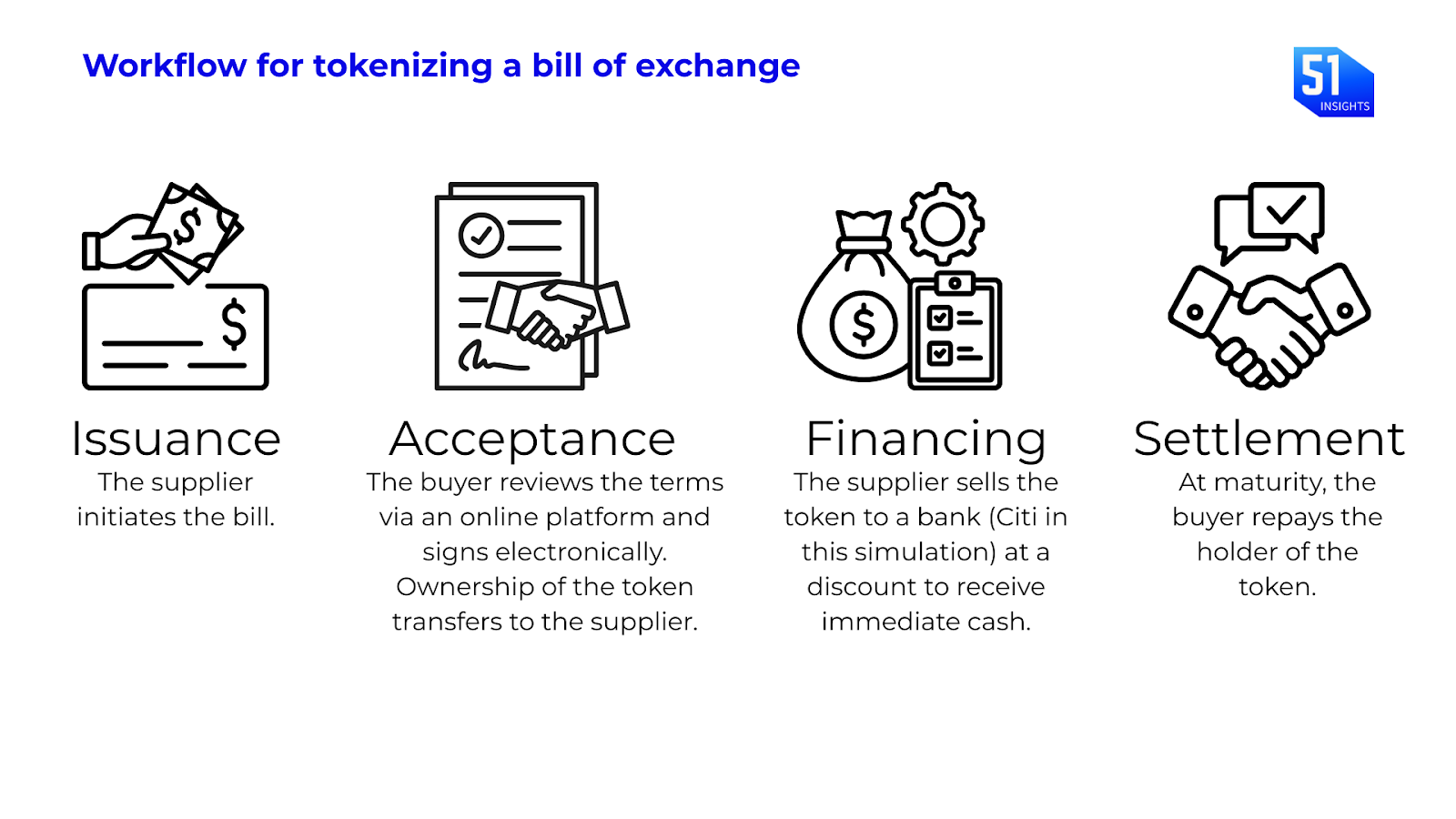
The project utilized smart contracts to automatically govern the business logic, such as timing and repayment terms. This allowed the payment legs of the transaction to be settled using tokenized funds, eliminating manual reconciliation.
Zooming out: This pilot sits inside a multi-year re-platforming effort. Citi is building three interlocking systems:
- Citi Integrated Digital Assets Platform (CIDAP, the platform for multi-chain asset tokenization),
- Citi Token Services (already live for instant cross-border payments in the US, UK, Singapore, Hong Kong),
- and institutional custody launching in 2026.
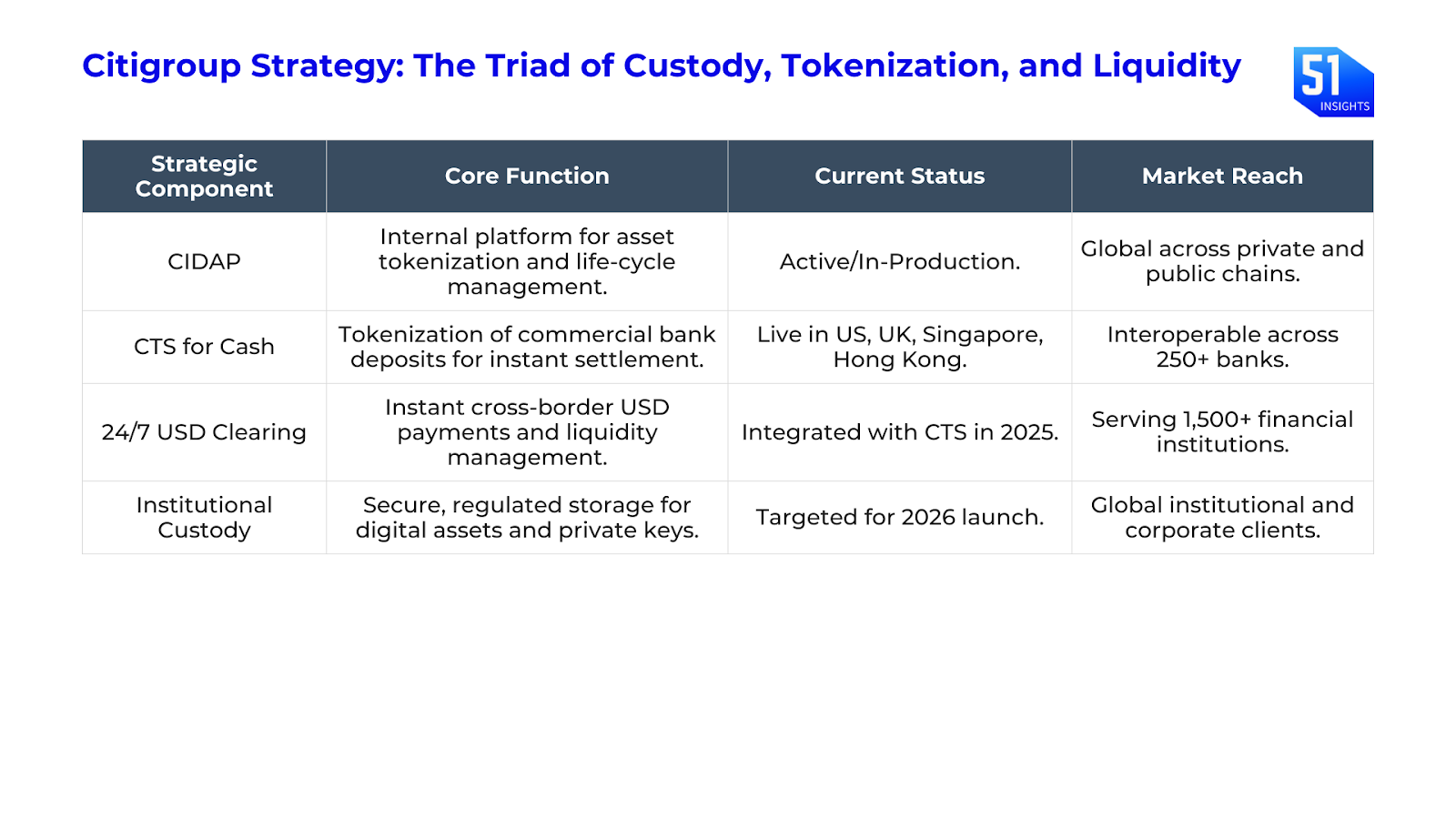
When those three pieces converge, a client can issue a tokenized bill on Solana, finance it using tokenized deposits, and store everything in a regulated Citi vault. This is all about infrastructure optimization.
Why it matters
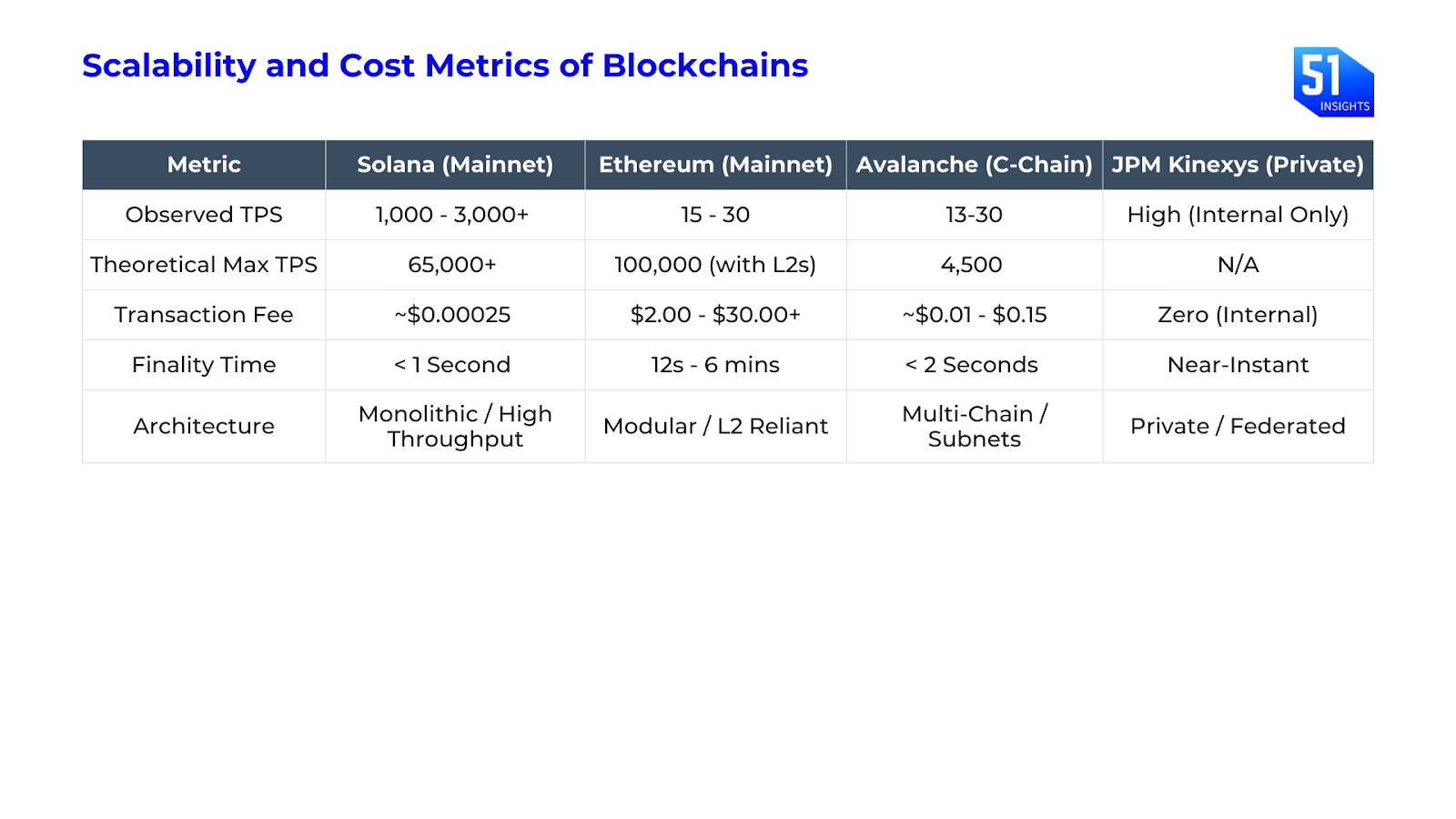
- Too big to ignore. Citi manages $2.6 trillion in assets across 160 countries. After years of banks building walled gardens, Citi looked at that model and went the opposite direction. And, the selection of blockchain was based on the output expected. Solana processes 1,000-3,000+ TPS natively. Ethereum does 15-30. Transaction fees on Solana: $0.00025. Ethereum: $2-$50+. Finality: under 1 second vs 12 seconds to 6 minutes. For a global clearing operation that can’t afford weekend downtime or gas wars during peak volume, those numbers are existential.
- Fractionalization unlocks a $24T secondary market. Trade finance instruments are typically held to maturity because selling small portions is prohibitively expensive. Tokenization changes that. A $10 million bill of exchange becomes ten thousand $1,000 tokens that can be distributed to institutional and retail investors. This creates liquidity in a market projected to hit $24 trillion by 2027. For banks, this is a mechanism to optimize Risk-Weighted Assets. Sell tokenized portions of trade portfolios to non-bank allocators, free up Tier 1 capital, issue more credit, drive higher ROE.
- The death of T+2 settlement. Traditional trade finance runs on a T+2 settlement window. That gap creates a “float,” capital locked in transit that banks monetize but which represents a tax on global liquidity. Citi’s Solana pilot eliminates that entirely through atomic settlement (T+0). The digital asset token and the payment token exchange simultaneously. Counterparty risk during settlement: zero. For corporate treasurers, this means just-in-time funding. Cash moves the moment a transaction completes, not days later after reconciliation.
Investor Alpha
The real alpha is in high-velocity use cases of tokenization and its multipliers.
Tokenized RWA platforms: Private credit tokenization is projected to rapidly with other RWAs platforms. Firms like Ondo Finance (ONDO) that operate yield-bearing token infrastructure become the rails for this migration. As Citi expands tokenization capabilities to Solana, demand for on-chain credit origination and servicing infrastructure accelerates.
Infrastructure custody plays: When Citi’s 2026 institutional custody service launches, it breaks the seal for pension funds and sovereign wealth allocators sitting on the sidelines. Firms providing institutional-grade storage and key management (Coinbase Custody, Fireblocks, Dfns) capture the service layer as trillions move on-chain.
The Firedancer event3: Watch Solana validator stake migration to the Firedancer client. If 33%+ of network stake moves to this independent implementation, it’s the de-risking signal that brings conservative institutional allocators off the sidelines.
Watchlist:
- Feb 10–12: Consensus Hong Kong (CoinDesk)
- Feb 11: US CPI (Jan) release
- Feb 12: US PPI release
- Feb 12: FCA consultation on applying handbook rules to cryptoasset firms
- Feb 17–21: ETHDenver 2026
- Feb 18: FOMC minutes for Jan 27–28 meeting
- Feb: CLARITY‑style market‑structure bills and stablecoin implementation
- Q1’26: Kraken IPO window
- Q1’26: Hong Kong stablecoin licensing regime
- Q1’26: Singapore stablecoin framework launch
- Q1’26: Bitmine MAVAN (Made-in-America Validator Network) rollout
That’s it for now.
Marc & Team
Download the PDF
A Proof of Concept (PoC) is a small-scale, preliminary study or pilot project designed to determine the feasibility of an idea, technology, or process before investing significant resources. It validates core functionality and technical viability, mitigating risks and providing evidence for stakeholders to decide whether to proceed with full-scale development. ↩
A bill of exchange is a negotiable legal instrument where a buyer promises to pay a specific amount on a future date. Historically, these have been paper-based, requiring physical signatures and courier services, which makes them slow and operationally burdensome. ↩
Firedancer is a new, independently built software client for the Solana network, developed by Jump Crypto. Today, most Solana validators run the same core software. That creates concentration risk, if there’s a bug, large parts of the network could be affected at once. Firedancer changes that. It’s a completely separate implementation of the Solana protocol. If 33% or more of the network’s validator stake migrates to this new client, it means the network is no longer dependent on a single codebase.
Why 33% matters: On Solana, roughly one-third of stake can block finalization. So if at least a third runs an independent client, the network becomes materially more resilient to software bugs or coordinated failures. ↩