
BNP Paribas called it an 'experiment'
Hey, it’s Marc,
Name one major institution that launched tokenized funds on a private blockchain and stayed there. You can’t.
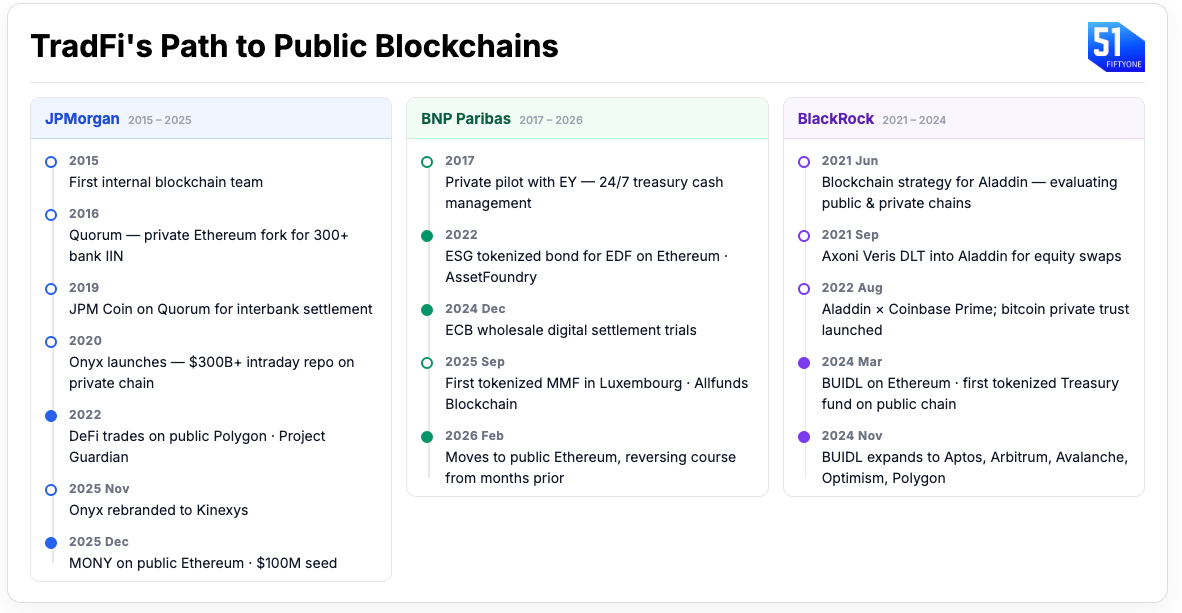
BlackRock moved to Ethereum. Franklin Templeton moved to Ethereum. JPMorgan moved to Ethereum. Last week, BNP Paribas joined them as the first and largest European bank. And they went further. [RELEASE]
Let’s unpack.
👉PRO: Download the PDF at the bottom
What happened
On February 19, 2026, BNP Paribas Asset Management issued a tokenized share class of an existing French-domiciled MMF on Ethereum. This made it the first major European bank to launch a regulated MMF on a public blockchain. [RELEASE]
Zooming in: BNP Paribas launched the tokenized MMF by combining three internal business together:
- BNP Paribas Asset Management acts as the issuer.
- BNP Paribas Securities Services serves as the transfer agent and custodian, holding private keys.
- BNP Paribas CIB‘s AssetFoundry provides the tokenization engine and connects to Ethereum.
The entire fund lifecycle; issuance, custody, dealing, and settlement is controlled in-house. No major competitor has demonstrated this level of vertical integration on a public chain.
Strategic understatement: BNP Paribas deliberately framed this as a “one-off, limited intra-group experiment”. However, the advanced nature of the infrastructure suggests it is, in fact, a blueprint for future operations, rather than a simple isolated test.
Zooming out: BNP Paribas is part of Qivalis, a 12-bank European consortium building a MiCA-compliant euro stablecoin, with MiCA’s securities framework going live mid-2026. What’s emerging is Europe’s answer to the US-led tokenization market: a regulated, euro-denominated financial infrastructure running on Ethereum.
Stepping back: Starting March 2024, BlackRock put BUIDL on public Ethereum, followed by Franklin Templeton, JPMorgan, and now BNP Paribas.,
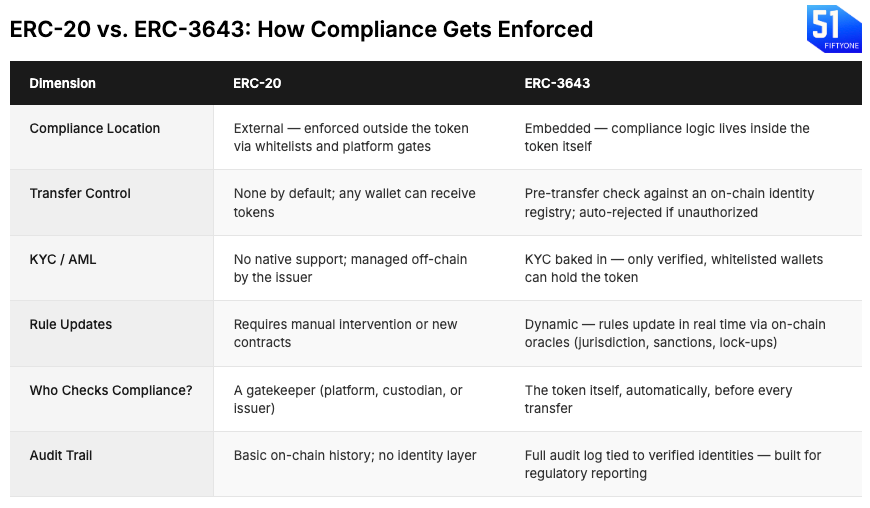
The token standard choice: When launching a regulated product onchain, enforcing compliance becomes the hard part. BlackRock and JPMorgan use standard ERC-20 tokens with compliance enforced around the token (whitelists, platform access gates).
BNP Paribas went further: ERC-3643 embeds compliance inside the token itself, validating every transfer against on-chain identity rules before it executes, no gatekeeper needed. The result is a token that is both publicly settable on Ethereum and institutionally restricted by design.
By the numbers: The tokenized US Treasury market is valued at $10.84B in total value, with Ethereum capturing $5.5B, more than all other chains combined. BlackRock leads all platforms at $2.3B and 20.78% market share. BNP Paribas, a €1.6 trillion asset manager just entered this market.
The gap: The US got a two-year head start, growing its tokenized Treasury market to $10.8B without a unified rulebook, while Europe’s on-chain equivalent remains in the tens of millions. Europe is now building with MiCA across 27 member states from day one, turning its late start into a structural advantage in a market projected to reach trillions.
Stablecoins can't pay yield. These can:
- Tokenized MMFs as stablecoin alternatives: Tokenized money market funds offer ~4-5% returns from underlying Treasuries while functioning on-chain like stablecoins — but with yield that stablecoins legally cannot provide. MiCA’s Article 40 explicitly bans stablecoin issuers from paying any interest or yield to holders. If stablecoins can’t pay yield by law, tokenized MMFs become the default on-chain instrument for institutional treasurers who refuse to hold non-yielding assets, making BNP Paribas‘ timing more strategic than it appears.
- Tokenized MMFs as repo collateral: The repo market averaged $12.6 trillion in daily exposures in Q3 2025 . This market helps banks, hedge funds, and asset managers with short-term funding. Tokenized MMF units are expected to qualify as General Collateral (GC) for repo agreements and bilateral ISDA contracts. This lets institutions use yield-bearing tokens directly instead of selling assets or holding cash. This results in a collateral that settles instantly, while earning ~4-5% while posted, and removes the “cash drag” that treasury operations have lived for decades.
- European regulatory alignment: BNP Paribas timed this carefully. MiCA is now fully in place across the EU, with its Title V securities rules launching in mid-2026. This is when banks need the infrastructure to shift from pilots to large-scale production. BNP Paribas Asset Management, Securities Services, and CIB’s AssetFoundry are designed to meet the complete needs of European institutions. This setup allows them to plug in and scale quickly to compete with US tokenized funds globally.
Investor Alpha
- Long Ethereum (ETH): Every major tokenized fund, BUIDL, BENJI, MONY, BNP Paribas chose Ethereum, reinforcing its dominance as the preferred layer for regulated RWAs. That concentration has created a liquidity depth, tighter spreads, more counterparties, and faster settlement for institutional participants. For regulated RWA issuers, liquidity depth isn’t a secondary consideration — it’s the primary one. Ethereum’s dominance is structural, not incidental. 👉 Trade on Robinhood
- The structural trade: With theMiCA’s Articles 22 and 40 banning stablecoin yield and uncertainty around whether the loophole extends to wallets and exchanges, capital will flow from zero-yield stablecoins into tokenized MMFs. The protocols and platforms that distribute TMMFs —Tokeny, Centrifuge, and BNP’s own AssetFoundry — are the direct beneficiaries. 👉 Trade on Robinhood
- Long BNP Paribas (BNP.PA):BNP Paribas is the first major European bank to use a public blockchain to show the full fund lifecycle. This gives the bank a leading position in Europe’s on-chain asset market, which is still in its early stages. Its fully integrated stack, including issuance, custody, dealing, and settlement, has no equal among European competitors on a public chain. As a result,BNP Paribas is well-positioned to benefit from MiCA Title V and the upcoming launch of euro stablecoins in mid-2026. 👉 Trade on Robinhood
The bear case: Ethereum handles low-frequency fund issuance today, but the repo market moves $12.6T daily, its speed and cost limitations become a real problem. Rival chains like Solana and Avalanche are actively pitching to the same banks, and the next wave may not land on Ethereum the way the first did. BNP Paribas itself called this an experiment — full production scale is still unproven.
So what? BNP Paribas just proved that Europe’s largest banks can run the full fund lifecycle on public Ethereum. The €1.6T question is whether this stays an “experiment” past mid-2026, or whether MiCA Title V turns it into the template every European asset manager follows. Either way, the capital is moving from private chains to public rails, and that trade has a name: ETH.
Watchlist:
- Mar 11: US CPI (Feb) release – critical for Fed rate cut expectations
- Mar 12–15: ETHMumbai 2026 (Mumbai) – Ethereum conference and hackathon
- Mar 16: ETHDC III (Washington) – Ethereum ecosystem and regulatory engagement
- Mar 17: CBC Summit Europe (London) – crypto banking, stablecoins, and MiCA
- Mar 17–18: DC Blockchain Summit (Chamber of Digital Commerce)
- Mar 18: FOMC Interest Rate Decision & Summary of Economic Projections
- Mar 26–27: Global Blockchain Congress (Dubai)
- Mar 30–Apr 2: EthCC 2026 (Cannes) – Europe’s largest Ethereum conference
- Apr 28–29: FOMC Meeting
- Jun 16–17: FOMC Meeting (with Summary of Economic Projections)
That’s it for now.
Missed last week? Access all our CEO notes here.
Marc & Team