Apollo bought 9% of a DeFi protocol
Wall Street went from dismissing DeFi to integrating DeFi for tokenized funds to acquiring governance stakes.
Morpho Association announced a cooperation agreement with Apollo Global Management affiliates. The deal: Apollo may acquire up to 90 million MORPHO tokens, over the next four years. This came just 48 hours after BlackRock listed its $2.1B BUIDL fund on Uniswap and purchased UNI governance tokens. [RELEASE]
This didn't happen overnight. The shift from dismissing DeFi to governing it tells you everything about where finance is heading.
👉PRO: Download the PDF below
What happened
On February 13, the Morpho Association announced a cooperation agreement with Apollo Global Management affiliates. The deal: Apollo may acquire up to 90 million MORPHO tokens, 9% of total supply over a four year window. At current prices (~$1.45), the full allocation is worth approximately $112–115M.
Beyond the token purchase, both parties committed to working together to support onchain lending markets built on Morpho’s infrastructure. The onchain lending market is already $73.6B and growing. Morpho commands $5.8B of it #6 globally among DeFi protocols.
Zooming in: This is not a one-off deal. BlackRock’s BUIDL is accepted as collateral on Binance and Deribit. JPMorgan’s MONY was launched explicitly for “broader collateral usage within the blockchain ecosystem.” Apollo’s ACRED (a $130M tokenized fund of Apollo’s Diversified Credit Fund) runs the same playbook on Morpho, where investors can deposit ACRED as collateral and borrow USDC. Every major tokenized fund is being engineered to function as onchain collateral and DeFi is the only infrastructure that makes that possible at scale.
 Marc Baumann
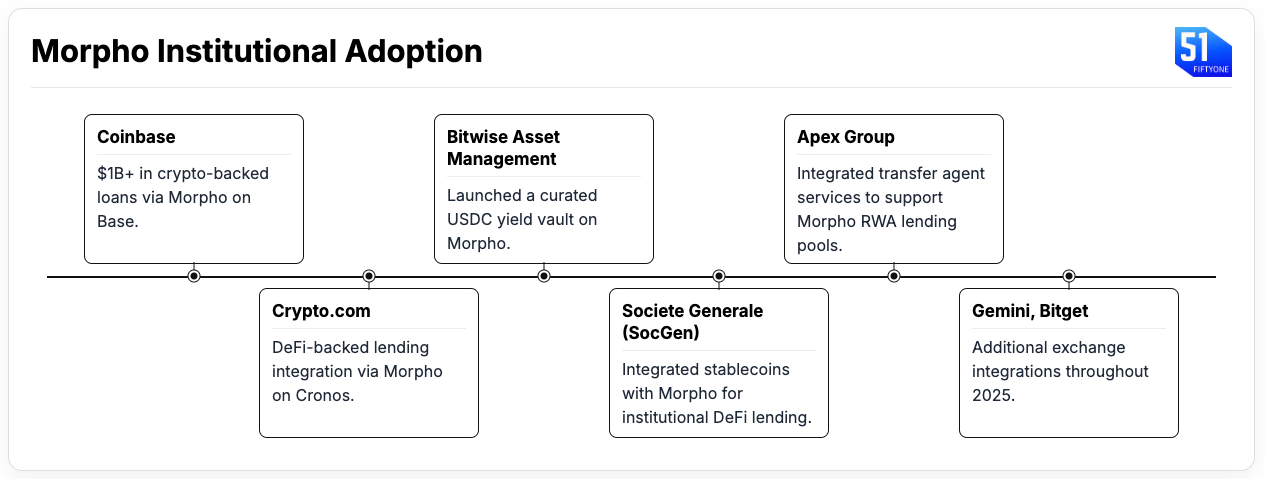
Stepping back: Institutional adoption was accelerating before the Apollo deal, with integrations spanning exchanges, asset management, banks, and servicing infrastructure as shown below.
Governance: At 9%, Apollo becomes one of the single largest governance voices in the entire protocol. In concrete terms, Apollo can influence which collateral types get listed, how risk parameters are set, and how Morpho’s DAO treasury gets deployed.
Incentives: The incentive structure is self-reinforcing. Apollo is motivated to build products on Morpho because it drives TVL, which drives fees, which drives token value and Apollo holds the token. It’s the same logic behind why a major shareholder in an exchange also becomes its highest-volume trader. The governance stake creates a structural incentive to be Morpho’s best customer.
Why it matters
- New architecture wins institutional capital: Unlike most DeFi protocols where DAO governance votes add friction at every turn. Morpho and UniswapX sit in a deliberate middle ground: modular enough for institutional compliance, permissionless enough to move fast. No shared risk pools. Each market is its own isolated container. Aave, despite commanding the largest TVL at $24B and offering permissioned deployments via Aave Arc, still anchors around pooled liquidity and full governance-mediated listings making it less natively suited for institution-specific markets then compared to what Morpho can offer.
- The defi mullet goes mainstream: Morpho coined the phrase: “fintech in the front, DeFi in the back”. Coinbase users borrow USDC against BTC through a familiar app, but settlement happens permissionlessly on Base via Morpho. This model already powers Coinbase, Crypto.com, Bitwise, Aplex, and Gemini. Apollo joining doesn’t just add another partner; it adds the largest alternative asset manager on the planet to an ecosystem that’s already proving the DeFi mullet works at scale.
- Protocol consolidation accelerating: The DeFi market is already dominated by a small handful of major platforms. As BlackRock, Apollo, and other institutions make direct integrations and investments with these leading protocols, they further strengthen already strong economics and network effects. But the risk profile of a highly consolidated DeFi lending market is not well understood yet. The same network effects create single points of failure, governance capture vectors, and long-term innovation stagnation.
- Private credit structural yield problem: Direct lending yields fell below 10% for the first time in three years, and 57% of sponsor-backed deals in Q3 2025 priced below a 500 bps spread. Private credit is entering its most challenging environment since 2008, and the yield compression problem is structural that scales with the market. Against that backdrop, curated Morpho vaults offer roughly 4–20% APY on stablecoin lending, while the sACRED levered strategy on Morpho has delivered up to ~16% versus ACRED’s standard 8–9%. If SOFR drifts toward 2.5% by late 2027, that DeFi yield premium only widens, and for a $938B credit origination machine, even a small spread pickup can translate into billions in incremental earnings.
Investor Alpha
If BlackRock ($11.5T AUM) and Apollo ($938B AUM) both now hold DeFi governance tokens on their balance sheets, the valuation framework for the entire governance token sector shifts. These tokens are no longer purely speculative instruments or community coordination mechanisms, they carry strategic acquisition value to the world's largest financial institutions.
The opportunities are:
- Long Morpho (MORPHO): Direct exposure to the validated institutional DeFi lending infrastructure layer. Existing partnerships with Coinbase, Bitwise, Apex Group, and others already prove Morpho‘s role as the backbone lending protocol for institutional DeFi. These partnerships are only going to accelerate, further driving protocol revenue, TVL, and compounding network effects. The next institutional partnership Ares, KKR, or JPMorgan are the most likely candidates, would be a further re-rating catalyst. 👉 Trade on Robinhood
- Infrastructure providers (Securitize, Galaxy Digital, Gauntlet): Every TradFi-to-DeFi deal requires a stack of specialized intermediaries, and this deal reveals exactly who they are. Securitize tokenizes Apollo’s credit strategies (ACRED). Gauntlet provides the risk curation layer for the ACRED leveraged strategy on Morpho. Galaxy Digital facilitates intermediation between TradFi and DeFi partnerships. All three are positioned to capture significant value as these TradFi–DeFi deal flows and partnerships accelerate. 👉 Trade on Robinhood
- Long Apollo Global Management (APO): For TradFi-oriented mandates, APO itself is the cleanest play on the onchain credit thesis. Apollo’s Morpho governance position, Coinbase asset management partnership, ACRED tokenized fund, and Plume/Zerohash investments represent a systematic DeFi yield extraction strategy that should expand fee-related earnings beyond the guided 20%+ growth in 2026. Reference: $938B AUM, 25% YoY growth. 👉 Trade on Robinhood
- Long Uniswap (UNI): UniswapX shares a similar design architecture to Morpho, positioning Uniswap as the default institutional trading infrastructure layer. BlackRock‘s strategic partnership and the launch of BUIDL on UniswapX proved this. This launch drives real, sticky volume across the entire Uniswap stack and revenue to Uniswap. Builds a strong flywheel effect as more assets and institutional market makers are added to the protocol. 👉 Trade on Robinhood
What to watch going forward
- New Apollo-originated lending markets on Morpho: Specific product launches — new ACRED strategies, institutional vaults, private credit pools — will indicate the depth of the collaboration.
- Governance proposals with Apollo involvement: When Apollo starts voting on Morpho governance proposals, we’ll see how institutional influence shapes protocol direction.
- Copycat deals: Watch for announcements from other asset managers (BlackRock,KKR,Ares, etc.) pursuing similar protocol-level partnerships with DeFi protocols.
Watchlist:
- Mar 1–2: Crypto Expo Europe (Bucharest)
- Mar 11: US CPI (Feb) release – critical for Fed rate cut expectations
- Mar 17–18: DC Blockchain Summit (Chamber of Digital Commerce)
- Mar 18: FOMC Interest Rate Decision & Summary of Economic Projections
- Mar 24–25: Next Block Expo (Warsaw)
- Mar 24–26: Digital Asset Summit (DAS) (New York City)
- Mar 25: Crypto Assets Conference (#CAC26 Frankfurt)
That’s it for now.
Missed last week? Access all our CEO notes here.
Marc & Team